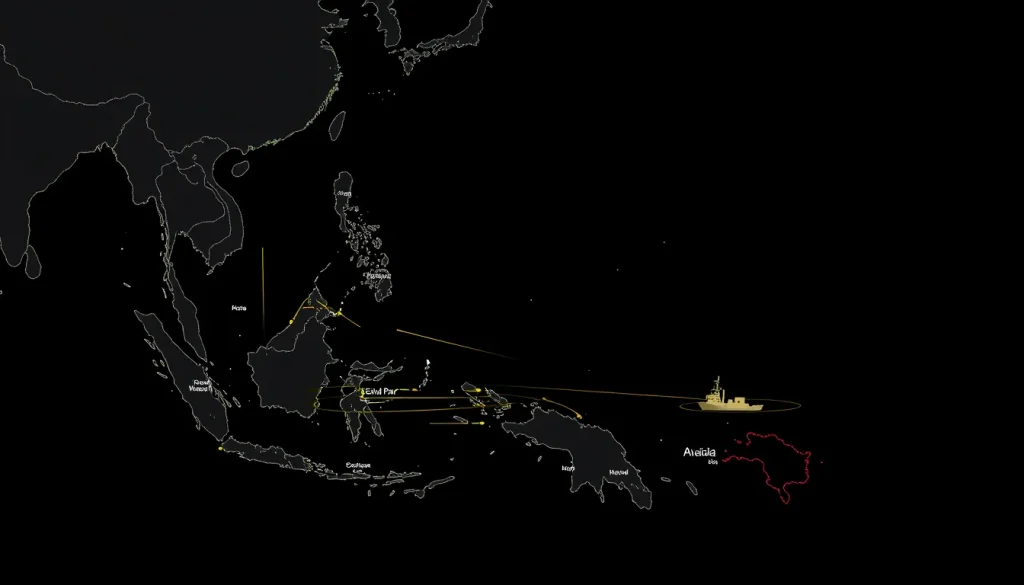
Short Answer
US$5.7bn for eight Indian corvettes; KRI Sriwijaya carrier conversion commissioned in 2026
Key Takeaways
- India signed a US$5.7 billion contract in November 2026 for eight next-generation corvettes for anti-submarine, anti-surface and coastal defense missions, alongside plans for six advanced submarines with Germany and 26 Rafale Marine aircraft, showing South Asia's shift from legacy single-role hulls to multi-domain surface and sub-surface fleets.
- Southeast Asia is modernizing below the carrier threshold: Indonesia converted the former ITS Giuseppe Garibaldi into KRI Sriwijaya in September 2026, while regional navies prioritize frigates, corvettes, patrol vessels and anti-ship missiles over large carrier groups.
- China's Type 004 carrier program and expanding PLAN capabilities keep the Asia-Pacific as the pacing maritime arena, forcing the US, Japan, Taiwan and Southeast Asian states to adjust operating postures, alliance burden-sharing and sea-denial inventories.
Quick-Spec Summary
Indo-Pacific naval modernization explained as a portfolio rather than a single procurement program: it combines prestige platforms such as aircraft carriers, workhorse surface fleets such as corvettes and frigates, asymmetric coastal missile batteries, submarine arms and amphibious lift. The common thread is not a single integrated architecture but an effort by East, Southeast and South Asian states to buy, convert or build enough maritime capability to shape sea-denial and presence outcomes without matching the full spectrum of the United States or China.
The cited record shows three distinct lanes. First, Indonesia converted the former Italian carrier ITS Giuseppe Garibaldi into KRI Sriwijaya, with the flag exchange at Tanjung Priok in September 2026. Second, India signed a US$5.7 billion contract in November 2026 for eight next-generation corvettes, alongside plans for six advanced submarines through a German partnership and 26 French Rafale Marine aircraft for carrier operations. Third, China continues to expand the People’s Liberation Army Navy, including construction of the Type 004 aircraft carrier, believed to be nuclear powered. The IISS describes the Asia-Pacific as the pacing maritime arena in technological change and operational development, even as the Ukraine war consumes attention.
| Capability lane | Route/Scope | Capacity | Estimated Cost | Lead Stakeholders | Current Status |
|---|---|---|---|---|---|
| Carrier conversions and carrier aviation | Indonesia, India and China; archipelagic and Indian Ocean approaches | Indonesia converted the former ITS Giuseppe Garibaldi into KRI Sriwijaya; India operates INS Vikrant and plans Rafale Marine aircraft; China is building Type 004, believed nuclear powered | Project-level carrier and air-wing costs are not disclosed in the cited sources; acquisition of a second-hand hull is generally cheaper than a newbuild but lifecycle costs remain high | TNI-AL, Indian Navy, PLAN, Italian transfer pathway, French and German suppliers | KRI Sriwijaya ceremony held 24 September 2026; India corvette and submarine programs in procurement; Type 004 reported under construction |
| Corvettes and surface combatants | India and Southeast Asian littorals; EEZ patrol, escort and coastal defense | Eight next-generation Indian corvettes for anti-submarine, anti-surface and coastal defense missions; regional navies modernizing frigates, corvettes and patrol vessels | US$5.7 billion for eight Indian corvettes | Indian Ministry of Defence, domestic shipyards, Southeast Asian navies | Contract signed 3 November 2026; phased replacement of aging single-role corvettes |
| A2/AD coastal missile batteries | East and Southeast Asian littorals, straits and island chains | Land-based anti-ship missiles, coastal sensors, command networks and mobile launchers intended to raise the cost of surface operations | Not quantified in the cited sources | Regional militaries and defense procurement agencies | Expanding alongside naval modernization; designed to complement rather than replace surface fleets |
| Submarine programs | India and Southeast Asian maritime approaches | India plans six advanced submarines with Germany; regional navies seek conventional submarines for sea denial and surveillance | Not disclosed in the cited sources | Indian Navy, German partners, regional navies | Planning and procurement stage; long-lead industrial and training requirements |
| Amphibious vessels | Indo-Pacific island states and littoral zones | Landing platform docks, tank landing ships and sealift for island defense, disaster relief and troop movement | Not disclosed in the cited sources | Regional navies and marine corps | Steady but lower-visibility procurement; often dual-use for humanitarian assistance |
The table makes the hierarchy clear. Carriers generate visibility and air coverage but demand escorts, trained air crews, maintenance and protected port infrastructure. Corvettes and offshore patrol vessels generate persistent presence at lower unit cost. Coastal missile batteries and submarines impose risk on opposing surface forces. Amphibious ships provide political utility in disaster response and non-combat evacuation, while also creating a latent power-projection option. The IISS assessment notes that China’s navy has attained new levels of capability while the US and its allies have redoubled capability investments and adjusted operating postures, which is why procurement choices in smaller navies are judged against a moving great-power benchmark rather than against a static regional threat.
How It Works & Strategic Mechanics
1. Carrier conversions: prestige with a sustainment bill
A carrier conversion takes an existing or second-hand hull and adapts it for a new operator. The attraction is time and capital: a converted ship can enter service faster than a newbuild and can be justified as a national flagship, disaster-relief platform and aviation training ship. The limitation is that the hull is only one part of a carrier system. The operator also needs a compatible air wing, deck crews, maintenance workers, escorts, port access and a training pipeline. Indonesia’s conversion of the former ITS Giuseppe Garibaldi into KRI Sriwijaya illustrates the model: the visible event is a flag exchange and a new name, but the real test is whether the ship can generate sorties, remain seaworthy and be sustained over a decade or more.
India’s carrier pathway is different because it combines an indigenous carrier, INS Vikrant, with planned procurement of 26 French Rafale Marine aircraft. That is a carrier-air integration problem, not merely a shipbuilding problem. Aircraft, simulators, weapons, spare engines and qualified pilots must arrive in sequence. China’s Type 004 program, described as believed to be nuclear powered, sits at the high end: it implies longer endurance and a larger industrial and escort requirement. For regional navies, the carrier is therefore best understood as a political and organizational commitment rather than a single platform. It can signal sovereignty and maritime ambition, but it also consumes budget that might otherwise buy many more corvettes, missile launchers or submarines.
2. Corvettes: the affordable mass of surface fleets
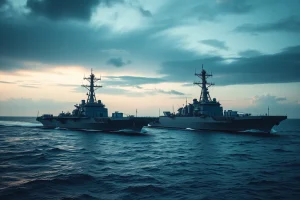
Corvettes sit below destroyers and frigates in size and cost but above patrol boats in combat capability. Their value in the Indo-Pacific is that they can be built in numbers, dispersed across archipelagos and used for anti-submarine warfare, anti-surface strikes, escort, maritime domain awareness and coastal defense. India’s November 2026 contract for eight next-generation corvettes is a clear example: the ships are intended to replace aging single-role corvettes and will carry advanced missiles, weapons and sensor suites for missions across air, surface and sub-surface domains. The contract is large enough to sustain domestic yards and to signal a shift toward multi-role hulls rather than ceremonial platforms.
For Southeast Asian navies, corvettes and frigates are the practical core of modernization. They are affordable enough to keep at sea, numerous enough to cover more than one sea lane and flexible enough to participate in exercises, patrols and disaster response. The Warsight survey of Southeast Asian navies describes modernization in the shadow of the PLAN, with regional forces doing what they can rather than attempting to match Chinese carrier and large-surface growth. That is a rational response: a navy with limited budgets can create more deterrence per dollar through several well-armed corvettes, coastal missile batteries and maritime patrol aircraft than through one prestige carrier that lacks escorts.
3. A2/AD coastal defense: turning geography into risk
Anti-access and area-denial coastal defense works through a kill chain: detect, classify, decide, target, engage and assess. Land-based anti-ship missiles, coastal radar, unmanned sensors, aircraft and command networks are linked so that an opposing surface group cannot assume safe passage through a strait or littoral. Mobile launchers and hardened sites complicate targeting. The strategic effect is not to control the sea in the classical sense but to make its use costly, uncertain and politically risky. This is why coastal missile batteries are often described as sea-denial tools: they can deny an adversary freedom of movement without requiring a fleet of equivalent size.
In the Indo-Pacific, A2/AD is not the property of one state. China’s missile and sensor networks are the most consequential because of their scale and proximity to contested waters, but regional states also field anti-ship missiles and coastal sensors to raise the cost of coercion. The operational mechanic is cumulative: a corvette with anti-ship missiles, a submarine on patrol, a coastal battery on an island and a maritime patrol aircraft may each be modest, but together they create a multi-axis problem. The weakness is integration. A missile battery without reliable targeting data is a static launcher; a corvette without air cover is vulnerable; a submarine without maintenance and crew depth is a periodic rather than persistent threat.
4. Submarines and amphibious vessels: the quiet and the useful
Submarines are the least visible and most politically sensitive leg of Indo-Pacific naval modernization. India’s plan to acquire six advanced submarines through a partnership with Germany shows how long-lead undersea capability has become a priority alongside surface ships and carrier aviation. Conventional submarines can conduct surveillance, lay mines, attack surface ships and complicate an adversary’s anti-submarine operations. Their deterrent value comes from uncertainty: an opponent must allocate escorts, aircraft and sonar time to a threat that may never surface. But submarines are expensive to operate, require secure bases, trained crews and a steady supply of batteries, propulsion components and weapons.
Amphibious vessels are the quiet workhorses of the same portfolio. Landing platform docks, tank landing ships and sealift vessels can move troops, vehicles and relief supplies. In Southeast Asia and the Pacific islands, humanitarian assistance and disaster relief is a legitimate mission that builds domestic political support and regional goodwill. In a contingency, the same ships can support island defense, evacuation or small-scale amphibious operations. They are not carrier replacements, but they add options at lower cost and with less escalatory signaling than a strike group. The strategic mechanic is dual-use ambiguity: a ship that delivers rice after a typhoon can also deliver engineers and vehicles to a disputed island.
5. Governance, financing and operational mechanics
Naval modernization is governed by defense ministries, procurement agencies, shipyards and alliance frameworks. Financing comes from national budgets, multi-year procurement plans, offsets, foreign military sales and technology-transfer agreements. India’s corvette contract is a domestic industrial policy instrument as much as a naval one; the Rafale Marine and German submarine tracks show how foreign suppliers remain embedded in national build-outs. Southeast Asian programs are more fragmented, often combining donated or surplus hulls, limited newbuilds and foreign missile purchases. China’s PLAN benefits from a large domestic shipbuilding base and a centralized procurement system, which allows faster fleet-level planning but does not eliminate training, maintenance and munitions constraints.
Operationally, a modernizing navy must manage fleet generation: ships cycle through deployment, maintenance and training. Munitions stockpiles matter as much as launchers. A corvette with eight anti-ship missiles is useful on day one; on day thirty it needs reloads. Carrier aviation needs spare engines and arrested-landing or short-takeoff recovery capacity. Submarines need dry docks and battery replacement. Amphibious ships need embarkation plans and beach survey data. The IISS assessment emphasizes new operational requirements and patterns of activity, which is a reminder that capability is generated by people, logistics and command networks, not only by hulls. The Euronaval shipbuilding survey likewise points to strong production growth and a return of naval power, but global output does not automatically solve a regional navy’s local yard, crew or budget bottlenecks.
Key Bottlenecks, Fault Lines & Risks
Financing gaps and opportunity costs
The first bottleneck is fiscal. India’s US$5.7 billion corvette contract is large relative to many regional procurement programs, and it sits alongside submarine, aircraft and carrier priorities. Every carrier conversion or submarine purchase creates a multi-decade operating liability. Navies often underestimate lifecycle costs: fuel, crew, spare parts, mid-life upgrades, dockyard time and weapons replenishment. For smaller Southeast Asian states, the choice is not between a carrier and a corvette but between a corvette and several years of maritime patrol aircraft, missiles, sensors or port improvements. The risk is a hollow fleet: ships are commissioned, but training, munitions and maintenance budgets are not funded at the same tempo.
Shipyard capacity, technology transfer and regulatory friction
The second bottleneck is industrial. Building or converting a warship requires dry docks, cranes, steel cutting, electronics integration, testing ranges and a skilled workforce. Euronaval’s 2026 survey records strong production growth and a return of naval power globally, but capacity is unevenly distributed. India’s domestic corvette order is intended to strengthen local yards, yet it must compete for skilled labor and imported components. Indonesia’s carrier conversion depends on foreign design knowledge and onboard systems. Submarine programs with Germany involve technology transfer, export licenses and sensitive propulsion or sensor approvals. Regulatory friction can add years: export controls, offset rules, foreign military sales processes and classification reviews all shape delivery schedules. A contract signature is not a capability; it is the start of an integration chain.
Physical chokepoints and contested geography
The third bottleneck is geography. Indo-Pacific sea lanes pass through narrow straits and contested archipelagic waters. Coastal missile batteries, submarines and mine warfare can make these chokepoints risky. For a trading state, that risk appears in insurance premiums, rerouting costs and naval escort demands. For a navy, it means that a small number of well-placed sensors and launchers can have disproportionate effect. The fault line is that the same geography that enables sea denial also makes forces vulnerable: islands are fixed, ports are known, and missile sites can be targeted. Redundancy therefore matters. A single coastal battery or a single carrier is a point of failure; a distributed network of corvettes, submarines, patrol aircraft and mobile launchers is harder to neutralize.
Integration, interoperability and readiness limits
The fourth bottleneck is integration. Indo-Pacific navies often operate equipment from different suppliers: French aircraft, German submarines, Italian carriers, Indian yards, US sensors and local missile systems. Each adds a logistics tail and a training burden. Interoperability with allies is valuable but not automatic. Data links, rules of engagement, fuel standards and maintenance procedures must be harmonized. The risk is a fleet that looks impressive in an order-of-battle table but cannot sustain a high tempo of operations. The IISS assessment’s emphasis on new operational dynamics points to this gap: the challenge is not only acquiring platforms but learning to operate them in contested electromagnetic, undersea and littoral environments.
Escalation and arms-race dynamics
The fifth risk is escalation. More ships, submarines and coastal missiles in the same waters increase the chance of accidental encounters, misidentification and crisis escalation. Carrier deployments and amphibious exercises are signaling tools; in a crisis they can be read as preparations for coercion. A2/AD systems compress decision time and may incentivize pre-emption. The regional security dilemma is real: one state’s defensive coastal missile battery can appear to another as an offensive threat to its sea lanes. The mitigation is transparency, hotlines, exercise notifications and alliance coordination, but these mechanisms are uneven across the Indo-Pacific. The IISS notes that even as China’s navy attains new capability, the US and allies have redoubled investments and adjusted postures, which suggests the competition is likely to intensify rather than stabilize quickly.
Regional Economic & Geopolitical Impact
Trade, insurance and shipping costs
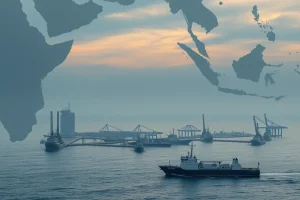
Indo-Pacific naval modernization matters economically because the region contains some of the world’s most important trade routes. Naval competition affects commercial shipping through risk perception: if insurers price higher war-risk premiums, if carriers reroute around contested waters, or if navies impose exclusion zones, costs rise for importers and exporters. Corvettes and coastal missile batteries are cheaper than carriers, but they can still change the risk calculus in a strait. For emerging markets dependent on imported energy and containerized goods, the relevant question is not who has the largest fleet but whether sea lanes remain predictable. A2/AD systems can deter coercion, but they can also make commercial operators reluctant to transit during a crisis.
Alliance burden-sharing and deterrence
Strategically, the modernization wave redistributes burdens. The United States has long provided the backbone of Indo-Pacific naval power, but the IISS assessment describes allies and partners redoubling capability investments and adjusting operating postures. Japan, Taiwan and Southeast Asian states are investing in maritime domain awareness, anti-ship missiles and survivable surface forces. India’s corvette, submarine and carrier-air programs position it as a net security provider in the Indian Ocean, though its capacity is finite. Indonesia’s converted carrier is a prestige and disaster-relief asset more than a power-projection tool, but it signals that archipelagic states want a seat at the maritime table. The geopolitical effect is a more fragmented but also more layered deterrence architecture: many smaller capabilities rather than one dominant fleet.
Defense industrial supply chains and emerging-market spillovers
Naval modernization also creates industrial supply chains. Corvette contracts sustain shipyards, steel suppliers, electronics firms and design offices. Carrier conversions create demand for deck crews, aviation maintenance and port services. Submarine programs require specialized welding, batteries, sonar and torpedo handling. India’s domestic corvette order is explicitly linked to a broad naval modernization push, while its German submarine and French aircraft tracks show that foreign suppliers remain essential. For Southeast Asian emerging markets, the spillover is more modest but still real: ship repair yards, training academies and port logistics benefit from naval investment. The risk is that defense spending crowds out other infrastructure, or that imported systems create a dependency on foreign spares during a crisis.
East Asia: China’s carrier and fleet expansion
In East Asia, China’s Type 004 carrier program and broader PLAN growth set the benchmark. A nuclear-powered carrier, if confirmed, would extend endurance and reduce dependence on fossil fuel logistics, but it would also require more escorts, aircraft and support ships. The strategic impact is not simply that China has another carrier; it is that the PLAN is learning to operate carriers, submarines and large surface fleets together. Taiwan, Japan and the United States are adjusting their force postures in response. The IISS assessment’s description of the Asia-Pacific as the pacing maritime arena reflects this dynamic: technology and operational concepts are developing fastest where China’s capabilities meet allied countermeasures.
Southeast Asia: below the carrier threshold
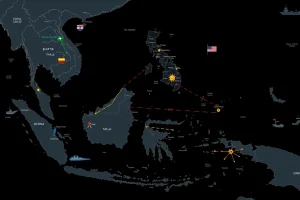
In Southeast Asia, the dominant pattern is modernization below the carrier threshold. Indonesia’s KRI Sriwijaya conversion is the visible exception, but the broader regional effort is in frigates, corvettes, patrol vessels, anti-ship missiles and maritime surveillance. This reflects budget reality and geography. Archipelagic states need presence across many islands, not a single carrier group. Corvettes and patrol vessels are better suited to countering piracy, illegal fishing and smuggling, while coastal missiles and submarines provide a deterrent against larger navies. The economic impact is a gradual improvement in maritime domain awareness, which can reduce insurance risk and improve fisheries enforcement, but also a risk of arms-race spirals if procurement outpaces dialogue.
South Asia: India’s multi-domain build-out
In South Asia, India’s US$5.7 billion corvette contract, six-submarine plan with Germany and 26 Rafale Marine aircraft plan show a multi-domain build-out. The corvettes will replace aging single-role ships and operate in anti-submarine, anti-surface and coastal defense roles. The submarine program adds undersea deterrence, while carrier aviation strengthens the Indian Navy’s ability to project power in the Indian Ocean. The economic effect is a boost to domestic shipbuilding and defense manufacturing, but the strategic effect is a more capable but also more budget-constrained navy. India’s challenge is to sustain training, maintenance and munitions stocks across a growing fleet while managing foreign-supplier dependencies.
What to watch
- Whether India’s eight corvettes move from contract to steel cutting and sea trials on schedule, and whether the submarine and Rafale Marine programs stay funded.
- Whether Indonesia operates KRI Sriwijaya as a genuine carrier capability or primarily as a flagship and disaster-relief asset, including air-wing and escort development.
- Whether Southeast Asian navies prioritize corvettes, coastal missiles and maritime patrol aircraft over prestige surface combatants.
- Whether China’s Type 004 carrier program leads to sustained carrier operations beyond the first-generation training and demonstration phase.
- Whether regional navies invest in munitions depth, maintenance capacity and command networks, not just hulls.
Indo-Pacific naval modernization explained in one sentence is this: it is a distributed build-out of carriers, corvettes, submarines, amphibious ships and coastal missiles that seeks to influence the cost of sea control without always matching the largest fleets. The binding constraints are financing, shipyard capacity, technology transfer and readiness. The strategic consequence is a more contested maritime environment in which smaller, well-integrated capabilities can matter as much as prestige platforms.
Primary Sources & Official Citations
- IISS Asia-Pacific Regional Security Assessment 2023, Chapter 3 — Analytical baseline on Asia-Pacific naval and maritime capability dynamics
- Euronaval World Defence Shipbuilding 2026 — Shipbuilding orders of battle and production trends
FAQ
What is Indo-Pacific naval modernization?
It is the combined procurement and conversion of carriers, corvettes, submarines, amphibious ships and coastal missile systems by states in East, Southeast and South Asia. The goal is to improve presence, sea denial and disaster response without necessarily matching the largest navies platform for platform.
Why are carrier conversions attractive to regional navies?
A second-hand or converted carrier can be acquired faster and more cheaply than a newbuild, and it provides a visible flagship, aviation training platform and disaster-relief asset. The trade-off is that the operator must still fund escorts, air wings, maintenance and trained crews, so lifecycle costs remain high.
How do corvettes and coastal missile batteries differ from carriers?
Carriers concentrate air power and political signaling in one high-value platform. Corvettes and coastal missile batteries distribute presence and risk across many smaller nodes, making them more affordable for budget-constrained navies and harder to neutralize in a littoral contested environment.
Leave a Reply