Short Answer
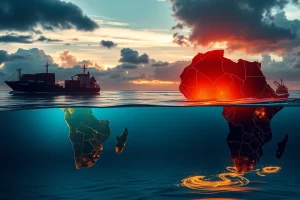
98%+ of international data traffic is carried by subsea cables
Key Takeaways
- Subsea cables carry more than 98% of all international data traffic, making them the operational base layer for cloud, trade, finance and public services across Africa and Asia (Vodafone, 2025).
- Africa has added at least 19 submarine Internet cables since 2000, but redundancy remains uneven because multiple systems can share the same landing stations, terrestrial backhaul corridors and power dependencies (Techpoint Africa, 2020; Carnegie Endowment, 2025).
- New systems such as 2Africa, Equiano, PEACE, SEA-ME-WE 6, Bifrost and Apricot are shifting capacity and strategic leverage toward hyperscalers, carrier consortiums and landing-party operators, making governance, repair access and route diversity core policy variables (Carnegie Endowment, 2025).
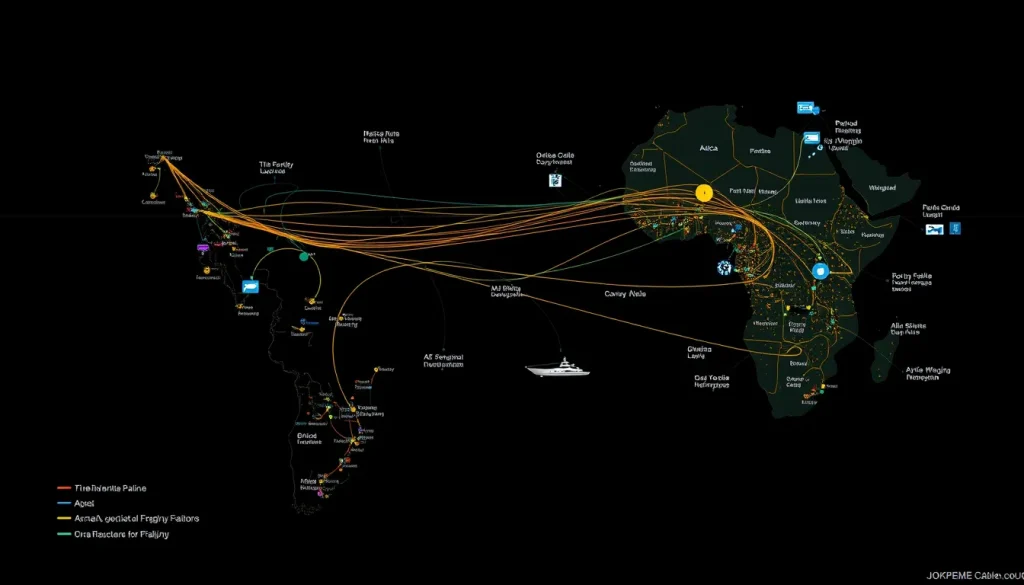
Subsea internet cables are the physical layer of global digital trade. They are fiber-optic systems laid on or buried beneath the ocean floor, connecting coastal landing stations to terrestrial backhaul, data centers and internet exchange points. They carry more than 98% of all international data traffic, according to Vodafone, and they transmit information at nearly the speed of light between continents (Vodafone, 2025). For Africa and Asia, these systems determine wholesale bandwidth prices, cloud latency, redundancy, cybersecurity exposure and the cost of participating in digital trade. This pillar explainer maps the technical architecture, governance and commercial mechanics behind Africa-Asia subsea internet cables, with reference to 2Africa, Equiano, PEACE, SEA-ME-WE 6, Bifrost, Apricot, WACS and EASSy. It then assesses bottlenecks and regional economic and geopolitical effects.
Quick-Spec Summary
| Specification | Reference position |
|---|---|
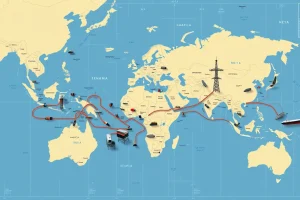
| Route / Scope | Africa-Europe-Asia-Middle East subsea fiber systems, including 2Africa, Equiano, PEACE, SEA-ME-WE 6, Bifrost, Apricot, WACS and EASSy; routes combine coastal landings, terrestrial backhaul and branching units. |
| Capacity | System-specific. New African and Asian systems are designed in multi-terabit to low-hundreds-of-terabits-per-second classes; usable capacity depends on fiber pairs, repeater design, landing-station capacity, backhaul and IP transit arrangements. |
| Estimated Cost | Portfolio costs vary by length, branching units, landing stations and repair arrangements. Facebook announced a 37,000 km subsea cable worth about $1 billion in May 2020, illustrating the scale of flagship projects (Techpoint Africa, 2020). |
| Lead Stakeholders | Carrier consortiums, landing-party operators, hyperscalers and specialist marine suppliers. Publicly cited actors in African projects include Facebook/Meta, MTN, Vodafone, Seacom, Glo and MainOne; Asian systems involve regional carriers, hyperscalers and consortium partners. |
| Current Status | Mixed. Legacy systems such as WACS and EASSy are operational; newer systems such as 2Africa, Equiano, PEACE, SEA-ME-WE 6, Bifrost and Apricot are at different stages of service, construction or phased deployment depending on segment. Resilience remains uneven by route and country. |
| Why It Matters | Subsea cables are critical infrastructure for cloud, financial messaging, e-commerce, logistics, public services and security cooperation. Governance and security vary by region, and great-power dynamics shape investment, deployment, repair and resilience (Carnegie Endowment, 2025). |
How It Works & Strategic Mechanics
A subsea cable is not a single wire. It is an integrated system of fiber-optic strands, repeaters, branching units, landing stations, power-feed equipment, network operations centers and maintenance arrangements. The system is designed to carry high volumes of data across oceans and to connect into terrestrial networks at each landing point. Its strategic value comes from both its capacity and its geography: the route determines which countries can reach global networks without transiting a third jurisdiction, and the landing station determines who can buy, control and monitor capacity.
Physical architecture: fiber, repeaters and branching units
The core of a modern subsea system is a set of fiber pairs bundled into a cable. Optical repeaters are placed along the route to amplify signals over long distances. Branching units allow a single trunk cable to serve multiple landing points, which is essential for regional systems that connect many countries rather than only two endpoints. The physical design affects upgradeability: more fiber pairs and flexible branching can support higher future capacity, while older systems may be constrained by repeater spacing, power budgets and landing-station equipment.
Subsea cables are distinct from satellites in their economics and performance. They offer high capacity and low latency, and they are the preferred medium for dense international traffic. Satellites remain important for remote areas, backup and broadcasting, but they are not a substitute for the bandwidth volumes generated by cloud computing, video, mobile data and enterprise networks. The physical layer is therefore a determinant of digital inclusion and commercial competitiveness.
Landing stations, backhaul and the last mile
A cable landing station is the shore facility where the subsea cable terminates and connects to power, transmission equipment and terrestrial fiber. The landing station is also a regulatory and commercial gate. The landing-party operator may be a telecom incumbent, a consortium, a specialist neutral operator or a government-linked entity. Access terms, licensing conditions and pricing at this point can shape competition far inland.
Terrestrial backhaul is often the weakest link in the chain. A country may have a new subsea cable landing but insufficient fiber routes to major cities, data centers and internet exchange points. Inland and landlocked markets depend on cross-border fiber, which can be subject to permits, transit fees and political risk. Energy availability is another constraint: landing stations and data centers require reliable power and cooling. The result is that nominal national connectivity can coexist with high retail prices, congested backhaul and limited redundancy.
Capacity, ownership and commercial mechanics
Subsea cables are financed and owned through several models. Traditional consortium or club cables are owned by a group of carriers that share construction and operating costs. Private cables may be built by a single operator or a hyperscaler and then sold wholesale to telecoms and cloud providers. Some systems are structured as open-access infrastructure, while others are more closed. Ownership affects pricing, priority access, upgrade decisions and the willingness to invest in route diversity.
Capacity is typically sold through long-term contracts, including indefeasible rights of use, or IRUs, and shorter-term leases. Wholesale buyers may include mobile operators, internet service providers, cloud providers and content delivery networks. The commercial model matters for Africa and Asia because it determines whether smaller markets can buy capacity at competitive rates and whether new entrants can aggregate demand across borders. Where landing stations are controlled by a single operator, access pricing can remain a bottleneck even when cable capacity is abundant.
Routing, latency and redundancy
Route selection is a strategic decision. A cable that follows a direct path can reduce latency, which matters for financial trading, cloud applications, video conferencing and industrial control. A cable that avoids a chokepoint can improve resilience even if it is longer. Modern systems often combine a trunk route with branches to multiple countries, creating a balance between cost and coverage. The design must also account for seabed conditions, fishing activity, shipping lanes, seismic zones and permitting constraints.
Redundancy is not simply a matter of counting cables. Two cables that land on the same beach, share the same terrestrial duct or depend on the same power substation may fail together. Effective redundancy requires physical separation of routes, diverse landing points and independent backhaul. This is a central issue for both Africa and Asia, where high-capacity systems can be concentrated along a few coastal corridors. Operators and governments increasingly assess resilience at the level of the whole path, not just the submarine segment.
Governance, security and repair regimes
Subsea cables are governed through a mix of international law, national licensing, consortium agreements and private contracts. Coastal states regulate landing rights, environmental permits and security access. Cable owners manage construction, operation and maintenance. International bodies and regional organizations provide norms and coordination, but there is no single global regulator for subsea cable systems. Carnegie Endowment analysis notes that governance and security approaches vary by region and that great-power dynamics are among the factors shaping investment, deployment, repair and resilience (Carnegie Endowment, 2025).
Security includes physical protection, cybersecurity at landing stations and network operations centers, supply-chain trust and lawful access requirements. Cable protection zones can reduce damage from anchors and fishing, but enforcement varies. Repair access is also strategic: specialized cable ships are limited, and repair permits can be delayed by weather, customs or political conditions. A cable system is only as resilient as its repair regime, because outages are inevitable over multi-decade asset lives.
Selected systems and their strategic roles
| System | Primary corridor | Strategic role |
|---|---|---|
| 2Africa | Africa circumnavigation with Middle East, Europe and Asia connections | Large-capacity African ring intended to reduce dependence on a single coastal route and support new landing points. |
| Equiano | Portugal to West Africa and South Africa | West-coast diversity and hyperscaler-backed capacity, with potential to lower wholesale costs and support cloud entry. |
| PEACE | Asia-Africa-Europe corridor | Eurasian and African connectivity through a long-haul system linking key landing markets. |
| SEA-ME-WE 6 | Southeast Asia to the Middle East and Western Europe | High-capacity Eurasia trunk supporting dense Asian traffic and Middle East transit. |
| Bifrost | Asia-Pacific to North America | Trans-Pacific diversity for Asian cloud, content and enterprise traffic. |
| Apricot | East Asia, Southeast Asia and Guam | Intra-Asia and Pacific connectivity that supports manufacturing, financial centers and data-center hubs. |
| WACS | West Africa to Europe | Legacy west-coast trunk that helped expand African international bandwidth and regional competition. |
| EASSy | East Africa to the global network via the Red Sea corridor | East-coast regional backbone that improved connectivity for Eastern and Southern African markets. |
These systems are not interchangeable. Each has a different ownership structure, landing footprint, capacity profile and repair arrangement. The strategic question is how they combine into a portfolio: whether a country has access to multiple routes, whether landing stations are competitive and whether terrestrial networks can distribute capacity beyond the coast. A single new cable can transform wholesale pricing, but it cannot by itself solve inland connectivity, energy reliability or regulatory fragmentation.
Key Bottlenecks, Fault Lines & Risks
The subsea cable system is capital-intensive, geographically exposed and politically sensitive. The main bottlenecks are not only technical. They include financing gaps, regulatory friction, physical chokepoints, limited redundancy and governance fragmentation. These risks are especially consequential for Africa and Asia because both regions combine fast-growing digital demand with uneven infrastructure and diverse regulatory regimes.
Financing and bankability
Subsea cables require large upfront capital and long payback periods. Financing depends on credible demand, anchor tenants and landing rights. A consortium may aggregate demand from several operators, while a hyperscaler may finance a system to secure cloud capacity. In lower-income markets, the challenge is to translate national connectivity needs into bankable demand. Techpoint Africa noted that billions of people in Africa remain unreached, have low-quality internet or cannot afford it, which limits the commercial case for some routes even when social and strategic benefits are high (Techpoint Africa, 2020).
Financing gaps also affect the terrestrial side. Landing stations, backhaul fiber, data centers and power infrastructure may require separate investment. If these complementary assets are not funded, a new cable can strand capacity or concentrate benefits in a few urban markets. Public development banks and multilateral institutions can support early-stage risk, but they must balance catalytic financing with commercial discipline. The most effective projects tend to combine anchor demand, open-access rules and credible maintenance arrangements.
Regulatory and landing-party friction
Landing rights, import permits, environmental approvals and security clearances can delay projects. Regulatory uncertainty raises the cost of capital. In some markets, the landing party has significant market power, which can limit competition in capacity sales. Data-sovereignty rules, lawful-intercept requirements and cybersecurity obligations add another layer of complexity. These are legitimate policy concerns, but they can become bottlenecks if they are opaque, inconsistent or applied discriminatorily.
Cross-border coordination is particularly important for landlocked countries and regional corridors. A cable landing in one country may serve several neighbors, but transit rights, customs procedures and pricing agreements must be in place. Regional economic communities can reduce friction, but implementation varies. The result is a patchwork in which some countries have multiple routes and competitive landing options, while others depend on a single coastal gateway.
Physical chokepoints and repair capacity
Subsea routes pass through geographic corridors that concentrate risk. The Red Sea, Bab el-Mandeb and Suez corridor are critical for Europe-Asia and Africa-Europe traffic. The Mediterranean, South China Sea and Luzon Strait are also strategically important. These are not chokepoints in the same sense as shipping lanes, because cables can sometimes be rerouted through branching units or alternate systems, but physical concentration still creates exposure. A disruption in a narrow corridor can affect multiple operators and countries at once.
Repair capacity is a separate constraint. Cable faults can result from anchors, fishing gear, seabed landslides, seismic events or deliberate damage. Repair requires specialized ships, spare cable and permits. The global fleet is limited, and vessels may be far from the fault. In the meantime, traffic must be rerouted, which can strain alternate routes and raise latency. Countries with only one cable or one landing station may experience prolonged outages even if the fault is far away.
Redundancy and last-mile constraints
Nominal redundancy can be misleading. A country may have three international cables, but if all three land at the same station and share the same terrestrial fiber to the capital, a single coastal event can take out all three. Similarly, a regional system may have many landing points, but capacity may be concentrated in a few markets with stronger backhaul. Redundancy therefore requires route diversity, separate landing facilities, independent power and multiple terrestrial paths.
Last-mile constraints also affect affordability. Even where international bandwidth is abundant, domestic wholesale and retail markets may be concentrated. Spectrum policy, tower regulation, fiber rights of way and taxation influence the final price. The subsea layer is necessary but not sufficient for digital inclusion. This is why cable projects are increasingly assessed alongside national broadband plans, data-center strategy and energy investment.
Cybersecurity, supplier concentration and geopolitics
Subsea cables are vulnerable to cyber and physical threats. Landing stations and network management systems can be targeted by malicious actors. Cable routes and repair operations can be surveilled. Supplier concentration in cable manufacturing, repeaters and marine repair creates dependency. Governments are increasingly scrutinizing who builds, owns and operates critical digital infrastructure, citing national security and data protection.
Geopolitical competition affects route choices and financing. The United States, China, European states, Gulf countries and regional powers all have interests in cable connectivity. Hyperscalers have become major investors, reflecting the strategic importance of cloud capacity. Carnegie Endowment research highlights that great-power dynamics shape investment, deployment, repair and resilience, and that regional approaches to governance and security differ (Carnegie Endowment, 2025). For African and Asian governments, the challenge is to capture connectivity benefits without becoming dependent on a single supplier or security partner.
Governance fragmentation and data sovereignty
There is no unified global regime for subsea cables. National licensing, consortium contracts, international law and regional norms overlap. This fragmentation can slow coordination during outages and complicate security cooperation. Data-sovereignty requirements may encourage local data centers and regional landing points, but they can also raise costs if implemented without regard to network economics. The policy challenge is to protect public interests while preserving the open, resilient and interoperable character of the global backbone.
Regional Economic & Geopolitical Impact
Subsea cables influence economic outcomes through price, latency, reliability and control. They enable cloud services, electronic payments, e-commerce, remote work, online education and government digital services. They also shape geopolitical leverage because route geography determines who can bypass whom. For Africa and Asia, the impact is not uniform: coastal hubs, landlocked markets, island states and manufacturing centers face different constraints and opportunities.
Africa: capacity, competition and inclusion
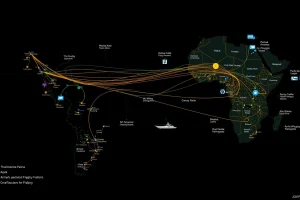
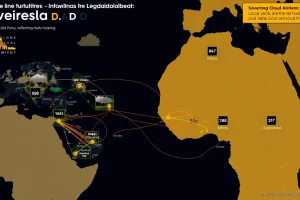
Africa has seen a substantial buildout since 2000. Techpoint Africa reported that at least 19 submarine Internet cables had connected to Africa from 2000 to 2020, with systems from Seacom, Glo, MTN, MainOne and others forming a major part of the backbone (Techpoint Africa, 2020). Newer projects such as 2Africa, Equiano, PEACE, WACS and EASSy add capacity and route options across West, East, Southern and North Africa. The economic effect depends on how that capacity is distributed and priced.
On the west coast, Equiano and WACS support Europe-Africa connectivity and provide alternatives to older routes. On the east coast, EASSy and PEACE-related corridors connect Eastern and Southern Africa to the Middle East, Asia and Europe. 2Africa is designed as a circumnavigation system, which can reduce dependence on a single coast and create new landing opportunities. However, landing-station access, cross-border backhaul and energy remain decisive. Carnegie Endowment analysis of Africa’s undersea digital infrastructure emphasizes vulnerabilities that go beyond cable construction, including governance, security and resilience (Carnegie Endowment, 2025).
The inclusion impact is significant but conditional. Lower wholesale bandwidth can reduce retail prices, expand mobile broadband and support data-center investment. Yet rural and landlocked areas may not benefit if backhaul is expensive or if competition is weak. African policymakers increasingly link cable investment to regional integration, cloud strategy and digital public infrastructure. The most effective approach is to treat subsea cables as part of a wider digital corridor that includes terrestrial fiber, energy, skills and regulation.
Asia-Pacific: density, manufacturing and route diversification
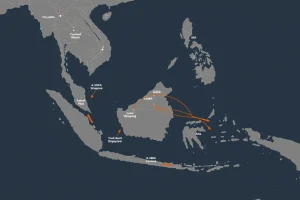
Asia-Pacific is the world’s most densely connected region for subsea cables, reflecting its manufacturing base, large populations, financial centers and cloud markets. SEA-ME-WE 6 supports Southeast Asia-Middle East-Europe traffic. Bifrost and Apricot add trans-Pacific and intra-Asia diversity. These systems underpin data-center hubs in Singapore, Japan, South Korea, Taiwan, Hong Kong and other markets, and they support supply-chain coordination across the region.
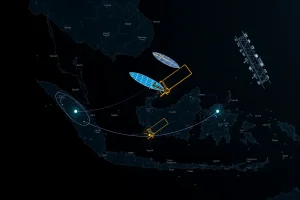
Route diversification is a central strategic concern. The South China Sea and Luzon Strait are important corridors, but they are also exposed to geopolitical tension and physical risk. Operators and governments seek alternate paths through Indonesia, the Pacific and the Indian Ocean. For Southeast Asia, new cable landing points can attract data-center investment and cloud capacity. For South Asia, systems such as SEA-ME-WE 6 and PEACE improve connectivity to the Middle East and Europe, but domestic backhaul and regulatory conditions still shape outcomes.
Asia’s cable market is also a test case for hyperscaler influence. Large cloud providers commission private systems or anchor consortiums, securing capacity for their own services while selling wholesale to telecoms. This can accelerate deployment and lower costs, but it can also concentrate control over strategic infrastructure. The policy debate is not whether private capital should participate, but how to ensure open access, security and resilience.
Trade, cloud and supply-chain effects
Subsea cables are foundational to trade in services. Financial messaging, logistics platforms, e-commerce, software-as-a-service and remote collaboration all depend on reliable international connectivity. For exporters, cable capacity supports access to global marketplaces and cloud-based supply-chain tools. For governments, it enables digital public services and cross-border data exchange. The 98% share of international data traffic carried by subsea cables underscores their systemic importance (Vodafone, 2025).
Cloud and content providers are reshaping demand. Data centers require diverse fiber routes, low latency and reliable power. Cable landing stations are increasingly integrated with data-center campuses and internet exchange points. This creates clusters of digital infrastructure in coastal cities, but it can also widen regional gaps if inland markets lack connectivity. Governments are responding with national data-center strategies, cloud policies and regional fiber corridors. The economic return on cable investment depends on complementary infrastructure and skills.
Security, sovereignty and strategic leverage
Subsea cables are now part of national security debates. States worry about foreign ownership of landing stations, surveillance risk, supply-chain integrity and the ability to repair cables during a crisis. Some impose restrictions on suppliers or require security reviews. Others promote domestic or like-minded consortiums. These measures can improve security, but they can also raise costs and fragment standards. The challenge is to balance risk management with the benefits of international interoperability.
For Africa and Asia, strategic leverage comes from becoming indispensable nodes rather than passive landing points. Countries that host data centers, internet exchange points and repair capabilities can capture more value than those that only provide beach access. Regional cooperation can strengthen bargaining power and improve resilience. Carnegie Endowment analysis notes that governance and security vary across Europe, Africa and Southeast Asia, and that great-power dynamics are one factor shaping investment, deployment, repair and resilience (Carnegie Endowment, 2025).
Investment and policy implications
Policymakers and investors should assess subsea cables as system assets. Key priorities include route diversity, competitive landing-station access, open-access wholesale models, independent terrestrial backhaul, reliable power, cybersecurity at landing facilities and regional coordination on permits and repair. Transparency on ownership and capacity contracts can reduce risk and improve trust. Development finance can support early-stage projects, but it should be paired with commercial discipline and strong maintenance arrangements.
The next phase of Africa-Asia subsea internet cables will be defined less by the number of new cables than by how well they are integrated. A cable is only as useful as the backhaul that distributes its capacity, the power that sustains its landing station, the regulation that governs access and the repair regime that restores service. The strategic winners will be markets that combine physical connectivity with competitive markets, skilled institutions and resilient infrastructure. The bottom line is that subsea cables are not merely technical links; they are the backbone of digital trade, security and regional influence.
Primary Sources & Official Citations
- Carnegie Endowment — Beneath the Waves: Addressing Vulnerabilities in Africa’s Undersea Digital Infrastructure — March 2025 policy analysis on African undersea cable vulnerabilities, governance and resilience
- Carnegie Endowment — How Different Regions Are Rethinking Their Approaches to Subsea Cables — June 2025 comparative analysis of subsea cable governance and security across Europe, Africa and Southeast Asia
- Vodafone — Beneath the surface: How Subsea Cables Keep the World Connected — Operator disclosure on subsea cable role, global data traffic share and network resilience
- Techpoint Africa — Subsea Internet cables and the race to connect Africa to the Internet — Industry analysis of African subsea cable buildout and 2020 Facebook 2Africa-scale announcement
FAQ
What is the difference between 2Africa, Equiano, PEACE, WACS and EASSy?
2Africa is a circumnavigation system designed to connect multiple African coasts with the Middle East, Europe and Asia. Equiano links Portugal to West Africa and South Africa. PEACE runs across Asia, Africa and Europe. WACS is a west-coast Africa-Europe trunk, while EASSy serves East Africa and connects to global routes through the Red Sea corridor. They differ in route, ownership, capacity and landing footprint.
Why are subsea cables more important than satellites for Africa-Asia connectivity?
Subsea cables carry more than 98% of international data traffic because they offer high capacity and low latency at scale. Satellites are useful for remote coverage, backup and broadcasting, but they cannot economically carry the dense cloud, video, mobile and enterprise traffic that drives modern digital economies.
What are the main risks to subsea cable resilience in Africa and Asia?
Key risks include physical chokepoints such as the Red Sea corridor and South China Sea, limited repair vessel capacity, landing-station concentration, weak terrestrial backhaul, regulatory delays, cybersecurity threats and geopolitical competition over ownership and supplier trust. Effective resilience requires route diversity and independent landing and backhaul facilities, not just more cables.
Leave a Reply