Short Answer
9th edition | August 2026 | Udorn Thani/Wing 23 | J-10C, J-11 and AWACS vs Gripen and Alpha Jet
Key Takeaways
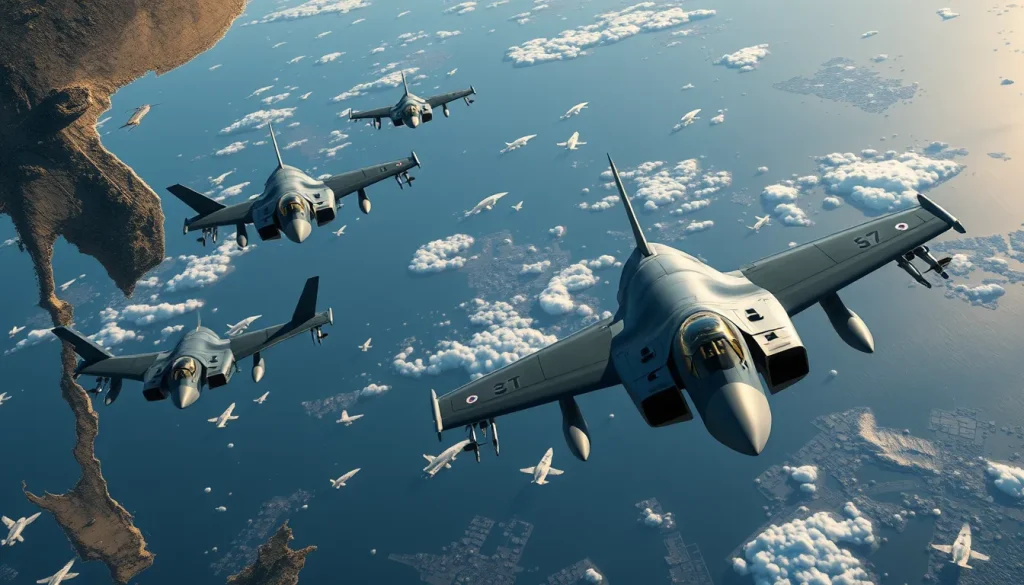
- The ninth Falcon Strike was held in August 2026 at Udorn Royal Thai Air Force Base and Wing 23, with PLAAF J-10C and J-11 fighters plus an AWACS aircraft training alongside RTAF Gripen and Alpha Jet aircraft.
- The exercise is sovereign-funded defense diplomacy, not a concession or DFI-backed project; no EPC contractor, debt tranche, freight volume or energy throughput applies.
- Bangkok uses Falcon Strike to signal hedging amid strained US-Thailand ties after the 2014 coup, while Beijing gains rare exposure to a Western-equipped and Western-trained air force.
This tracker treats the Sino-Thai Falcon Strike joint air force exercise as a recurring defense-diplomacy program, not a commercial infrastructure megaproject. That distinction drives the status call: there is no special-purpose vehicle, no EPC contract, no concession, and no DFI debt tranche. The relevant test is whether the exercise cycle moved from planning to force deployment and execution. It did. The ninth edition was held in August 2026 at Udorn Royal Thai Air Force Base and Wing 23 in Udon Thani, with the Royal Thai Air Force and the People’s Liberation Army Air Force participating [3][4].
Chronological Milestone Timeline
No feasibility study, financial close, construction phase, or revenue service date applies. The analogous cycle for a military exercise is planning, adaptation training, deployment, execution, and post-exercise assessment. The table below maps that cycle using the retrieved reporting.
| Phase | Date | Milestone | Status / Evidence |
|---|---|---|---|
| Inaugural edition | 2015 | First Falcon Strike conducted | Completed; historical baseline reported by RSIS [1] |
| Recurring cycle | 2015 to 2025 | Successive editions build a bilateral training rhythm | Completed; by 2026 the ninth edition is reported [1][3] |
| 2026 adaptation and planning | August 2026 | Adaptation training for Falcon Strike-2026 begins at Udorn Royal Thai Air Force Base | Completed; official MND announcement [3] |
| Force deployment | August 2026 | PLAAF deploys J-10C and J-11 fighters and an AWACS aircraft; Y-20 transport aircraft are also reported. RTAF fields Gripen and Alpha Jet aircraft | Completed; Khaosod and Zona Militar [4][2] |
| Opening and command set-up | August 2026 | Opening at Wing 23, Udon Thani; AVM Sitthipol Pomtree and AVM Ma Yuping preside | Completed; Khaosod [4] |
| Execution | August 2026 | Joint air defense, tactical air operations, aerial refuelling, combined-force escort, and humanitarian medical rescue or evacuation training | Completed; MND, Khaosod, Zona Militar [3][4][2] |
| Post-exercise assessment | 3 November 2026 | RSIS commentary assesses significance and limitations | Completed; analytical source [1] |
The timeline shows a mature, recurring exercise rather than a one-off deployment. The first Falcon Strike was conducted in 2015, and by August 2026 the two air forces were running the ninth edition [1][3]. The 2026 cycle included adaptation training at Udorn, an opening ceremony at Wing 23, and mission sets covering joint air defense, tactical air operations, aerial refuelling, and humanitarian medical rescue or evacuation [3][4][2]. There is no publicly disclosed budget or acquisition milestone attached to the exercise.
Three features stand out. First, the exercise is now old enough to have a repeat cycle and a comparative baseline: RSIS can assess 2026 against earlier editions and against the broader US-Thailand and China-Thailand relationships [1]. Second, the 2026 edition was not limited to air-combat maneuvering. It added aerial refuelling, AWACS participation and humanitarian medical rescue, which are force-multiplier mission sets rather than simple confidence-building flypasts [3][4]. Third, the public record remains thin on quantitative metrics such as sortie counts, munitions expended, or cost. That opacity is itself a finding for analysts who track defense engagement.
Consortium, Operators & Financing Breakdown
Sovereign sponsors and operators. The exercise is run by two sovereign air forces rather than a project company. The RTAF Training Division directs Thai participation, with Air Vice Marshal Sitthipol Pomtree identified as director. China’s exercise director is Air Vice Marshal Ma Yuping [4]. The PLAAF supplies combat aircraft and surface-to-air missile troops, while Thailand supplies host-nation base access at Udorn Royal Thai Air Force Base and Wing 23 [3][4].
No EPC, concessionaire, or DFI tranche. There is no EPC contractor, concessionaire, special-purpose vehicle, or DFI/multilateral debt tranche. No budget figure is disclosed in the retrieved sources. Funding is sovereign defense spending, not project finance. This matters for readers who track infrastructure: Falcon Strike should not be entered into a pipeline as a capex-bearing corridor asset.
Command and coordination. The opening ceremony was jointly presided over by AVM Sitthipol Pomtree and AVM Ma Yuping [4]. That co-presence is a small but useful indicator of a peer-to-peer exercise design rather than a clientelist training mission. The RTAF Training Division is the Thai institutional owner; on the Chinese side, the exercise director role sits within the PLAAF delegation. No civilian infrastructure ministry, port authority, or multilateral lender appears in the chain.
Procurement and industry angle. The exercise sits alongside Thailand’s Gripen fleet and China’s J-10C operational ecosystem, but the sources do not report a procurement contract from Falcon Strike 2026. Analysts should not infer a sale from participation. The more defensible commercial read-through is limited to defense-diplomacy signaling and potential marketing exposure, not a signed order.
Engineering Specs & Route Bottlenecks
No gauge, draft or voltage specs. Because this is an air exercise, railway gauge, port draft depth, transmission voltage and pipeline capacity are not applicable. The engineering variables that matter are airbase throughput, runway and ramp availability, fuel and ground support, data-link interoperability, and airspace coordination.
Udorn RTAFB and Wing 23 deployment
Udorn Royal Thai Air Force Base, also referred to as Wing 23, is in Udon Thani province in northeastern Thailand. It hosted the 2026 adaptation training and opening ceremony [3][4]. The retrieved sources do not disclose force numbers, sortie rates, runway use, munitions storage, or the precise basing plan for deployed Chinese aircraft. The base’s location in the Mekong subregion gives it political and operational salience, but the public record remains at the level of aircraft types and mission sets.
Airbase throughput. Udorn and Wing 23 are existing RTAF facilities, so the exercise does not require greenfield construction. The practical constraints are parking space for deployed fighters and transports, fuel bowser capacity, ground-power and maintenance support, and the ability to sequence mixed RTAF and PLAAF operations without degrading host-unit readiness. The sources do not provide enough data to model sortie generation rates. What can be said is that the deployment of fighters, an AWACS aircraft, transports and surface-to-air missile troops implies a composite force package rather than a single-squadron exchange [3][4][2].
Confirmed and unconfirmed platform mix
- PLAAF confirmed: J-10C multirole fighters and J-11 fighters, plus an AWACS aircraft; Y-20 transport aircraft are also reported to participate [2][4]. China also dispatched surface-to-air missile troops [3].
- RTAF confirmed: Gripen fighters and Alpha Jet aircraft [4]. The RTAF’s Gripen C/D fleet is the core of its modern fighter force, though the 2026 source says Gripen without sub-variant detail.
- Unconfirmed for 2026: the AWACS model is not named in the retrieved coverage. KJ-500, JH-7A and Saab 340 AEW are known in the two air forces’ wider inventories, but the 2026 sources do not confirm their participation. They should be treated as unverified for this edition rather than asserted.
Platform comparison. The J-10C is a modern multirole fighter; the J-11 is a heavier air-superiority-oriented platform; the Gripen is a lighter, networked fighter; the Alpha Jet is a trainer and light-attack aircraft. Mixing these types in joint missions tests more than basic airmanship. It tests how a smaller Western-equipped air force and a larger Chinese force manage radar picture sharing, escort geometry, refuelling windows and medical evacuation under notional threat conditions. The sources confirm the mission categories but not the detailed tactics, techniques and procedures.
Operational bottlenecks
The main bottlenecks are not terrain or customs. They are interoperability and political risk. Thai Gripen aircraft and Chinese fighters use different data links, doctrine and command cultures, so combined operations require procedural workarounds. Language and rules-of-engagement differences add friction. Chinese deployments also depend on overflight and logistics arrangements that are not detailed publicly. On the Thai side, the exercise must be calibrated to avoid appearing as an alliance commitment. These are the practical limits that make Falcon Strike significant but not transformative [1].
Economic & Geopolitical Significance
No freight or energy volume. Falcon Strike is not a trade corridor. There are no freight volumes, energy throughput projections, tariff revenues, or commercial capacity figures to model. The measurable output is training exposure: sorties, joint mission sets, command-post coordination, and interoperability experience. That is the correct unit of analysis for this tracker.
Economic significance is indirect. Defense exercises can support interoperability, familiarity with equipment, and future procurement signaling, but they do not generate freight or energy rents. For Thailand, the economic value is mainly in military training and diplomatic optionality. For China, the value is in learning and in demonstrating a defense relationship with a US treaty ally. Those are real but non-quantified returns. Any attempt to assign a capex or throughput figure would be fabricated.
Strategic objectives
For Thailand, Falcon Strike is a hedging instrument. RSIS notes that the exercise took place amid strained US-Thailand relations following the 2014 coup and signaled that Bangkok had alternative defense partners [1]. That does not mean Thailand has switched alignment. It means Bangkok is preserving optionality and extracting training value from more than one major power.
For China, the exercise offers a rare opportunity to learn from a Western-equipped and Western-trained air force, potentially improving PLAAF combat capabilities in support of broader military modernization [1]. The presence of AWACS aircraft, aerial refuelling drills and joint air-defense training points to a relatively ambitious mission set for a bilateral exercise [3][4]. The limits are equally important: Thailand retains its wider US security relationship, and the exercise does not establish Chinese basing rights or an alliance.
At the regional level, Falcon Strike is part of a broader pattern of Chinese air diplomacy in Southeast Asia. It gives Beijing visible defense engagement with an ASEAN member that also hosts US-linked exercises and procurement relationships. For Washington and other partners, the signal is less about a decisive realignment than about Bangkok’s willingness to diversify. The correct read is strategic hedging under constrained transparency, not a completed shift in the regional balance.
Limits and risks. The RSIS assessment frames Falcon Strike as significant but limited [1]. Thailand’s hedging is constrained by its US security relationship, domestic politics and ASEAN norms. China’s learning is constrained by the fact that Thailand operates a small, specific fleet and will not expose all its procedures. The exercise therefore should not be read as a rehearsal for Chinese access to Thai bases. It is a bilateral training event with political signaling value.
Primary Sources & Official Citations
- China Ministry of National Defense: Falcon Strike-2026 kicks off — Official exercise announcement, 14 August 2026
- RSIS: Falcon Strike and Fighter Jets — Analytical assessment, 3 November 2026
- Khaosod English: Thailand, China launch Falcon Strike 2026 — Exercise opening and aircraft reporting, 13 August 2026
FAQ
How many Falcon Strike editions have there been?
The 2026 exercise is the ninth edition; the first was conducted in 2015.
Which aircraft are confirmed for Falcon Strike 2026?
Retrieved reporting confirms PLAAF J-10C and J-11 fighters, an AWACS aircraft and Y-20 transports, and RTAF Gripen and Alpha Jet aircraft. The AWACS model, JH-7A and KJ-500 are not named in the 2026 sources.
Is Falcon Strike a commercial infrastructure project?
No. It is a sovereign military exercise with no EPC contract, concession, DFI debt, freight volume or energy capacity.

Leave a Reply