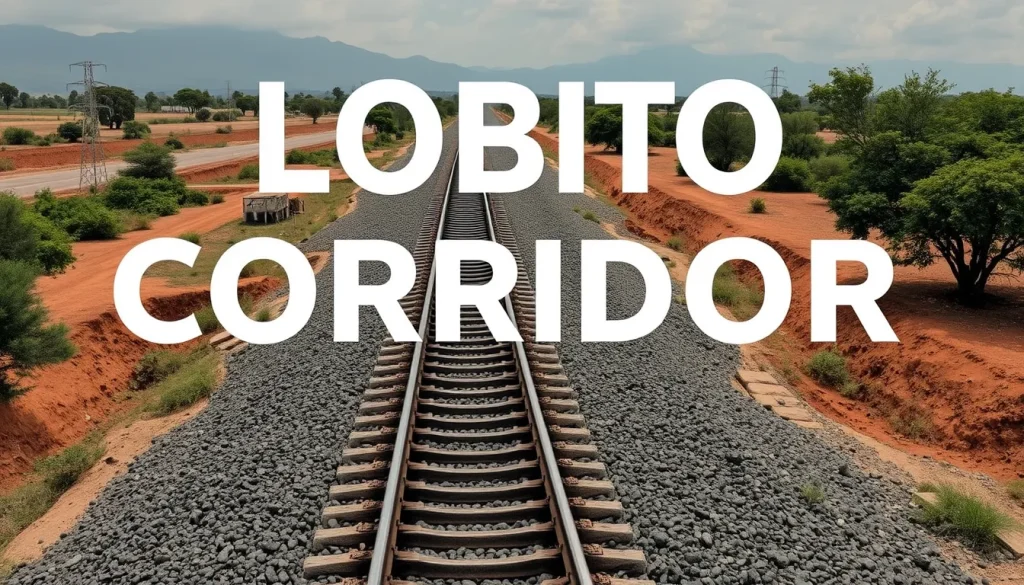
Short Answer
1,739 km Lobito–Kolwezi corridor | 1,289 km Angola section operational | 7-day rail transit | 12 trains/week, rising to 20 by 2027
Key Takeaways
- Lobito Atlantic Railway operates the 1,289 km Angolan section and Lobito minerals terminal under a 30-year concession awarded in 2022; the route has been operational since 2024, with a reported 7-day Lobito–Kolwezi transit and 12 trains per week rising to 20 by 2027.
- The full 1,739 km Lobito–Kolwezi corridor is not yet matched by an operational DRC–Zambia extension: rehabilitation from Dilolo via Kolwezi and Lubumbashi to Kapiri Mposhi, plus a new Luacano–Chingola spur, remains at feasibility or development stage.
- Strategically, the corridor is backed through the G7 Partnership for Global Infrastructure and Investment and the EU’s Global Gateway as an Atlantic outlet for Copperbelt copper and cobalt, but its bankability depends on border formalities, gauge interoperability, rolling stock and port-terminal throughput.
The Lobito Corridor is no longer a purely speculative map line. Its central axis—the Benguela railway from the Port of Lobito on Angola’s Atlantic coast to Luau on the DRC border—is operational under a 30-year concession held by Lobito Atlantic Railway (LAR). The strategic question has shifted from “can the line run?” to “how quickly can DRC and Zambian extensions, border formalities and port capacity convert an operational railway into a reliable alternative to Durban and Dar es Salaam?” This tracker separates disclosed operating facts from feasibility-stage ambitions across the Lobito Corridor railway Angola DRC Zambia system.
Chronological Milestone Timeline
The corridor’s modern history is layered: colonial-era construction, Chinese rehabilitation, a European-led concession and a G7-backed effort to extend reach into the Copperbelt. The disclosed timeline is set out below.
| Date / Period | Milestone | Status | Disclosed detail |
|---|---|---|---|
| 1902 | Benguela Railway established | Historical | The line has been described as a trade lifeline since 1902, forming the historical basis of the Lobito corridor. |
| 2015 | CR20 rehabilitation and modernisation | Completed | China Railway 20 Bureau invested in rebuilding and modernising the route; the line has been operational since this rehabilitation. |
| 2022 | LAR concession awarded | Completed | Angola’s Ministry of Transport awarded Lobito Atlantic Railway a 30-year concession covering the Angola section and the mineral terminal at the Port of Lobito. |
| 2024 | LAR takes over operations | Operational | LAR assumed operations and maintenance from Caminhos de Ferro de Benguela (CFB), with CFB continuing passenger services. |
| 2024 onward | Commercial rail service | Operational | LAR reports 7-day transit from Lobito to Kolwezi and 12 trains per week on the corridor. |
| By 2027 | Capacity expansion target | Target | LAR aims to increase service from 12 to 20 trains per week by 2027. |
| May 2026 | EITI Lobito Corridor report | Published | The EITI-commissioned study examines governance, investment and value-capture opportunities in Angola, DRC and Zambia. |
| TBD | DRC and Zambia extensions | Feasibility / planned | The wider corridor envisions rehabilitation of the Congolese stretch from Dilolo via Kolwezi and Lubumbashi to Kapiri Mposhi, plus a new spur from Luacano through Zambia’s North-Western and Copperbelt provinces to Chingola. These are not yet operational. |
Consortium, Operators & Financing Breakdown
The Lobito Corridor combines a concession-operated Angolan railway with a much larger, still-unbuilt or unrehabilitated DRC–Zambia extension. That split matters for financing: the operating concession has a revenue model around freight, while the extensions require sovereign coordination, environmental and land work, and fresh capital.
Concessionaire and operating structure
LAR is described as a consortium of European-based companies. It operates the 1,289 km Angola section of the line and the mineral terminal at the Port of Lobito under a 30-year concession awarded by the Government of Angola in 2022. The route runs from Lobito to the DRC border via Benguela, Huambo, Kuito, Luacano, Luena and Luau. LAR reports a 945-strong workforce, 97% of whom are Angolan nationals. CFB continues to manage passenger services, while LAR handles freight-oriented operations, maintenance and rehabilitation of existing infrastructure and rolling stock.
EPC and historical rehabilitation
The cited sources do not provide a current EPC breakdown for new DRC or Zambian works. The visible construction history is the 2015 rehabilitation and modernisation by China Railway 20 Bureau (CR20), after which the Angolan route was operational. Any new greenfield or rehabilitation contracts on the DRC–Zambia side should therefore be treated as procurement to be confirmed, not as committed EPC awards.
Financing and DFI backing
The corridor is supported through the G7 Partnership for Global Infrastructure and Investment (PGI) by the United States and the European Union through its Global Gateway initiative. The EITI report situates the corridor within transition-mineral partnerships and value-capture debates across Angola, DRC and Zambia. However, the cited public sources do not itemise specific debt tranches from DFC, AfDB or other multilateral lenders. References to DFC, AfDB or EU PGI backing should therefore be read as part of the corridor’s financing architecture and policy support, not as a disclosed financial close for every segment.
DRC and Zambia extension structure
The full corridor concept extends beyond LAR’s Angolan concession. It envisions rehabilitation of the Congolese railway from Dilolo via Kolwezi and Lubumbashi to Kapiri Mposhi in Zambia, and construction of a new railway spur from Luacano through Zambia’s North-Western and Copperbelt provinces to Chingola. These works would require separate project structures, sovereign agreements, offtake arrangements and environmental approvals. They are best classified as feasibility or development-stage rather than operational.
Engineering Specs & Route Bottlenecks
The operating Angolan section is a heavy-freight rail route tied to a deep-water Atlantic port. The corridor’s constraints are less about whether trains can run and more about whether the full chain can handle higher frequency, longer trains, border dwell time and Copperbelt demand.
| Parameter | Disclosed or established position | Bottleneck implication |
|---|---|---|
| Route length | LAR cites 1,739 km from Lobito to Kolwezi and 1,289 km for the Angola section. Some corridor summaries round the route to about 1,300 km. | Length references vary by perimeter; the cross-border DRC leg adds operational and customs complexity beyond the Angolan concession. |
| Gauge | The Benguela system is generally described as Cape gauge, 1,067 mm; interoperability with DRC and Zambian networks is a technical planning issue. | Gauge and interface constraints can force transshipment or limit through-running, undermining corridor-level transit-time savings. |
| Port and terminal | Lobito is described as a congestion-free deep-water port with a minerals terminal established for efficient shipping to global destinations. | Rail capacity must be matched by stockyard, ship-loader and berth capacity; 20 trains per week would require corresponding terminal throughput. |
| Traction and voltage | Published sources do not disclose electrification voltage or traction capacity for the concession. | Without disclosed electrification, diesel traction, rolling stock availability and maintenance cycles are likely capacity variables. |
| Border crossings | Key interface is Luau on the Angola–DRC border, with onward movement via Dilolo toward Kolwezi. | Customs documentation, inspection, security and harmonisation between Angola, DRC and Zambia determine door-to-door reliability. |
| Terrain | The route climbs from the Atlantic coast through Angola’s interior toward the Copperbelt. | Escarpment grades, curvature and long inland hauls affect speed, axle loads and fuel or traction costs. |
| DRC–Zambia extension | Dilolo–Kolwezi–Lubumbashi–Kapiri Mposhi rehabilitation and the Luacano–Chingola spur are planned. | Financing, land acquisition, construction sequencing and rail-network integration remain unresolved. |
Length references require care. The operating disclosure from LAR is 1,289 km for the Angola section and 1,739 km for the Lobito–Kolwezi corridor. The 1,344 km figure sometimes attached to the Benguela railway concession should be treated as a concession-perimeter or reference discrepancy to be reconciled against official concession maps, not as a substitute for the disclosed operating figures. For investors, the practical metric is not the headline length but the achievable annual tonnage through Lobito and the reliability of the DRC border interface.
Economic & Geopolitical Significance
The Lobito Corridor’s economic logic is straightforward: the Central African Copperbelt is a globally significant source of copper and cobalt, while the Atlantic coast offers a shorter maritime outlet than Indian Ocean routes. LAR’s disclosed 7-day Lobito–Kolwezi transit is the corridor’s core commercial claim. Compared with road-rail routings via Durban or Dar es Salaam, the Lobito route reduces the inland haul to the Atlantic and avoids some of the congestion and border friction associated with longer southern or eastern corridors. Total door-to-door time still depends on mine-to-rail logistics, border clearance and port scheduling, so the 7-day rail figure should not be confused with a complete export cycle.
The corridor’s freight base is diversified but mineral-led. LAR reports transporting copper, cobalt, sulphur, reagents, fuel, agricultural, industrial and commercial products to and from Angola and the DRC. Copper and cobalt are the strategic anchors because they feed global energy-transition supply chains. Sulphur and reagents support mining operations, while fuel and agricultural traffic provide backhaul and regional trade opportunities. The 12-trains-per-week baseline, rising to 20 by 2027, is a capacity signal: the corridor is moving from restart to scale-up, but it is not yet at the frequency required to absorb the entire Copperbelt’s export potential.
Geopolitically, the corridor sits at the intersection of US and EU infrastructure policy, African resource diplomacy and China’s prior role in rebuilding the Benguela line. The G7 PGI and EU Global Gateway backing signal a Western effort to provide a trusted logistics route for transition minerals. Angola, DRC and Zambia each have different incentives: Angola seeks port and rail revenue, DRC seeks an Atlantic outlet for its copper and cobalt, and Zambia seeks diversified export routes and regional integration. The EITI report’s focus on governance and value capture underscores that the corridor’s success will be judged not only by tonnage but by whether mineral wealth is translated into fiscal and industrial benefits.
The main risks are commercial and institutional rather than purely engineering. First, the DRC and Zambian extensions are not yet operational, so the corridor’s full promise depends on projects outside LAR’s Angolan concession. Second, border formalities and security along the DRC segment can erode the 7-day rail advantage. Third, the corridor needs sufficient rolling stock, terminal capacity at Lobito and predictable offtake to justify expansion to 20 trains per week. Fourth, financing for rehabilitation and greenfield spurs must be structured without overloading sovereign balance sheets. The Lobito Corridor is therefore best described as an operational railway with a development-stage hinterland extension—a status that is strategically important but not yet a fully integrated Angola–DRC–Zambia logistics system.
Primary Sources & Official Citations
- Lobito Atlantic Railway — Homepage — Official operator disclosure on route length, transit time, train frequency and concession scope
- EITI — The Lobito Corridor: A frontier for transition mineral partnerships in Africa — Multilateral-commissioned governance, investment and value-capture report
FAQ
Is the Lobito Corridor railway operational?
Yes for the Angolan section. LAR has operated the 1,289 km Angola route and Lobito minerals terminal since 2024, reporting 7-day Lobito–Kolwezi transit and 12 trains per week. The DRC and Zambian extension works are not yet fully operational.
How long is the Lobito Corridor and which countries does it cross?
LAR cites 1,739 km from Lobito to Kolwezi and 1,289 km for the Angola section. The wider corridor crosses Angola, DRC and Zambia, with planned rehabilitation from Dilolo via Kolwezi and Lubumbashi to Kapiri Mposhi and a proposed Luacano–Chingola spur.
How does Lobito compare with Durban or Dar es Salaam for Copperbelt exports?
Lobito offers a shorter rail haul to the Atlantic and a reported 7-day Lobito–Kolwezi transit, which can reduce inland logistics time versus longer routings via Durban or Dar es Salaam. Actual competitiveness depends on border clearance, port capacity, rolling stock and total mine-to-vessel costs.






Leave a Reply