Short Answer
32 African States, 2 Drone Procurement Tiers
Key Takeaways
- The Africa Center’s 2025 proliferation map identifies 32 African states with military drone acquisition, domestic production, or confirmed armed nonstate actor drone use, while its 2026 brief warns that cheap attritable systems are eroding government airpower advantage.
- Nigeria illustrates the hybrid procurement model: traditional surveillance and attack drones are being augmented with cheaper, even disposable, systems as Sahel jihadist groups rig DIY drones for combat.
- Southeast Asia’s DSA 2026 exhibition in Kuala Lumpur showed vendors from Abu Dhabi to Pretoria chasing very large regional demand, making cost-effective MALE UAV and C-UAS packages the key competitive frontier.
Quantitative Snapshot
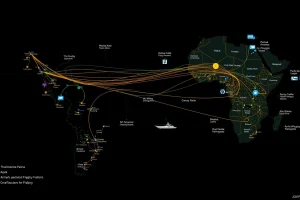
African and Southeast Asian military drone procurement is not a single market. It is a two-tier portfolio: imported medium-altitude long-endurance (MALE) ISR/strike UAVs for maritime patrol, border surveillance, and pipeline security, plus cheap, attritable small drones for tactical ISR and one-way attack. The Africa Center’s October 2026 brief finds that inexpensive attritable unmanned systems are giving nonstate actors an asymmetric advantage and reducing governments’ longstanding airpower edge; it also notes that African military drone capabilities remain concentrated on imported long-endurance platforms and that counter-unmanned aerial systems (C-UAS) capabilities are limited [1]. The Africa Center’s April 2025 proliferation map, drawing on Military Africa, the CNAS Drone Proliferation Dataset, and ACLED, lists 32 African states with acquired military drones, domestic production, or confirmed armed nonstate actor drone use [3]. In Southeast Asia, the April 2026 Defence Services Asia (DSA) exhibition in Kuala Lumpur showed vendors from Abu Dhabi to Pretoria competing for regional demand described by one exhibitor as very, very big [4].
| Metric | Africa | Southeast Asia | Read-through |
|---|---|---|---|
| Confirmed drone activity | 32 states on Africa Center map, covering military acquisition, production, and nonstate use [3] | DSA 2026 exhibitors and regional buyers signal active demand [4] | The market is broader than published contract awards. |
| Government tier 1 | Imported long-endurance MALE UAVs remain the core capability [1] | Regional militaries are evaluating UAVs at DSA [4] | Maritime, border, and pipeline persistence drives range requirements. |
| Conflict tier 2 | Commercial-derived small drones; Sahel groups rig DIY devices [2] | Cheap commercial drones and Shahed-type effects are cited as demand drivers [4] | Attritable systems change cost per effect, but not the need for wide-area persistence. |
| Cost posture | High-cost imported platforms plus cheaper disposable augmentation in Nigeria [2] | Price competition among vendors from Abu Dhabi to Pretoria [4] | Package financing, training, and munitions matter more than sticker price. |
| Range/endurance posture | Long-endurance MALE for wide areas; short-range tactical drones for units | MALE for maritime and border missions; small drones for local tactical use | The two tiers are complementary, not interchangeable. |
| C-UAS | Limited capabilities; layered defensive systems are an imperative [1] | Not detailed in the retrieved source [4] | C-UAS is the binding operational bottleneck. |
| Data anchor | Military Africa, CNAS Drone Proliferation Dataset, ACLED [3] | DSA 2026 exhibition reporting [4] | Procurement opacity remains high in both regions. |
For country-level benchmarking, analysts can use
to compare budget headroom, threat exposure, and procurement mix. The tool should be read alongside the qualitative tiers below because unit prices are rarely disclosed and package contents vary sharply.| Platform family | Typical role fit | Indicative cost tier | Range/endurance tier | Procurement caveat |
|---|---|---|---|---|
| Bayraktar TB2 | Medium-altitude ISR/strike; maritime and border patrol | Medium-high | Long-endurance MALE | Package price varies with sensors, munitions, ground stations, training, and financing. |
| Bayraktar Akinci | High-end MALE strike/ISR; maritime surveillance | High | Long-endurance MALE | Requires larger support, datalink, and sustainment footprint. |
| Wing Loong II | MALE ISR/strike; border and pipeline security | Medium | Long-endurance MALE | Export-finance terms and payload fit are decisive. |
| CH-4 | MALE ISR/strike; persistent surveillance | Medium | Long-endurance MALE | Sensor and munition configurations vary by buyer. |
| Anka | MALE ISR/strike; maritime and land surveillance | Medium-high | Long-endurance MALE | Indigenous Turkish supply chain can ease sustainment but not financing. |
| Hermes 450/900 | MALE/tactical ISR; border and force protection | Medium-high | Long-endurance MALE or tactical | Variant choice changes payload, endurance, and support requirements. |
| Commercial-derived small drones | Tactical ISR, one-way attack, local reconnaissance | Low | Short-range attritable | High attrition; vulnerable to jamming and C-UAS; limited persistence. |
These are ordinal tiers, not list prices. Publicly cited unit costs are not comparable because they bundle sensors, munitions, ground control stations, training, spares, and sovereign financing. Across African Southeast Asian military drone procurement, the binding constraint is not range alone; it is cost per persistent surveillance hour and cost per effect.
Three Structural Drivers
1. Economic driver: cost asymmetry now favors attritable mass
The economics of aerial advantage have shifted. Small unmanned systems are inexpensive and attritable, and their rapid diffusion has given nonstate actors an asymmetric advantage that reduces governments’ longstanding airpower edge [1]. The rational government response is not to abandon MALE UAVs but to tier the fleet: imported long-endurance platforms for maritime patrol, border surveillance, and pipeline security; cheaper tactical drones for local reconnaissance and one-way attack. Nigeria is the clearest example in the retrieved record, augmenting traditional surveillance and attack drones with cheaper, even disposable, technology [2]. The Sahel reinforces the point: jihadist groups are documented rigging DIY devices for combat, including suicide missions [2]. For finance ministries, the relevant metrics are cost per persistent surveillance hour and cost per attritable effect, not headline airframe price alone.
2. Technological driver: commercial diffusion outpaces C-UAS
The technological frontier is moving faster in small drones and counter-drone systems than in traditional airframes. The adaptation of commercial drones for combat, including suicide missions, was closely followed in the Russia-Ukraine war and has more recently been documented in West Africa’s Sahel region [2]. African military drone capabilities remain concentrated on imported long-endurance platforms, while C-UAS capabilities are limited [1]. That mismatch matters because MALE UAVs deliver persistence and payload but require airbases, datalinks, maintenance, and trained crews; small drones deliver local awareness at low cost but are spectrum-dependent, attrition-heavy, and vulnerable to jamming. The procurement race is therefore shifting toward layered C-UAS, electronic warfare, modular payloads, and local sustainment, not simply more airframes.
3. Policy driver: risk-based doctrine for maritime, border, and pipeline security
Policy demand is being shaped by three mission sets: maritime patrol and exclusive economic zone awareness, border surveillance in the Sahel and Horn of Africa, and pipeline or resource-corridor security. The Africa Center argues that African governments should adopt a risk-based doctrine for countering armed nonstate actor drone threats that combines layered C-UAS with conventional airpower and ground forces [1]. That doctrine should also guide procurement: a long-endurance MALE fleet is justified only where persistence over water, deserts, or pipeline corridors is operationally necessary; attritable drones are justified where attrition and local responsiveness dominate. In Southeast Asia, DSA 2026 demonstrated that defense ministries are buying in and that vendors are chasing market share aggressively [4]. The policy risk is fragmentation: too many platforms, incompatible datalinks, and insufficient training can erode the cost advantage of any tier.
Regional Winners, Bottlenecks & 2026–2030 Watchlist
Africa
- Nigeria: A hybrid procurement model is emerging, with traditional surveillance and attack drones augmented by cheaper, even disposable, systems [2]. The bottleneck is integration: tactical drones must feed joint fires, intelligence, and C-UAS without creating logistics clutter.
- Sahel states (Mali, Burkina Faso, Niger): Armed groups are rigging DIY drones, and the Africa Center map records confirmed nonstate drone use across the region [2][3]. The bottleneck is force protection and layered C-UAS at dispersed bases.
- Sudan: A drone-launched assassination attempt against the Sudanese Armed Forces leader on 31 July 2024 illustrates the command-security threat from precision aerial systems [3]. The bottleneck is airbase and VIP protection.
- Egypt, Algeria, Morocco, Ethiopia, Kenya, Somalia, Mozambique, Zambia, Burundi, Rwanda, Democratic Republic of the Congo, Angola, Botswana, South Africa, Madagascar, Djibouti and others: These states appear on the proliferation map with acquired drones, production, or nonstate activity [3]. Relative winners will be those that can finance sustainment and C-UAS, not merely acquire MALE platforms.
Southeast Asia
- Malaysia: The DSA 2026 host is a market hub, with vendors from Abu Dhabi to Pretoria chasing regional deals [4]. The bottleneck is converting exhibition interest into funded, interoperable programs.
- Regional buyers: Southeast Asian defense ministries are showing strong interest in UAVs, with cheap commercial drones and Shahed-type effects cited as demand drivers [4]. The bottleneck is fragmented demand and financing, which favors suppliers offering package deals and local assembly.
2026–2030 watchlist: first, layered C-UAS procurement will become as important as airframe acquisition [1]. Second, attritable drone assembly and localization will spread, especially where import dependence is politically costly. Third, MALE maritime-patrol configurations—radar, EO/IR, SATCOM, and maritime strike—will differentiate winners in Africa and Southeast Asia. Fourth, financing from Turkey, China, the UAE, Israel, and South Africa will shape market share. Fifth, export-control and datalink-security rules will determine which platforms can be sustained in contested environments.
Data & Methodology Note
Definitions. MALE UAV means a medium-altitude long-endurance unmanned aerial vehicle optimized for persistent ISR and, in strike variants, precision munitions. Attritable drone means a low-cost unmanned system designed to be expended or risked at high rates. C-UAS means counter-unmanned aerial systems, including kinetic, electronic, and layered detection capabilities. Range/endurance tiers are ordinal: long-endurance MALE for persistent wide-area coverage, medium tactical systems, and short-range attritable systems. Cost tiers are also ordinal because public unit prices are not comparable; they bundle sensors, munitions, ground stations, training, spares, and financing.
Caveats. The Africa Center map includes acquired military drones, domestic production, and confirmed armed nonstate actor use; it is not a count of formal procurement contracts [3]. Southeast Asia evidence here is exhibition-based and should be validated against national budget documents and contract notices [4]. Procurement opacity, dual-use commercial imports, nonstate attribution, and package pricing all limit cross-country precision. No exact unit-cost figures are asserted where the retrieved sources do not provide them.
Primary datasets. Drone-specific evidence draws on Military Africa, the CNAS Drone Proliferation Dataset, and ACLED as used by the Africa Center [3]. Macro affordability cross-checks should use World Bank World Development Indicators and IMF World Economic Outlook. Connectivity and telecom-adjacent infrastructure cross-checks should use TeleGeography where maritime or cable corridors intersect with drone patrol missions. The country-comparator tool can operationalize these indicators for budget headroom, threat exposure, and procurement mix.
Primary Sources & Official Citations
- Africa Center, Lessons from Africa’s Drone Wars — Primary policy brief on nonstate drone use, C-UAS gaps, and layered defense doctrine
- Africa Center, Military Drone Proliferation Marks Destabilizing Shift in Africa’s Armed Conflicts — Proliferation map and dataset references: Military Africa, CNAS, ACLED
- The Defense Post, African Militaries Eye Lighter, Cheaper Drones — Procurement trend and Nigeria/Sahel examples
- South China Morning Post, At Malaysia’s arms bazaar, drone dealers chase Southeast Asian market share — DSA 2026 exhibition reporting and regional demand signal
FAQ
Which is more cost-effective for African maritime patrol: MALE UAVs or small drones?
MALE UAVs remain more cost-effective for persistent wide-area maritime patrol because they provide endurance and payload capacity that small drones lack. Small attritable drones are better suited to short-range tactical reconnaissance and one-way attack; a layered fleet is usually more efficient than choosing one tier alone.
Why are African militaries buying cheaper drones?
The main driver is cost asymmetry. Inexpensive attritable systems have given nonstate actors an asymmetric advantage, reducing governments’ airpower edge. Nigeria is augmenting traditional surveillance and attack drones with cheaper, even disposable, technology, while Sahel groups are rigging DIY drones for combat.
What does DSA 2026 reveal about Southeast Asian drone demand?
The April 2026 Defence Services Asia exhibition in Kuala Lumpur showed vendors from Abu Dhabi to Pretoria competing for regional demand described as very large. Southeast Asian defense ministries are interested in UAVs, with cheap commercial drones and Shahed-type effects cited as demand drivers.



Leave a Reply