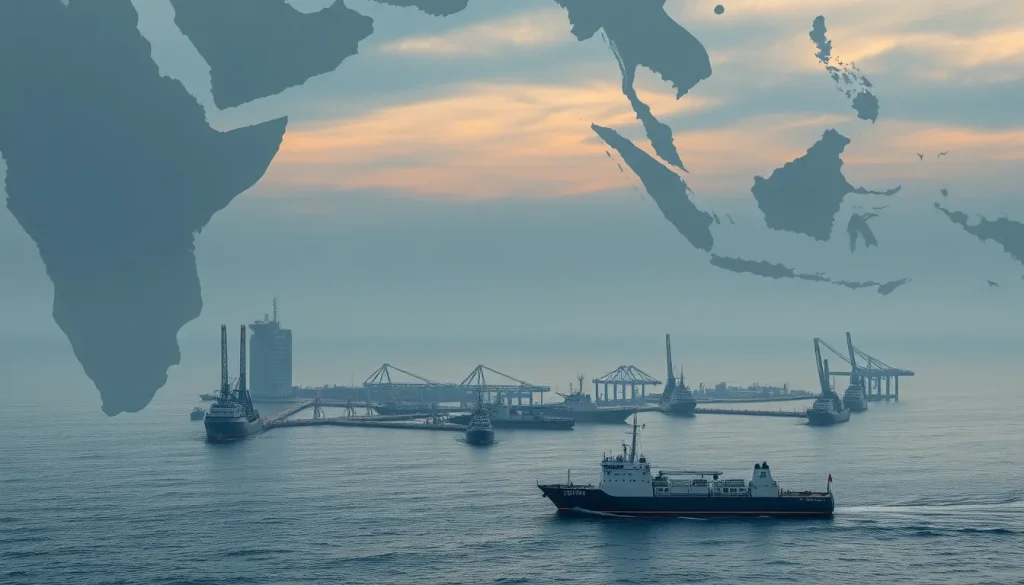
Short Answer
Bab el-Mandeb: ~10% of global oil; Hormuz/Malacca: ~34 million b/d
Key Takeaways
- Djibouti is the only confirmed Chinese overseas military base in the Indian Ocean (2017), positioned near Bab el-Mandeb, through which nearly 10% of global oil flows [1].
- Hambantota and Gwadar are commercial leases with latent dual-use potential, not formal PLAN bases; their strategic value is incremental logistics access rather than ready naval capability [2].
- Duqm and Diego Garcia provide assured deep-draft access and formal munitions/logistics, but Duqm is not a foreign base and Diego Garcia is military-only, so neither replaces commercial transshipment capacity [3][4].
Executive Verdict & Core Distinctions
This comparative matrix contrasts Option A, the China-linked commercial-naval port network anchored at Djibouti, Hambantota and Gwadar, with Option B, the partner/sovereign naval logistics model represented by Duqm and Diego Garcia. The distinction matters because the Indian Ocean dual-use ports commercial vs naval debate often conflates commercial throughput with military capability. Option A leads on commercial reach, financing speed and political leverage; Option B leads on assured naval access, munitions safety and interoperability.
Capacity and cost differ structurally. Option A aggregates multi-purpose berths, transshipment yards and free-zone land, financed through Chinese policy banks and state-owned enterprises under military-civil fusion (MCF) doctrine; public project estimates range from roughly $250m for Gwadar Phase I to more than $1.5bn for Hambantota. Option B is smaller in commercial terms but more secure militarily: Duqm is an Omani national megaport with strategic access, while Diego Garcia is a UK/US sovereign base with integrated fuel, airlift and ammunition storage. Strategic backing is therefore asymmetrical: Option A rests on Chinese SOEs and host-port concessions; Option B rests on Omani sovereign development, UK/US defense budgets and Indian naval access at Duqm.
The core verdict is that Djibouti is the only confirmed Chinese overseas military base in the Indian Ocean, established in 2017 near the Bab el-Mandeb Strait, through which nearly 10% of global oil flows [1]. Hambantota and Gwadar are not formal PLAN bases; their dual-use value is latent, incremental and legally ambiguous [2]. Duqm is a commercial port with strategic access rather than a foreign base, and Diego Garcia is military-only. For naval capability, Option B is more assured; for commercial scalability, Option A is more expansive; for escalation risk, Option A is more opaque.
Side-by-Side Technical Comparison
The matrix below compares design capacity, capital cost, timeline, route specifications and consortium backing. It also disaggregates the engineering variables that determine whether a commercial port can support naval replenishment: draft, berth length, turning circle, cold-ironing shore power, munitions safety arcs and replenishment logistics.
| Comparison axis | Option A: China-linked dual-use network (Djibouti, Hambantota, Gwadar) | Option B: Partner/sovereign naval hubs (Duqm, Diego Garcia) |
|---|---|---|
| Design capacity | Multi-purpose commercial berths, container and bulk transshipment; latent naval berthing at Djibouti; limited secure magazine space elsewhere. | Naval berths, fuel farms, airlift and ammunition storage; Duqm adds commercial bulk and liquid berths; Diego Garcia is military-only. |
| CapEx | Multi-billion-dollar aggregate; public estimates include Gwadar Phase I at roughly $250m and Hambantota above $1.5bn; financed by Chinese policy banks and SOEs. | Host-government and military construction; Duqm is a national megaproject with refinery and port investment; Diego Garcia is sustained by UK/US defense budgets. |
| Timeline | 2007-2020s: Gwadar Phase I from 2007; Hambantota construction from 2010 and 99-year lease in 2017; Djibouti base in 2017. | Diego Garcia from the 1970s; Duqm port from the 2010s, with Indian warship access expanding after 2018. |
| Route / specs | Bab el-Mandeb at Djibouti, south Asian transshipment at Hambantota, CPEC gateway at Gwadar. Draft above 14 m at Djibouti and Hambantota; Gwadar Phase I reported around 14.5 m. | Arabian Sea at Duqm; central Indian Ocean at Diego Garcia. Duqm around 18 m draft; Diego Garcia lagoon deep-water anchorage and 3,000 m-plus runway. |
| Consortium backing | Chinese SOEs including China Merchants Port, China Harbour and COPHC with host port authorities; Djibouti base under the PLA. | Oman government and Port of Duqm with international partners; UK/US sovereign base at Diego Garcia. |
| Berth length / turning | Doraleh multi-berth quay above 1,200 m; Hambantota initial quay around 600 m; Gwadar Phase I around 600 m. Turning basins constrained by harbor geometry and not publicly disclosed for naval use. | Duqm quay multi-kilometre with wide turning basin; Diego Garcia lagoon provides natural turning and anchorage. |
| Cold-ironing | Limited or none at most berths; not a design priority. | Limited at Duqm; military microgrid at Diego Garcia, but cold-ironing is not a naval requirement. |
| Munitions safety arcs | Not publicly documented except a secure PLA compound at Djibouti; latent dual-use raises ambiguity. | Formal magazines and quantity-distance arcs at Diego Garcia; Duqm remains a commercial port without foreign magazine. |
| Replenishment logistics | Fuel, water, food and limited repair at Djibouti; Hambantota and Gwadar lack integrated naval replenishment. | Integrated fuel, ammunition, airlift and secure communications at Diego Garcia; Duqm offers bunkering, dry dock and access. |
Several engineering caveats apply. Public berth and draft figures are approximations and vary by terminal phase. Naval turning circles and munitions quantity-distance arcs are rarely disclosed for dual-use facilities. Cold-ironing shore power is not a decisive differentiator in the Indian Ocean because few berths advertise it and naval hulls typically rely on onboard generation. The more binding constraints are draft, secure storage and dedicated logistics space.
Port-Level Engineering Profile
| Port | Berth and draft | Turning basin | Cold-ironing | Munitions and security | Replenishment role |
|---|---|---|---|---|---|
| Djibouti (Doraleh) | Multi-berth quay above 1,200 m; reported draft near 18 m | Harbor-limited; naval berth not publicly specified | Not standard | PLA base since 2017; secure compound; magazine details not public | Fuel, water, food and anti-piracy logistics; surveillance at Bab el-Mandeb |
| Hambantota | Initial quay around 600 m; reported draft around 16-17 m | Dredged basin; exact turning circle not public | No | Commercial perimeter; no formal magazine | Bunkering and transshipment; latent naval access under 99-year lease |
| Gwadar | Phase I three berths; reported draft around 14.5 m; quay around 600 m | Dredged approach; constrained by siltation | No | Pakistan Navy and security presence; no confirmed PLAN base | Minimal naval replenishment; commercial underutilized |
| Duqm | Deep draft around 18 m; multi-kilometre quay | Wide turning basin | Planned or limited | Commercial port; no foreign magazine; Indian warship calls | Bunkering, dry dock and logistics; strategic access without formal base |
| Diego Garcia | Lagoon anchorage; deep draft; airfield above 3,000 m | Natural lagoon turning | Military microgrid | Full magazines; formal safety arcs; secure perimeter | Integrated fuel, ammunition, airlift and communications |
Djibouti and Duqm provide the deepest reported commercial access, with drafts around 18 m at key berths; Gwadar Phase I is shallower at roughly 14.5 m, which limits large combatant access without dredging. Hambantota’s initial quay is shorter and its naval turning basin is not publicly specified. Diego Garcia is the outlier: its lagoon offers natural deep-water anchorage, while its airfield and magazines make it a fully integrated naval and air logistics hub rather than a dual-use commercial port.
Option A: Architecture, Strengths & Trade-Offs
Option A is an architecture of Chinese-financed commercial ports with latent naval utility. Djibouti is the hardened node: the PLA base established in 2017 sits near the Bab el-Mandeb chokepoint and has supported anti-piracy missions and amphibious training, signalling a shift toward power projection [1]. Hambantota, leased to Chinese interests for 99 years after a debt-distressed transfer, and Gwadar, the CPEC gateway port, are commercial concessions with dual-use potential rather than declared bases. The MCF doctrine links these commercial assets to national defense logistics, which is why India treats them as a logistical encirclement risk [2].
Technically, Option A’s commercial berths are optimized for bulk, container and transshipment cargo, not for magazine safety or secure naval segregated storage. Djibouti’s Doraleh complex offers over 1,200 m of quay and reported drafts near 18 m, sufficient for large combatants and amphibious ships. Hambantota’s initial quay is around 600 m with reported drafts in the 16-17 m range, but its turning basin and naval berth allocation are not publicly documented. Gwadar Phase I has three berths and a reported draft of about 14.5 m; the approach is dredged but siltation and a constrained turning circle limit sustained large-deck access. None of the three ports publicly advertises cold-ironing shore power as a standard service.
Munitions safety is the weakest disclosed link. Djibouti’s PLA compound almost certainly includes secure storage, but quantity-distance arcs and blast separation are not public. Hambantota and Gwadar have commercial perimeters and no publicly documented foreign munitions magazines. Replenishment logistics at Djibouti are more mature—fuel, water, food and limited repair support for anti-piracy deployments—while Hambantota and Gwadar remain commercially underutilized and lack integrated naval replenishment chains.
Strengths: Option A delivers rapid financing, sovereign-backed construction, transshipment capacity and political leverage at chokepoints. It creates a scalable logistics skeleton that can be militarized incrementally without formal basing. Trade-offs: commercial viability at Hambantota and Gwadar is weak, debt and sovereignty costs are high, legal status is ambiguous, and the security dilemma for India is acute. The architecture also lacks the formal munitions safety, interoperable command systems and assured fuel and airlift integration of a dedicated naval base.
Option B: Architecture, Strengths & Trade-Offs
Option B separates commercial and military functions more cleanly. Duqm is Oman’s deep-water commercial and industrial port on the Arabian Sea, with a multi-kilometre quay, reported drafts around 18 m, a dry dock and bunkering capacity. It is not a foreign base. India has arranged warship calls at Duqm as a counterweight to Chinese port influence, while some analysts view Chinese interest in Duqm as a potential military foothold; field research indicates the port remains commercially governed and sovereign Omani [3]. Diego Garcia, by contrast, is a UK/US sovereign base in the Chagos Archipelago with a deep lagoon, a 3,000 m-plus runway, fuel storage and formal munitions magazines. It is military-only and has no commercial dual-use overlay.
Technically, Duqm’s value lies in deep draft, long quay and a wide turning basin that can accommodate large vessels without the harbor constraints of Hambantota or Gwadar. Its cold-ironing offering is limited or planned rather than standard. Munitions safety arcs are governed by commercial port rules, not foreign naval magazines, which limits its use as a full ammunition replenishment hub. Its replenishment role is therefore fuel, water, provisions, dry-docking and access, not integrated weapons handling. Diego Garcia provides the full package: lagoon anchorage, secure magazines, quantity-distance arcs, fuel farms, airlift and communications. Cold-ironing is irrelevant to its naval mission because the base generates and manages its own power.
Strengths: Option B offers assured access, deep draft, interoperable logistics, formal munitions safety and political signalling. Duqm gives partners a sovereign-hosted hedge without a formal base; Diego Garcia gives the UK and US an irreplaceable central Indian Ocean node. Trade-offs: Duqm is politically constrained by Oman’s balancing posture and is not a commercial transshipment substitute for Hambantota or Gwadar. Diego Garcia is military-only, politically contested on sovereignty grounds and unavailable for commercial diversification. Option B also carries higher fixed security costs and narrower commercial spillovers than Option A.
Strategic Outlook: Which Scenario Matters Most
For shippers, the relevant comparison is not whether a port can host a warship, but whether dual-use ambiguity raises insurance, compliance and schedule risk. Option A offers more commercial capacity and transshipment options, but Hambantota and Gwadar are underutilized and politically exposed; Djibouti is a hardened security node. Option B is not a commercial alternative: Duqm can handle commercial and naval traffic, but Diego Garcia cannot substitute for container or bulk transshipment. The chokepoint math remains decisive: Bab el-Mandeb carries nearly 10% of global oil [1], while Hormuz and Malacca together move around 34 million barrels of crude and petroleum products daily [4].
For operators, berth selection should turn on draft greater than 14 m, berth length, turning circle, secure storage and replenishment chain—not cold-ironing. Djibouti and Duqm meet the draft threshold at key berths; Gwadar Phase I is marginal without dredging; Hambantota is commercially sized but navally opaque; Diego Garcia is fully integrated but inaccessible commercially. Munitions safety arcs are the sharpest differentiator: only Diego Garcia publicly operates formal naval magazines in this set, while Djibouti’s PLA compound is a security black box and the commercial ports lack documented foreign ammunition storage.
For policymakers, the scenario that matters most is grey-zone dual-use: China gains incremental logistics access at Hambantota and Gwadar without declaring bases, while Djibouti remains the hardened node. That scenario erodes India’s deterrence and raises risk premiums more than a formal base at every port would. The counter-scenario is partner assured access at Duqm and Diego Garcia, which preserves naval replenishment but does not replace commercial transshipment. The practical policy implication is to separate commercial port governance from naval access agreements, harden munitions and fuel logistics where formal basing exists, and treat dual-use ambiguity as a pricing and deterrence variable rather than a binary base/no-base question.
Primary Sources & Official Citations
- Australian Institute of International Affairs – Harbors of Power — Analysis of China’s African port dual-use network and Djibouti base
- CENJOWS – From Commerce to Control — Military-civil fusion and dual-use port doctrine
- MEIJ – Geopolitical Implications of Oman Duqm Port — Field research on Duqm port and India-China competition
- Carnegie Endowment – Great Game in the Indian Ocean — Chokepoint and trade-flow context
FAQ
What distinguishes a dual-use port from a naval base?
A naval base has formal basing rights, dedicated command, secure munitions storage and host-nation defense agreements. A dual-use port remains commercially governed but has berths, draft and logistics that can support naval vessels episodically or incrementally without declared basing.
Which Indian Ocean port offers the deepest draft for naval replenishment?
Publicly reported drafts at Djibouti’s Doraleh complex and Oman’s Duqm are around 18 m, while Diego Garcia offers deep lagoon anchorage. Gwadar Phase I is shallower at roughly 14.5 m, and Hambantota is reported around 16-17 m.
Why is cold-ironing shore power not a decisive factor for Indian Ocean dual-use ports?
Few berths in the region advertise cold-ironing, naval hulls typically generate their own power, and the binding naval constraints are draft, turning circle, secure storage, fuel and ammunition logistics rather than shore electricity.

Leave a Reply