
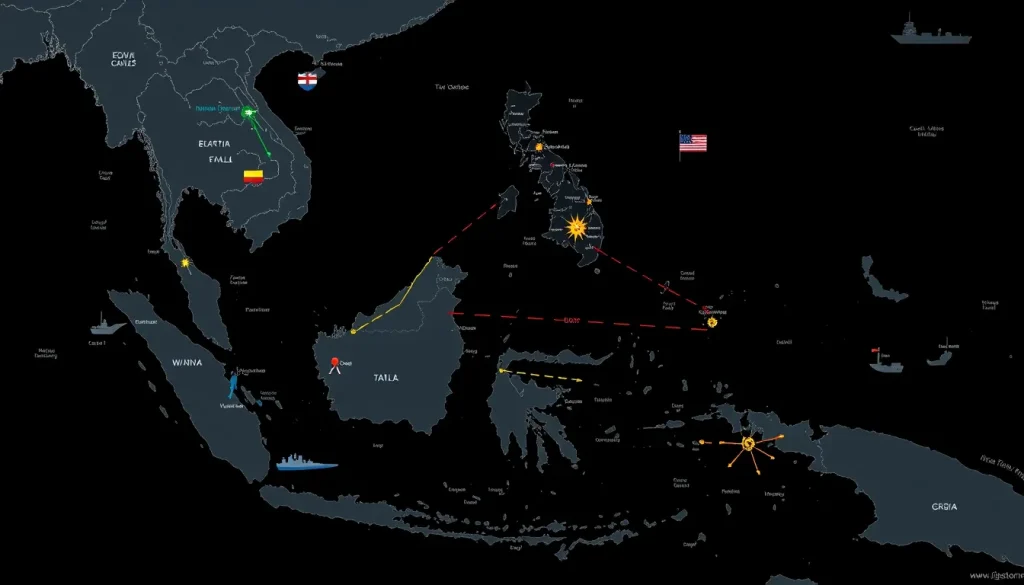
Short Answer
Key Takeaways
- Coast guards have become the primary agencies for non-military maritime security in Southeast Asia, with investments rising significantly since 2019 (Wilson Center, 2019).
- In the South China Sea, coast guards enable states to protect maritime resources and assert claims without militarising disputes, thanks to their law-enforcement mandate and lower escalation risk (RSIS, 2022).
- Blue-water navies remain essential for deterrence and sea control, but their high cost and long procurement timelines make them less suitable for daily grey-zone patrols.
Executive Verdict & Core Distinctions
The choice between coast guards and blue-water navies in Southeast Asia is not binary but a matter of specialisation. Coast guards are maritime law enforcement agencies (MLEAs) with constabulary mandates: they enforce fisheries, customs, and immigration laws, conduct search and rescue, and increasingly patrol disputed waters. Blue-water navies are military instruments designed for sea control, deterrence, and power projection. In capacity terms, coast guard vessels are smaller—typically 50–150 metres and 500–4,000 tonnes—and lightly armed, while blue-water frigates and destroyers exceed 3,000 tonnes and carry anti-ship missiles, air-defence systems, and anti-submarine weapons. Cost structures diverge sharply: a coast guard offshore patrol vessel (OPV) may cost tens of millions of US dollars, whereas a naval frigate can exceed US$200 million, with lifecycle costs several times higher. Procurement timelines also differ: coast guard vessels can be acquired in one to three years, often through foreign donations or commercial shipyards, while naval warships take five to ten years from contract to commissioning. Strategic backing reinforces these roles: coast guards in the Philippines, Vietnam, Indonesia, and Malaysia have received vessels and training from the United States, Japan, and Australia, whereas navies depend on domestic defence budgets and alliance frameworks. The result is a division of labour: coast guards handle daily grey-zone patrols and constabulary tasks, while navies provide the ultimate deterrent.
Side-by-Side Technical Comparison
| Dimension | Coast Guard (Option A) | Blue-Water Navy (Option B) |
|---|---|---|
| Design Capacity | Hull sizes typically 50–150m, 500–4,000 tonnes. Examples: Philippines PCG operates former US Coast Guard Hamilton-class cutters (~3,250t) and Japan-built Parola-class OPVs (~320t); Vietnam Coast Guard has DN-2000 (~2,000t) and ex-US Hamilton-class CSB 8021; Indonesia’s Bakamla operates 80m OPVs; Malaysia’s MMEA has 83m New Generation Patrol Craft. Armament: light guns, water cannon, small arms. | Hull sizes typically 100–150m, 2,000–6,000 tonnes. Examples: Philippines’ Jose Rizal-class frigates (~2,600t); Vietnam’s Gepard-class frigates (~2,100t); Indonesia’s Sigma-class corvettes (~1,700t); Malaysia’s Maharaja Lela-class frigates (~3,000t). Armament: anti-ship missiles, surface-to-air missiles, torpedoes, naval guns. |
| CapEx | OPV: ~US$10–50 million per vessel; often offset by foreign grants (e.g., US Excess Defense Articles, Japan’s Official Development Assistance). | Frigate: ~US$200–800 million per vessel; lifecycle costs (crew, fuel, maintenance) multiply acquisition cost by 3–5x. |
| Timeline | 1–3 years from order to delivery; donations can be faster. | 5–10 years from contract to commissioning; complex systems integration adds delay. |
| Route/Specs | Operating range: 1,000–5,000 nautical miles; designed for EEZ patrol, sea state 4–6; helicopter deck on larger OPVs. | Operating range: 4,000–8,000 nautical miles; designed for blue-water operations, sea state 6–8; hangar and aviation facilities. |
| Consortium Backing | Diverse: commercial shipyards (e.g., Japan’s JMU, Damen, Austal), foreign aid programmes (US Coast Guard transfer, Japan’s ODA), domestic yards in Indonesia and Malaysia. | State-owned defence conglomerates: Naval Group, Fincantieri, Damen, Hanwha, or domestic defence industries; government-to-government deals with transfer of technology. |
Note: Figures are indicative and vary by configuration and contract terms. The table highlights structural differences rather than precise prices.
Option A: Architecture, Strengths & Trade-Offs
Coast guards in Southeast Asia are organised as civilian or hybrid law-enforcement agencies. The Philippines Coast Guard (PCG) is under the Department of Transportation and has increasingly taken the lead in South China Sea patrols, often confronting Chinese maritime militia and coast guard vessels. Vietnam Coast Guard (VCG) operates under the Ministry of National Defence but performs law-enforcement functions, blurring the line between constabulary and military roles. Indonesia’s Bakamla (Badan Keamanan Laut) is a coordinating agency that brings together the Navy, police, and fisheries ministry, while operational assets are often held by other agencies. Malaysia’s Maritime Enforcement Agency (MMEA) is a civilian agency under the Home Ministry, focused on fisheries, smuggling, and border protection.
Rules of engagement for coast guards emphasise minimum force, boarding, warning shots, and non-lethal measures such as water cannon. This legal framing is crucial: it allows states to assert sovereignty and protect resources without triggering military escalation. As the RSIS commentary notes, the increasing prevalence of grey-zone tactics makes coast guards a valuable instrument that allows states to protect maritime resources without militarising disputes [2]. The Wilson Center similarly observes that Southeast Asian states have significantly increased investments in coast guards and other MLEAs, recognising their utility in wider regional stability [1]. Morris (2017) describes coast guards as ‘blunt defenders of sovereignty’—less escalatory than navies but still assertive [4].
Strengths of the coast guard model include lower escalation risk, legal clarity as law enforcement, cost-effectiveness, rapid procurement, and the ability to accept foreign donations. The PCG, for example, received former US Coast Guard cutters and Japan-built OPVs, boosting its presence without a major defence budget outlay. The VCG has received US Hamilton-class cutters and Japanese patrol vessels. Indonesia and Malaysia have built OPVs domestically with foreign design input.
Trade-offs are equally clear. Coast guard vessels are lightly armed and cannot deter conventional military threats. They are vulnerable to armed aggression and lack the sensors and weapons for high-intensity conflict. In wartime, their command arrangements may be unclear, and they may be expected to support naval operations without adequate protection. Moreover, coast guard expansion can still escalate tensions—grey-zone confrontations between coast guards can be dangerous, as seen in the South China Sea.
Option B: Architecture, Strengths & Trade-Offs
Blue-water navies are organised as military forces under defence ministries, with centralised command and warfighting mandates. They operate frigates, corvettes, destroyers, and submarines equipped with advanced sensors, anti-ship missiles, surface-to-air missiles, and anti-submarine weapons. In Southeast Asia, navies such as the Philippine Navy, Vietnam People’s Navy, Indonesian Navy, and Royal Malaysian Navy are modernising, but at a slower pace than coast guards.
Strengths of the navy model include deterrence, sea control, defence against invasion, and power projection. Navies signal resolve and can respond to conventional threats. They are essential for protecting sea lines of communication and for participating in alliance operations. However, their high cost and long procurement timelines make them less suitable for daily grey-zone patrols. A single frigate costs hundreds of millions of dollars and takes years to deliver, tying up resources that could fund multiple coast guard vessels. Navies also carry greater political sensitivity: deploying a warship to a disputed area is a stronger signal than sending a coast guard cutter, and it raises the risk of escalation.
In grey-zone scenarios, navies are often held back to avoid provocation. Coast guards, by contrast, are the preferred instrument for presence and assertion. As Tarriela argues, coast guards allow states to protect maritime resources without militarising disputes [2]. This does not make navies obsolete; rather, it creates a layered maritime strategy. Navies provide the ultimate guarantee, while coast guards do the daily work.
Strategic Outlook: Which Scenario Matters Most
For shippers and operators, the coast guard vs. navy distinction has practical implications. Coast guards are the primary responders to piracy, armed robbery, fisheries disputes, and search-and-rescue incidents. In the Malacca Strait, the Philippines’ Sulu Sea, and the South China Sea, coast guard presence directly affects insurance premiums, route security, and port delays. Navies provide the overarching security umbrella but are rarely the first responder to civilian maritime incidents.
For policymakers, the key insight is that grey-zone competition favours coast guards. China’s maritime militia and coast guard have been the tip of the spear in the South China Sea, and Southeast Asian states have responded by bolstering their own coast guards. The Philippines has been most active in publicising coast guard confrontations, while Vietnam has used its coast guard to assert sovereignty in the Paracels and Spratlys. Indonesia’s Bakamla coordinates patrols in the North Natuna Sea, and Malaysia’s MMEA enforces claims in the Luconia Shoals.
The scenario that matters most is a prolonged grey-zone standoff. In this scenario, coast guards are indispensable: they provide persistent presence, legal manoeuvrability, and lower escalation risk. Navies remain critical for deterrence and for responding to conventional threats, but they are not a substitute for coast guard constabulary work. The optimal approach is a hybrid fleet: coast guards for daily patrols and law enforcement, navies for deterrence and warfighting. This division of labour is already emerging across Southeast Asia, driven by cost, politics, and the nature of maritime disputes.
Primary Sources & Official Citations
- Managing the Rise of Southeast Asia’s Coast Guards — Primary analysis of regional coast guard investments
- The Maritime Security Roles of Coast Guards in Southeast Asia — RSIS commentary on coast guard roles and grey-zone tactics
FAQ
What is the main difference between a coast guard and a blue-water navy in Southeast Asia?
Coast guards are law enforcement agencies focused on non-military threats and grey-zone operations, while blue-water navies are military forces designed for sea control and deterrence. Coast guards typically operate smaller, lightly armed vessels and have rules of engagement that emphasise minimum force.
Why are Southeast Asian states investing more in coast guards?
States are investing in coast guards to protect maritime resources, counter grey-zone tactics, and assert sovereignty without militarising disputes, as coast guard actions are framed as law enforcement rather than military escalation (RSIS, 2022).
Which countries have the most active coast guards in Southeast Asia?
The Philippines Coast Guard (PCG), Vietnam Coast Guard (VCG), Indonesia's Bakamla, and Malaysia's Maritime Enforcement Agency (MMEA) are among the most active. Each has distinct mandates: the PCG is civilian-led, the VCG is under the Ministry of Defense, Bakamla coordinates maritime security, and MMEA is a civilian law enforcement agency.
Leave a Reply