
Short Answer
90 million tonnes cumulative cargo; 21 million tonnes cross-border; RMB100.4 billion foreign-trade value
Key Takeaways
- By August 2026 the railway had carried over 90 million tonnes of cargo, including more than 21 million tonnes cross-border; October 2026 reporting put import-export goods at 20.77 million tonnes worth over RMB100.4 billion [1][3].
- 2025 cross-border freight reached 5.46 million tonnes, up 14% year on year; 2026 year-to-date freight exceeded 10 million tonnes by 13 June, with cross-border freight above 2.5 million tonnes and average daily freight of 67,000 tonnes [4][5].
- The corridor now connects 19 countries and regions and 31 Chinese provinces, but the Vientiane South/Thanaleng gauge-break into Thailand remains the main downstream capacity bottleneck [1][3][5].
Chronological Milestone Timeline
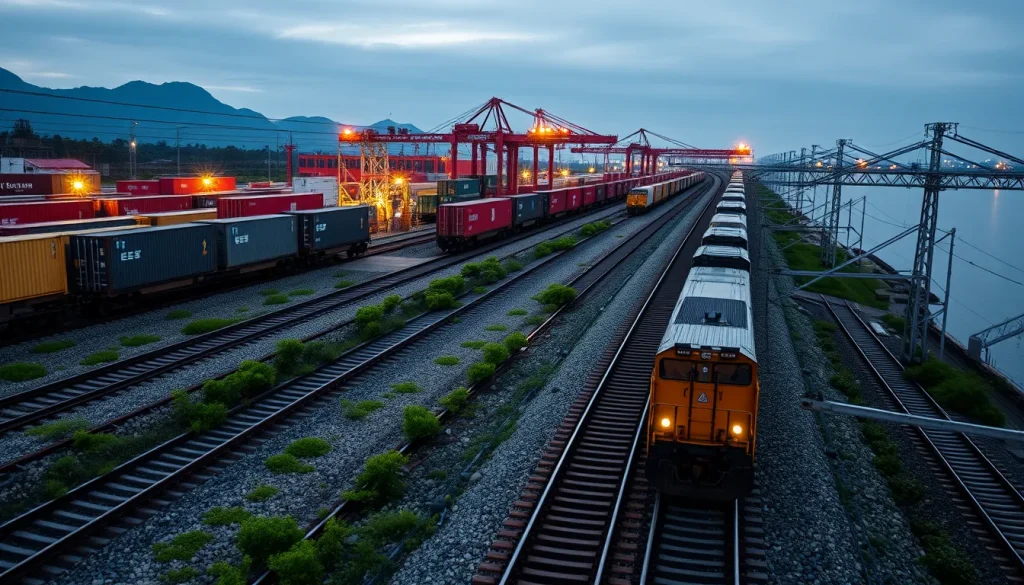
The China–Laos Railway is an operating cross-border rail corridor, not a speculative project. It links Kunming in Yunnan with Vientiane and has moved from a bilateral construction venture into a freight artery whose 2026 statistics are now the main indicator of China–ASEAN overland trade. The chronology below separates established project phases from the freight milestones disclosed in 2026 official releases.
| Date / phase | Milestone | Tracker read-across |
|---|---|---|
| 2010–2015 | Feasibility, bilateral framework and alignment finalisation. | Project advanced from a bilateral concept to a joint-venture and construction-ready corridor. |
| 2015–2016 | Financing framework, joint-venture arrangements and construction launch in December 2016. | Financial close at tranche level is not disclosed in retrieved official freight releases; the project moved into civil works. |
| 2017–2021 | Civil works, tunnels, bridges, track-laying and electrification. | Mountainous terrain and cross-border coordination drove the construction schedule. |
| December 2021 | Revenue service / RFS achieved; Kunming–Vientiane link opens. | RFS target met; the corridor becomes operational [1][3]. |
| 28 March 2025 | China–Laos–Thailand–Cambodia multimodal freight train launched from Kunming [2]. | Onward multimodal connectivity extends beyond the bilateral China–Laos segment. |
| 2025 | Cross-border freight reaches 5.46 million tonnes, up 14% year on year [5]. | Growth confirms cross-border demand and commodity diversification. |
| 13 June 2026 | 2026 freight volume exceeds 10 million tonnes; cross-border freight above 2.5 million tonnes; average daily freight 67,000 tonnes [4]. | Run-rate indicates another record year. |
| 18 August 2026 | Cumulative cargo passes 90 million tonnes; cross-border cargo above 21 million tonnes; over 80,000 freight trains and over 23,000 cross-border trains [3]. | Peak daily cross-border trains reach 23; maximum haul per train rises from 2,000 to 2,800 tonnes [3]. |
| 8 October 2026 | Import-export goods reach 20.77 million tonnes worth over RMB100.4 billion; more than 25,000 international freight trains; 19 countries and regions connected [1]. | Trade value and network reach become the headline indicators. |
| November 2026 | Operational status maintained. | Tracker focus shifts to Vientiane South transshipment capacity, cold-chain handling and debt-service risk. |
The 90 million tonne total and the 20.77 million tonne import-export figure use different statistical scopes: total railway cargo versus import-export goods. Analysts should not treat them as interchangeable, but together they confirm that the corridor is now a high-volume operating system rather than a pilot service.
Consortium, Operators & Financing Breakdown
The project is structured as a bilateral joint venture rather than a multilateral concession. The Government of Laos and Chinese state-linked railway sponsors anchor the Laos–China Railway Co., Ltd. project company. China Railway Kunming Group is the operational entity cited in 2026 freight disclosures, including the 90 million tonne and 67,000 tonne daily figures [3][4]. The arrangement gives China a long-term operating and logistics role while giving Laos a sovereign equity stake and transit-revenue exposure.
EPC delivery was led by Chinese state railway construction and design entities under the bilateral framework. The retrieved 2026 official freight releases do not list contract packages, EPC award values or the precise split between civil works, rolling stock and signalling contracts. That is a data gap for contract-level tracking, not evidence that the works were unstructured.
On financing, established reporting places project cost at roughly US$5.9 billion, with Chinese policy-bank lending as the dominant external debt source and Lao counterpart equity or in-kind support as the sovereign contribution. No multilateral DFI tranche is identified in the 2026 official freight releases, and tranche-level interest rates, grace periods and repayment schedules are not disclosed there. The debt structure should therefore be tracked as a separate sovereign-risk workstream: freight tonnage growth improves the corridor’s economic case, but it does not by itself resolve debt-service or refinancing questions.
Engineering Specs & Route Bottlenecks
The China–Laos Railway is a 1,435 mm standard-gauge, electrified railway. It is technically compatible with China’s national rail network but not with Thailand’s metre-gauge system. The route runs from Kunming through Yunnan’s mountainous border zone to Vientiane; the Lao section required heavy tunnelling and bridge works, which raises maintenance and resilience costs in a landslide- and flood-prone environment.
Freight capacity is improving. Maximum haul per train has risen from 2,000 to 2,800 tonnes, and daily cross-border freight trains have reached a peak of 23 [3]. In 2026, average daily freight volume exceeded 67,000 tonnes [4]. Those figures show that the constraint is shifting from line-haul capacity to border, terminal and transshipment capacity.
The key bottleneck is the gauge break at Vientiane South/Thanaleng. Standard-gauge containers and bulk cargo must be transloaded onto Thailand’s metre-gauge network for onward flows to Thailand, Malaysia and Singapore. Transshipment adds handling cost, dwell time and terminal-capacity risk. Customs clearance and cold-chain services have improved, supporting rising Southeast Asian tropical fruit imports and high-tech and mechanical-electrical exports [1], but cold-chain plug capacity, phytosanitary inspection and container yard throughput remain operational pinch points.
Commodity handling is also widening. Cross-border goods have expanded from a small initial list to more than 3,800 categories, including electronics, photovoltaic products and cold-chain fruits [5]. Potash is an emerging Lao bulk export that can improve backhaul economics, but the 2026 official freight releases do not disaggregate potash tonnage. Potash should therefore be tracked through mining-export and border-customs datasets rather than inferred from total railway cargo.
Economic & Geopolitical Significance
The corridor’s economic impact is now measurable in three layers. First, volume: cumulative cargo passed 90 million tonnes by August 2026, with cross-border cargo above 21 million tonnes [3]. Second, trade value: import-export goods reached 20.77 million tonnes worth over RMB100.4 billion by October 2026 [1]. Third, network reach: the railway connects 19 countries and regions [1][3] and serves 31 Chinese provinces and 19 Belt and Road partner countries [5].
For Laos, the railway converts a landlocked economy into a land-linked transit and export platform. Tropical fruit, rubber, minerals and potash can move to Chinese and wider ASEAN markets, while Chinese machinery, electronics and photovoltaic products move south. For China, the corridor diversifies overland access to Southeast Asia and supports Yunnan’s logistics and industrial clustering. For the wider region, the March 2025 China–Laos–Thailand–Cambodia multimodal train shows how the standard-gauge line can feed onward road and metre-gauge networks [2].
The strategic significance is not only commercial. The railway is a flagship of the Trans-Asian Railway and Belt and Road connectivity in Southeast Asia, and it strengthens China–ASEAN supply-chain integration in agricultural cold chains, consumer goods and critical minerals such as potash. The main geopolitical risk is financial rather than engineering: Laos carries sovereign exposure to the project, and debt-service pressure can complicate the political economy of expansion. The main operational risk is the Vientiane South gauge-break, which caps the corridor’s ability to convert China–Laos tonnage into seamless China–Thailand–Malaysia–Singapore freight.
For 2026–2028, the tracker should monitor four indicators: cross-border tonnage growth against the 2025 baseline of 5.46 million tonnes [5]; cold-chain fruit volumes and phytosanitary clearance times; potash and bulk-mineral export tonnage; and terminal capacity at Vientiane South and Thanaleng. The China Laos Railway freight volume impact is therefore best read as a logistics-capacity story with a sovereign-debt overlay, not as a simple construction milestone.
Primary Sources & Official Citations
- Embassy of the People's Republic of China in Laos — China–Laos Railway registers over 100 billion yuan in foreign trade value — October 2026 official trade, train-count and network statistics
- China Railway — China–Laos Railway Freight Volume Exceeds 10 Million Tons This Year — June 2026 year-to-date freight and daily average
- China Railway — China–Laos Railway Surpasses 18 Million Tons in Freight Volume — 2025 cross-border freight, commodity mix and provincial coverage
FAQ
How much cargo has the China–Laos Railway carried?
Over 90 million tonnes cumulatively by August 2026, including over 21 million tonnes cross-border; October 2026 reporting put import-export goods at 20.77 million tonnes worth over RMB100.4 billion [1][3].
Where does the China–Laos Railway meet Thailand’s metre-gauge network?
At the Vientiane South/Thanaleng logistics interface, where standard-gauge freight is transshipped onto metre-gauge services for Thailand and onward Southeast Asia.
What is the China–Laos Railway’s financing structure?
It is held through the Laos–China Railway Co. joint venture, with Chinese policy-bank debt and Lao sovereign/equity participation; detailed tranche terms are not disclosed in 2026 official freight releases.





Leave a Reply