Short Answer
Key Takeaways
- Nigeria's domestic cloud market is projected to triple to US$3.28 billion by 2030, driven by the National Digital Cloud Policy and mandatory local hosting rules effective 1 January 2027.
- The National Cloud Computing Guideline 2026 applies to federal, state, and local government entities, cloud service providers, and data centre operators, with enforcement by NITDA under the NITDA Act 2007.
- Sovereign cloud mandates in Nigeria, South Africa, Indonesia, and Saudi Arabia respond to jurisdictional subpoena risks such as the US CLOUD Act, while hyperscaler regions in Johannesburg, Jakarta, Mumbai, and Riyadh signal market adaptation.
Scope & Who It Applies To
Nigeria’s National Digital Cloud Policy, unveiled in August 2026, and the National Cloud Computing Guideline 2026 (effective 1 January 2027) establish a mandatory framework for cloud adoption and data hosting across the public sector. The guideline’s target audience is broad: Federal Public Institutions (FPIs), State Governments, Local Governments, Cloud Service Providers, Data Centre Operators, ICT Service Providers, Service Integrators, Professional Bodies, Development Partners, and other organisations within scope [3].
Foreign cloud providers serving Nigerian public institutions or processing government data fall within the extraterritorial reach of the guideline. To comply, they may need to establish a local presence, partner with licensed data centre operators, or host data in certified sovereign cloud environments. Thresholds are expected to be defined by the National Data Classification & Localisation Framework, which categorises data by sensitivity and imposes corresponding hosting requirements [3]. The guideline also applies to private entities that contract with government agencies, effectively extending compliance obligations through procurement rules.
Smaller agencies and local governments may face phased implementation, with technical assistance and shared-service arrangements envisioned under the policy. However, the mandatory status of the guideline means that non-compliance can trigger enforcement action regardless of entity size or nationality.
Core Statutory Provisions (Clause Breakdown)
The guideline translates the policy objectives into operational mandates. Key provisions include:
- Data Localisation: Government data classified as restricted or confidential must be stored and processed within Nigeria, preferably in sovereign cloud infrastructure. The National Digital Cloud Policy explicitly seeks to “establish proportionate safeguards for government and regulated data” [1].
- Licensing and Registration: Cloud service providers and data centre operators must register with NITDA and demonstrate compliance with local hosting, security, and resilience standards. The guideline is mandatory, with enforcement status marked as such [3].
- Reporting and Audit: Providers must report cybersecurity incidents, submit to periodic audits, and maintain logs accessible to regulators. These obligations mirror the NITDA Act 2007’s broader compliance powers.
- Tax and Investment Incentives: While the policy does not impose a specific cloud tax, it aims to attract investment through incentives and reduce capital flight by localising infrastructure spend [4].
Public-Sector Cloud Classification Tiers
The guideline references the National Data Classification & Localisation Framework, which is expected to define tiers such as public, internal, restricted, and confidential. Lower tiers may be hosted in commercial hyperscale clouds within Nigeria, while higher tiers require sovereign cloud environments—either government-owned data centres or certified domestic providers. This tiered approach allows agencies to adopt cloud services progressively while ensuring that sensitive data remains under national jurisdiction. The classification framework is not yet publicly detailed, but its inclusion as a related document signals that hosting obligations will be risk-based rather than one-size-fits-all [3].
Hyperscaler Cloud Regions and Sovereign Cloud
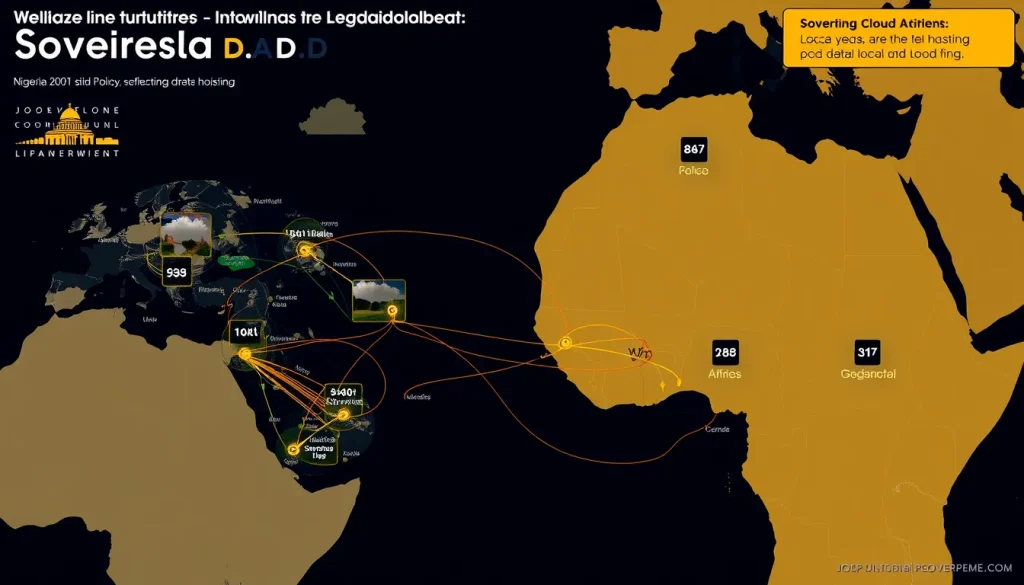
Hyperscaler regions in Johannesburg, Jakarta, Mumbai, and Riyadh illustrate how global cloud providers adapt to local data residency laws. These regions offer in-country hosting to satisfy government mandates, but they remain subject to the legal jurisdiction of the provider’s home country. Sovereign cloud initiatives go further by requiring data to be hosted by domestically controlled entities or in environments immune from foreign subpoenas. Nigeria’s policy positions the country as a “digital gateway for West and Central Africa” and aims to localise critical infrastructure to reduce capital flight and create jobs [4].
Jurisdictional Subpoena and the CLOUD Act
A central driver of sovereign cloud mandates is the risk of extraterritorial subpoenas, particularly under the US CLOUD Act, which allows US authorities to compel US-based cloud providers to disclose data stored abroad. For governments in emerging markets, this creates a conflict between local privacy laws and foreign legal demands. Sovereign cloud frameworks seek to mitigate this by ensuring that government data is held by entities not subject to foreign jurisdiction, or by requiring providers to challenge subpoenas and notify local authorities. Nigeria’s emphasis on “digital self-determination” reflects this concern [4].
Enforcement Bodies & Penalties
The National Information Technology Development Agency (NITDA) is the lead regulator, operating under the NITDA Act 2007. The guideline is mandatory, and NITDA has audit powers to verify compliance. Penalties for non-compliance are not specified in the public guideline, but the NITDA Act provides for administrative fines, sanctions, and potential licence revocation. Compliance timelines are phased: the guideline takes effect on 1 January 2027, giving providers and government agencies a transition period to migrate workloads and certify data centres. NITDA is expected to issue further implementation notes and a compliance checklist before the effective date.
Enforcement will likely begin with audits and remediation notices for non-compliant entities, followed by financial penalties for persistent breaches. The NITDA Act 2007 empowers the agency to impose fines on organisations that fail to comply with its guidelines, and the mandatory status of the 2026 guideline strengthens that authority. Foreign providers that do not establish a local presence or partner with certified data centres may be excluded from public-sector procurement.
Comparison With Neighboring Jurisdictions
The table below compares Nigeria’s framework with three peer emerging markets that have adopted data localisation or sovereign cloud rules.
| Jurisdiction | Localisation Requirement | Public-Sector Cloud Rules | Enforcement / Regulator | Key Hyperscaler Region |
|---|---|---|---|---|
| Nigeria | Restricted/confidential government data must be hosted locally; sovereign cloud preferred. | Mandatory guideline effective 1 Jan 2027; tiered classification. | NITDA; NITDA Act 2007. | No hyperscale region yet; sovereign cloud focus. |
| South Africa | No general localisation mandate; POPIA regulates cross-border transfers. | Government cloud policy encourages local hosting but not absolute. | Information Regulator; POPIA. | Johannesburg (Azure, AWS Cape Town). |
| Indonesia | Public electronic system operators must store data locally (GR 71/2019). | Government cloud (Kominfo) requires local data centres. | Kominfo (Ministry of Communication). | Jakarta (AWS, Azure, Google). |
| Saudi Arabia | Government data must be hosted locally; NDMO framework. | Sovereign cloud mandate for sensitive data. | National Data Management Office (NDMO). | Riyadh (AWS, Azure, Google). |
Note: India’s RBI mandates payment data localisation, and Mumbai hosts multiple hyperscaler regions. India’s draft data protection law also contemplates localisation for sensitive data, but enforcement varies by sector.
Nigeria’s approach is distinctive in combining a whole-of-government cloud policy with a mandatory guideline and a sovereign cloud initiative. South Africa relies more on cross-border transfer safeguards under POPIA, while Indonesia and Saudi Arabia have adopted explicit localisation for public-sector data. The presence of hyperscaler regions in Johannesburg, Jakarta, Mumbai, and Riyadh demonstrates that global providers can adapt to localisation mandates, but sovereign cloud requirements may push governments toward domestic providers or dedicated government clouds. Nigeria’s policy aims to replicate the hyperscaler-region model domestically by attracting investment into local data centres and positioning itself as a regional hub for West and Central Africa [2][4].
Primary Sources & Official Citations
- National Cloud Computing Guideline 2026 — Primary regulatory instrument with target audience, effective date, and enforcement status
- Federal Government Unveils National Digital Cloud Policy — Official policy announcement and objectives
FAQ
What is the effective date of Nigeria's National Cloud Computing Guideline 2026?
The guideline takes effect on 1 January 2027 and is mandatory for all covered entities.
Which regulator enforces Nigeria's cloud policy?
The National Information Technology Development Agency (NITDA) enforces the guideline under the NITDA Act 2007.
How does Nigeria's sovereign cloud initiative address jurisdictional subpoena risks?
By requiring sensitive government data to be hosted in domestically controlled environments, the initiative aims to reduce exposure to foreign legal orders such as those under the US CLOUD Act.










Leave a Reply