
Short Answer
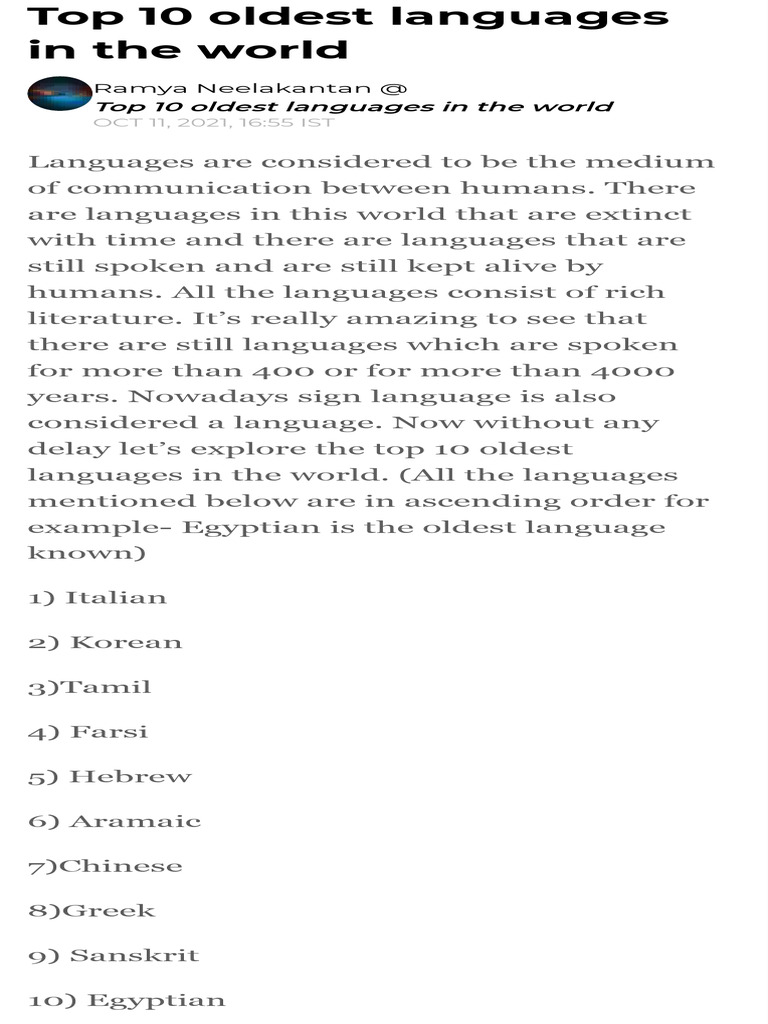
Humanity’s linguistic tapestry is rich and intricate, threaded with myriad languages that reveal the evolution of culture and thought. Among these, a select few languages have withstood the test of time, continuing to echo through the ages and spoken in various forms today. The concept of an “old” language fascinates us not just for its antiquity but for the insight it provides into the minds of those who came before us. Below, we explore the top ten oldest languages still in use today, intriguing relics that have survived countless transformations.
1. Hebrew
Firstly, Hebrew has shown incredible resilience. Once relegated to written scripture, it experienced a remarkable revival as a spoken language in the 19th and 20th centuries. This ancient tongue, with its roots tracing back over 3,000 years, is integral to Jewish identity and Israel’s national language. The interplay between its ancient texts and contemporary usage enriches both religious and secular dialogue.
2. Tamil
The Dravidian language of Tamil is another poignant example, stretching back at least 2,200 years. This language, predominantly spoken in India and Sri Lanka, boasts a literary tradition that includes both poetry and philosophy. Its preservation of classical poetry and modern prose creates a linguistic continuity that both honors its heritage and fosters innovation, igniting curiosity about how a language alive today still echoes its ancient origins.
3. Chinese (Mandarin)
Mandarin Chinese, with a written history exceeding 3,000 years, is an astonishing linguistic entity. While modern dialects may diverge, the roots of Mandarin remain readily traceable in contemporary calligraphy and phonetics. The subtle shifts in tones and characters reflect the dynamism of Chinese culture over millennia. To explore Mandarin is to traverse vast historical landscapes, resonating with the philosophies, poetry, and myriad experiences of a civilization.
4. Greek
Ancient Greek, a language that flourished more than 3,500 years ago, has profoundly influenced many modern languages. Present-day Greek, though altered by time, still maintains a remarkable connection to its classical predecessor. The rich lexicon and complex syntax of Greek continue to delight linguists and scholars alike, who marvel at its ability to articulate nuanced thought. The transition from Homeric epics to modern discourse invites a deeper understanding of cultural continuity through language.
5. Arabic
Arabic, spoken in various dialects across the globe, boasts a heritage that spans over 1,500 years. The language’s profound connection to Islam, as the language of the Quran, has elevated its status and preserved its classical form. Linguistically, Arabic serves as a bridge between numerous cultures, filled with poetic richness and intricate grammar. To study Arabic is to engage with centuries of philosophical discourse, scientific advancement, and vibrant storytelling.
6. Armenian
The Armenian language, whose history dates over 1,500 years, reflects the nation’s rich cultural tapestry. The unique alphabet developed by Mesrop Mashtots in the 5th century A.D. showcases both creativity and innovation. Despite geographically and politically tumultuous circumstances, Armenian has maintained its integrity as a living relic of its ancient past. The preservation of folklore and oral traditions in contemporary Armenian is a testament to its endurance.
7. Basque
Basque stands out uniquely among European languages, boasting a history steeped in mystery and defiance against assimilation. With roots that extend over 2,000 years, its non-Indo-European origins make it a linguistic anomaly. Surrounded by Romance languages, Basque survives due to the cultural pride and resilience of its speakers. Its persistence compels curiosity, inviting exploration into the historical events that shaped the region and its people.
8. Lithuanian
With an astonishing linguistic preservation dating back to 1,000 years, Lithuanian is often hailed as one of the most archaic living languages in Europe. Its grammatical structures and vocabulary provide a linguistic lens into the Proto-Indo-European roots, offering clues about the historical phonetic evolution of languages. The commitment of its speakers to retaining this unique linguistic heritage speaks volumes about cultural identity and pride.
9. Farsi (Persian)
Farsi, or Persian, has been spoken for over 2,500 years and remains a vital component of Iranian national identity. The beauty and complexity of its poetry are emblematic of its cultural significance, intertwining with the rich tapestry of Persian literature and philosophy. The modern evolution of Farsi preserves the echoes of its ancient form while accommodating contemporary society, further igniting fascination among those who seek to unravel its history.
10. Georgian
Finally, the Georgian language, with a cursive script developed over 1,500 years ago, highlights a unique blend of antiquity and modernity. Its melodious phonetics and distinctive grammar reflect the cultural crossroads of the Caucasus region. To communicate in Georgian today is to carry forward a linguistic tradition that has remained vibrant amidst the tumult of regional changes.
In conclusion, these ten languages offer a glimpse into humanity’s historical consciousness and cultural evolution. Each tongue tells a story—a narrative shaped by resilience and adaptation across centuries. Engaging with these languages enriches our understanding of the human experience and underscores the beauty of diversity. As we traverse the labyrinth of time through language, we discover not just words, but the invaluable connections that bind us, inspiring curiosity in the ways languages can thrive amid the changing winds of history.
FAQ
What criteria define the oldest languages still spoken today?
The oldest languages still spoken today are generally defined by their continuous use over centuries or millennia, historical documentation, and cultural significance that has kept them alive in spoken or written form.
Are these languages still spoken in their original forms?
Most of these languages have evolved over time, with modern forms differing from their ancient predecessors, but they maintain significant links to their historical roots.
Why is Hebrew considered a revived ancient language?
Hebrew was primarily a liturgical and literary language for many centuries before experiencing a successful revival as a spoken language in the 19th and 20th centuries, becoming Israel’s official language.
What makes Basque unique among European languages?
Basque is unique because it is a non-Indo-European language with origins that predate most other European languages, making it a linguistic isolate.






Leave a Reply