
Short Answer
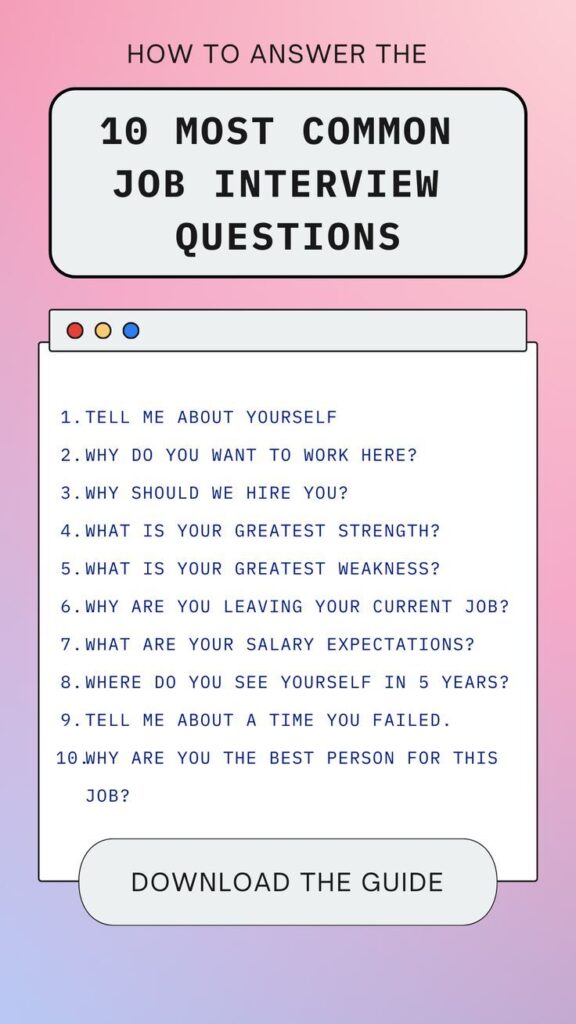
The proverbial job interview is akin to a delicate dance, where every step can either lead to a harmonious partnership or a painful misstep. Navigating this intricate ballet can be daunting for many. To succeed, one must not only understand the choreography of the questions posed but also respond with confidence and finesse. Here, we shall delve into the top ten most common interview questions, accompanied by strategic responses that exude both professionalism and authenticity.
1. Tell Me About Yourself
This question is often the opening gambit in an interview, serving as a warm-up exercise for both candidate and interviewer. The objective is to succinctly present a narrative that encompasses your professional journey. Begin by outlining your educational background, then transition to your relevant work experience, and finally, conclude with what brings you to this particular opportunity. A compelling response could be:
“I graduated with a degree in Marketing from XYZ University, where my passion for digital communications blossomed. Post-graduation, I immersed myself in a two-year role at ABC Corp, honing my skills in social media strategy. I’m particularly drawn to this position at your company because it aligns perfectly with my aspirations to innovate and drive brand engagement through creative campaigns.”
2. What Are Your Greatest Strengths?
This question invites you to tout your capabilities, but also requires a balance of humility. Aim to highlight strengths that are pertinent to the position while providing instances that showcase these attributes in action. A well-crafted response might be:
“One of my strongest attributes is my adaptability; I thrive in dynamic environments. During my tenure at ABC Corp, I took on diverse roles within a project, pivoting our approach when unexpected challenges arose, which ultimately led to a successful rebranding initiative.”
3. What Is Your Greatest Weakness?
Every hero has a flaw, and this question aims to reveal your self-awareness and willingness to improve. Choose a genuine weakness, but follow up with how you are actively working to mitigate it. A thoughtful answer could be:
“I tend to be detail-oriented, sometimes leading to analysis paralysis. However, I am learning to embrace the concept of ‘good enough’ to allow for timely decision-making without compromising quality. I’ve started setting tighter deadlines for myself in projects to enhance efficiency.”
4. Why Should We Hire You?
This question evokes the imagery of a sales pitch where you are the product, and you must highlight your unique value proposition. Tailor your response to align your skills with the company’s needs, articulating how you can contribute to their success. An ideal response might be:
“With my robust background in data analytics and a proven track record in driving actionable insights, I believe I can significantly contribute to your team’s goals. Moreover, my innovative mindset allows me to approach problem-solving creatively, which I understand is invaluable in your fast-paced environment.”
5. Where Do You See Yourself in Five Years?
This inquiry demands foresight and ambition. Interviewers look for candidates whose aspirations resonate with the company’s trajectory. A well-considered response could be:
“In five years, I envision myself in a leadership role within this company, spearheading projects that align innovation with our core values. I’m eager to cultivate skills that will prepare me for such opportunities, and I am particularly excited about your company’s commitment to professional development.”
6. Tell Me About a Challenge or Conflict You’ve Faced at Work and How You Dealt with It
Here lies an opportunity to weave a narrative that demonstrates your conflict resolution abilities and resilience. Use the STAR (Situation, Task, Action, Result) method to structure your answer. A compelling story might be:
“In a previous role, we faced a significant software issue that delayed our project timeline. I coordinated a cross-department meeting, where we collaborated to troubleshoot the problem. By fostering open communication between teams, we resolved the issue and delivered the project on time, which resulted in a 15% increase in client satisfaction.”
7. How Do You Prioritize Your Work?
Effective time management is crucial in any role, and this question aims to extract your methods for handling multiple responsibilities. Articulate your organizational procedures and tools that aid in managing tasks. An insightful response could be:
“I employ a combination of digital tools and a priority matrix. Each morning, I assess my tasks by urgency and impact, ensuring that I tackle the most critical projects first. This structured approach has improved my productivity and allowed me to meet tight deadlines consistently.”
8. What Is Your Salary Expectation?
This question can feel like stepping on a landmine; however, it is fundamentally a negotiation. Conduct thorough research on industry standards for the role and formulate a range that reflects your worth and experience. A diplomatic answer may include:
“Based on my research and understanding of the responsibilities required for this role, I believe a salary in the range of $X to $Y is appropriate. However, I am open to discussing this further, in the context of the overall benefits package.”
9. Describe Your Work Style
Interviewers seek to comprehend how you integrate into their existing team dynamic. Respond by highlighting traits that either complement the company’s culture or align with the specific role. An effective answer might be:
“I thrive in collaborative environments where creativity is encouraged. I value feedback and believe it can enhance collaboration. In my last role, I worked closely with design and content teams to develop campaigns that exceeded expectations, blending our strengths to achieve stellar results.”
10. Do You Have Any Questions for Us?
This question serves as a closing note, allowing you to gauge the company’s culture further. Prepare thoughtful inquiries that demonstrate your interest and research. A possible question could be:
“I am particularly intrigued by the company’s sustainability initiatives. Could you elaborate on how your team contributes to these efforts?”
In conclusion, mastering the art of interview preparation is akin to cultivating a garden; it requires patience, diligence, and knowledge. By familiarizing yourself with these commonly posed questions and tailoring your responses accordingly, you equip yourself with the tools necessary to navigate this professional landscape. As you step into the interview room, remember that each question is an opportunity to showcase your prowess, articulate your aspirations, and ultimately, step closer to your dream role.
FAQ
What is the best way to answer 'Tell me about yourself' in an interview?
Provide a concise narrative that covers your educational background, relevant work experience, and reasons for your interest in the position, tailored to align with the company’s values and the job role.
How should I discuss my weaknesses in an interview?
Choose a genuine weakness and follow up by explaining the steps you are taking to improve on it, demonstrating self-awareness and commitment to personal growth.
Why do interviewers ask 'Where do you see yourself in five years?'
To assess your ambition, career goals, and whether they align with the company’s growth and values.
How can I prepare questions to ask the interviewer?
Research the company’s initiatives, culture, and recent developments, then formulate thoughtful questions that show genuine interest and engagement.





Leave a Reply