
Short Answer
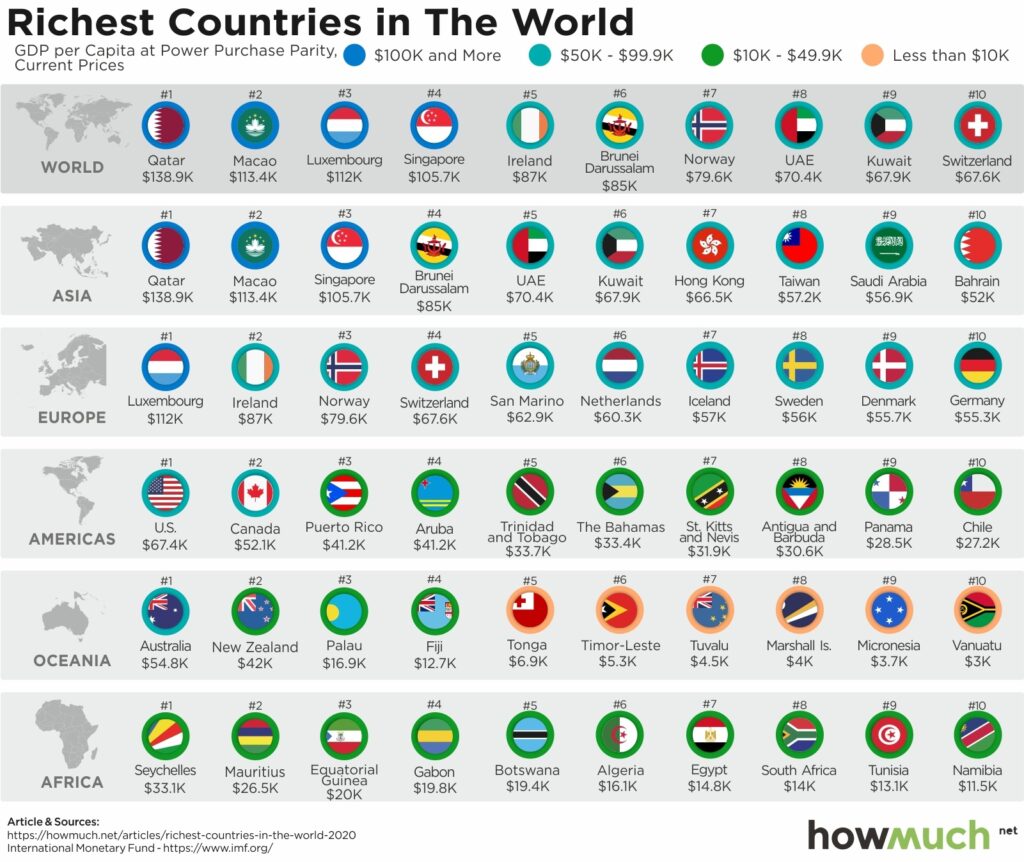
The world is a tapestry woven with varying economic realities, and among these, the wealthiest countries command attention due to their significant impact on global finance, culture, and technological advancement. In the realm of international economics, wealth can be measured in myriad ways, though the most notable metric often employed is Gross Domestic Product (GDP) per capita. This article delves into the characteristics, economic frameworks, and societal elements that define some of the richest countries across the globe.
Understanding Wealth Measurement
To grasp the essence of wealth among nations, we must first unpack the concept of GDP per capita. This metric, calculated by dividing a country’s total economic output by its population, provides insight into individual prosperity within a nation. It is essential to distinguish GDP per capita from total GDP, as the former offers a clearer perspective on the standard of living for ordinary citizens. Richer countries typically possess robust economies, refined infrastructures, and a high level of human capital. However, mere numerical superiority does not encapsulate the diverse factors contributing to a nation’s affluence.
1. Luxembourg: The Pinnacle of Prosperity
Occupying the zenith of wealth, Luxembourg boasts a GDP per capita that is strikingly high. This small, landlocked nation capitalizes on its strategic position within Europe, manifesting its economic prowess primarily through the financial services sector. With a plethora of multinational corporations establishing their headquarters there, Luxembourg epitomizes the benefits of a favorable business climate, alongside a stellar education system that fosters skilled professionals.
2. Switzerland: A Model of Stability and Innovation
Renowned for its banking secrecy and robust pharmaceutical industry, Switzerland consistently ranks among the wealthiest countries globally. The Swiss economy is characterized by stability and innovation, heavily investing in research and development. Its highly educated workforce and commitment to sustainability create an environment conducive to high productivity rates. Furthermore, the country’s neutral political stance contributes to a stable economic landscape, attracting foreign investments.
3. Ireland: The Emerald Isle’s Economic Ascendancy
With an impressive surge in GDP per capita, Ireland has evolved into a significant player on the global economic stage. This transformation can be attributed to favorable corporate tax policies that have lured multinational tech giants and pharmaceutical companies. As a result, Dublin has become a bustling tech hub, driving economic growth. Additionally, Ireland’s rich cultural heritage and stunning landscapes make it a desirable location for expatriates and tourists alike, fueling further economic activity.
4. Norway: Wealth from Natural Resources
Norway presents a fascinating case of wealth derived predominantly from its natural resources, particularly oil and gas. The country has expertly managed its oil revenues through the Government Pension Fund Global, ensuring long-term sustainability and providing for its citizens. With an astonishing GDP per capita and an enviable quality of life, Norway seamlessly blends economic success with a commitment to environmental sustainability, prioritizing green initiatives and social welfare programs.
5. Qatar: The Oligarchs of the Gulf
Qatar, a small nation with colossal natural gas reserves, showcases how resource wealth can translate into unparalleled economic power. With significant investments in infrastructure, education, and healthcare, Qatar strives to diversify its economy beyond hydrocarbons. The nation’s emphasis on hosting global events and investing in tourism is indicative of its long-term plan to foster a vibrant, knowledge-based economy.
6. Singapore: A Testament to Strategic Location and Trade
Often lauded for its remarkable economic growth, Singapore is a veritable lighthouse of prosperity in Southeast Asia. By leveraging its strategic location as a trading hub, Singapore has developed a highly efficient port, becoming one of the busiest in the world. The nation’s rigorous education system and progressive governance have created a conducive environment for entrepreneurship and innovation. Additionally, its commitment to maintaining a business-friendly climate has drawn investments from around the globe.
7. United States: The Economic Colossus
The United States remains an economic juggernaut, underscoring its diverse economy that spans various sectors, including technology, finance, and entertainment. With abundant natural resources, a robust industrial base, and access to a skilled workforce, the U.S. maintains a remarkable GDP despite fluctuations in global markets. Moreover, its cultural influence, characterized by media and technology advancements, underscores its role as a global leader.
8. Australia: The Land Down Under’s Riches
Australia’s wealth is anchored in its rich natural resources and agricultural sectors. The nation is a primary exporter of minerals, coal, and agricultural products, contributing significantly to its GDP. Moreover, Australia’s strong service sector, particularly in finance and tourism, bolsters its economy. The country takes pride in its high standard of living, supported by a reliable healthcare system and a well-educated populace.
Conclusion: The Dynamics of Wealth in the Modern World
The richest countries in the world exemplify diverse paths to prosperity, each uniquely shaped by its resources, governance, and societal structure. Wealth, while often quantified through GDP per capita, encompasses a broader narrative that includes cultural heritage, social systems, and environmental sustainability. As global economics continue to evolve, these nations provide invaluable lessons in navigating the complexities of wealth and the intricate interplay between economic, social, and environmental factors. Understanding the dynamics within these affluent nations not only fosters a greater appreciation for their achievements but also inspires emerging economies to pursue sustainable paths toward prosperity.
FAQ
What is GDP per capita and why is it important in measuring wealth?
GDP per capita is the total economic output of a country divided by its population, indicating average individual prosperity and standard of living.
Which country has the highest GDP per capita?
Luxembourg currently holds the highest GDP per capita due to its strong financial services sector and favorable business environment.
How do natural resources impact the wealth of countries like Norway and Qatar?
Countries rich in natural resources like oil and gas generate significant wealth which they often manage through sovereign wealth funds to ensure long-term economic stability.
Why is the United States considered an economic colossus?
The U.S. has a diverse economy spanning technology, finance, entertainment, and natural resources, supported by a skilled workforce and cultural influence worldwide.




Leave a Reply