Short Answer
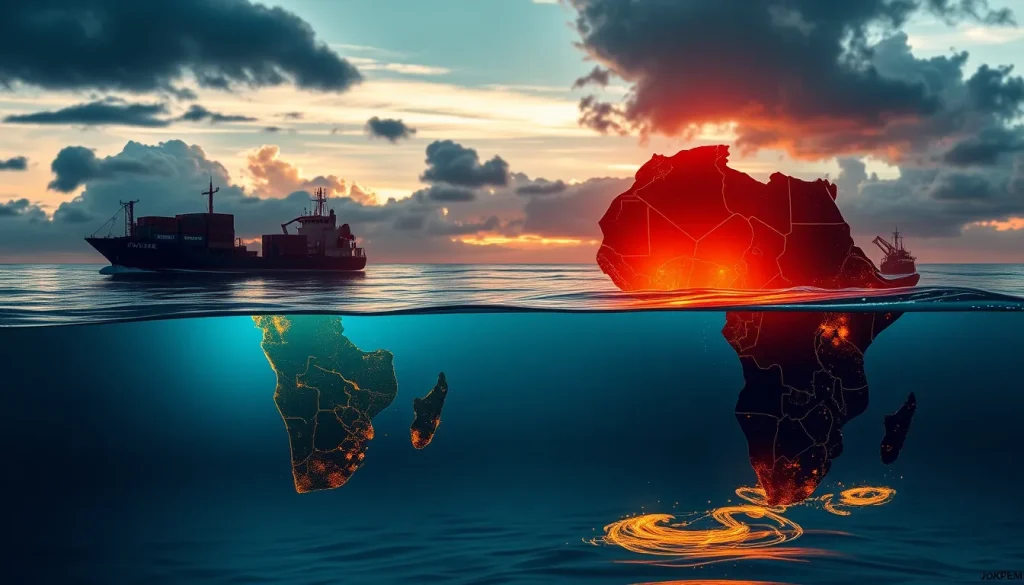
13 African countries were affected by the 14 March 2024 West Africa subsea cable outage.
Key Takeaways
- The 14 March 2024 outage knocked ACE, SAT-3, WACS and MainOne offline after a suspected underwater rock slide off Côte d’Ivoire, degrading or cutting internet in 13 African countries.
- West Africa’s problem is not only cable count: WACS, MainOne, ACE and SAT-3 share a narrow seabed and landing corridor, so one geophysical event can create a cluster fault.
- Repair resilience depends on Atlantic cable-ship availability, permits and spares; new capacity from Equiano and 2Africa must be matched by diverse terrestrial backhaul and IXP peering.
Quick-Spec Summary
West Africa’s subsea cable system is a narrow, high-capacity coastal corridor carrying most international data for a fast-growing digital market. The causes of West Africa subsea cable outages are therefore not reducible to one weak cable: they combine geophysical exposure on the Atlantic seabed, concentrated route and landing-point geography, a thin repair-vessel market and uneven terrestrial redundancy. Submarine fibre-optic cables handle up to 99% of global internet traffic and communications, and West Africa depends on that same architecture for cloud, finance, government and mobile data.
| Spec | Detail |
|---|---|
| Route/Scope | West African Atlantic seaboard subsea corridor: ACE, SAT-3, WACS and MainOne, with newer Equiano and 2Africa systems adding landing and capacity diversity. |
| Capacity | Multi-terabit design capacity across the corridor; usable capacity varies by system, landing station and terrestrial backhaul. The binding constraint is resilience, not nominal design capacity. |
| Estimated Cost | Cumulative consortium capex is not publicly consolidated. The recurring hidden cost is outage loss plus repair mobilisation, spares and vessel scarcity. |
| Lead Stakeholders | WATRA, national administrations and regulators, cable consortia and landing partners, Equiano and 2Africa sponsors, and regional IXPs. |
| Current Status | Operational but recurrently degraded. After the 14 March 2024 outage, repairs were still ongoing in early April 2024, according to the Internet Society. |
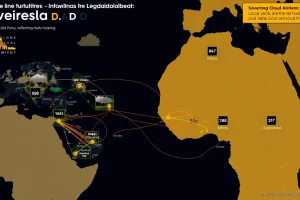
The March 2024 event is the clearest recent stress test. The Internet Society reports that a suspected underwater rock slide off the coast of Côte d’Ivoire resulted in ACE, SAT-3, WACS and MainOne being offline, impacting 13 African countries on the West African seaboard with either degraded services or near-total internet outages. The New York Times reported tens of millions of people waking to no internet, hospitals shut out of patient records and business owners unable to pay wages.
How It Works & Strategic Mechanics
Architecture: landing stations, repeaters and backhaul
A subsea cable is not a single wire. It is a system of landing stations, submarine line terminal equipment, repeaters, branching units, power feed equipment, terrestrial backhaul and internet exchange points. The wet segment crosses the seabed; the dry segment determines whether traffic can reach users. A cable landing in Lagos, Accra, Abidjan or Dakar is only as resilient as the national fibre, cross-border links, power supply and IXP peering behind it. When one of those layers is missing, a new cable can add capacity without adding redundancy.
WATRA notes that 12 submarine cable companies with 37 landing points pass through West Africa, and that over 99% of international data exchange depends on telecommunications submarine cables. That density is an asset, but it is also a concentration: many systems share the same coastal shelf, the same landing cities and, in some cases, the same terrestrial backhaul corridors. A single seabed event can therefore remove multiple logical cables at once.
Routing and fault physics
West African cable routes must cross a geologically active and sediment-rich continental margin. The Trou Sans Fond canyon system off Abidjan is a known conduit for sediment and slope failure; the March 2024 outage was suspected to be caused by an underwater rock slide off Côte d’Ivoire. Further south, the Congo Canyon is one of the world’s largest submarine canyons and has produced cable-damaging turbidity currents in recent years. Turbidity currents are sediment-laden density flows that can travel downslope with enough force to snap or bury cables. They are not ordinary currents, and they are difficult to forecast with the precision needed for cable routing.
The strategic mechanic is simple: cable routes avoid some hazards but cannot avoid all canyon mouths, shelf edges and sediment fans. Where routes converge, a landslide, turbidity current or anchor strike can produce a fault cluster rather than a single-fault incident. That is why WACS, MainOne, ACE and SAT-3 are often discussed together: they are not interchangeable from a resilience standpoint if they share the same seabed corridor and landing points.
Governance and the repair chain
Most cables are owned by consortia or private sponsors, governed by construction and maintenance agreements, landing-party permits and repair contracts. WATRA’s working group on infrastructure development has recommended stronger regional coordination by its secretariat and member administrations. Operationally, a repair follows a sequence: detect the fault, localise it, obtain permits and customs clearance, mobilise a cable ship, grapple and cut the damaged section, splice a replacement, and test the system. Each step consumes time; the ship step is the most visible bottleneck.
African Arguments describes a sub-Saharan subsea repair vessel deficit, warning that the region is under-equipped to maintain the infrastructure being laid. For West Africa, a cable ship may need to mobilise from Europe or South Africa. That can mean days to weeks before a repair splice begins, depending on vessel location, weather, permits and spare availability. A fault that takes minutes to occur can take weeks to restore at full redundancy.
Key Bottlenecks, Fault Lines & Risks
Fault clusters: WACS, MainOne, ACE and SAT-3
The 14 March 2024 incident demonstrated cluster risk. A suspected underwater rock slide off Côte d’Ivoire took ACE, SAT-3, WACS and MainOne offline at the same time. The Internet Society’s report records that 13 African countries on the West African seaboard were impacted, with either degraded services or near-total internet outages. The same report notes a separate 24 February 2024 Red Sea outage affecting Seacom/TGN-EA, EIG and AAE-1, which forced rerouting even where African landfalls were not directly cut. Two corridors failing in the same year is a reminder that West African resilience cannot be assessed in isolation from global route diversity.
Repair ship deficit and Atlantic mobilisation time
The repair-vessel market is small, specialised and globally allocated. A vessel deployed to the Atlantic may be committed elsewhere, and mobilisation to a West African fault site can take days to weeks before permits, customs and weather are cleared. The African Arguments analysis frames this as a looming danger for sub-Saharan Africa: the region is laying more cable than it can properly maintain. The practical consequence is that a cable cut in West Africa is not only an engineering problem but a scheduling problem. Repair queues, spare availability and port access become strategic variables.
Redundancy limits: Equiano, 2Africa and terrestrial IXPs
Equiano and 2Africa add important capacity and landing diversity to West Africa. But redundancy is not the same as cable count. If new capacity lands in the same coastal cities and depends on the same terrestrial backhaul, it may not protect against a landing-station failure, a national fibre cut or a power outage. Terrestrial IXPs, cross-border fibre links and diverse backhaul routes are what convert subsea capacity into resilient service. Regulatory friction, landing licences, customs procedures and financing gaps for domestic backhaul can all leave new cable capacity stranded from the users who need it.
There is also a financing gap in maintenance. Consortia may fund construction more readily than long-term repair readiness, especially where revenue per user is low and multiple operators share the same corridor. The result is a collective-action problem: every operator benefits from a repair vessel and spares pool, but no single small operator wants to carry the full fixed cost. WATRA’s recommendations point toward regional coordination, but implementation depends on national administrations and operators aligning on maintenance, permits and emergency access.
Regional Economic & Geopolitical Impact
Economic continuity and public services
The March 2024 outage showed that subsea cable failure is immediately an economic event. The New York Times reported hospitals shut out of patient records, business owners unable to pay wages and public panic across affected West African cities. For a region with a fast-growing population and a large connectivity gap, those hours and days matter: they interrupt cloud services, mobile money, payroll, logistics, remote work and government digital services. The Internet Society’s 13-country impact estimate is a reminder that the blast radius of a single seabed event can be regional.
Bandwidth, trade and geopolitical leverage
Because submarine cables carry over 99% of international data exchange, West Africa’s cable corridor is core economic infrastructure, not a niche telecom asset. New systems such as Equiano and 2Africa increase available bandwidth and can lower wholesale costs, but they do not automatically reduce geopolitical exposure. Dependence on a small number of repair vessels, cable suppliers and landing points creates leverage for external operators and raises the cost of prolonged outages. Maritime security, seabed mapping and cable protection also become trade-security issues, not only telecoms issues.
Policy and operational implications
- Diversify terrestrial backhaul and IXP peering so that Equiano and 2Africa capacity reaches users through more than one national route.
- Fund regional repair-vessel access, spares and training rather than treating maintenance as an afterthought to construction.
- Map and monitor canyon and shelf-edge hazards, including Trou Sans Fond and Congo Canyon sediment systems, to inform route planning and fault response.
- Streamline landing-party permits, customs and emergency access so cable ships can mobilise faster.
- Treat cable resilience as critical infrastructure policy, with WATRA, national regulators and operators sharing fault data and restoration plans.
The bottom line is that West Africa’s subsea cable outages are caused by a compound system: geophysical fault zones, concentrated route geography, scarce repair ships and incomplete terrestrial redundancy. Adding cable capacity helps, but resilience requires the less visible layers — maintenance financing, vessel access, permits, IXPs and diverse backhaul — to keep pace with the cables themselves.
Primary Sources & Official Citations
- Internet Society — 2024 West Africa Submarine Cable Outage Report — Primary outage report on the 14 March 2024 ACE, SAT-3, WACS and MainOne disruption
- WATRA — Recommendations on Submarine Cable Resilience in West Africa — Regional regulator recommendations and landing-point data
FAQ
What caused the March 2024 West Africa subsea cable outage?
The Internet Society reports that a suspected underwater rock slide off the coast of Côte d’Ivoire resulted in ACE, SAT-3, WACS and MainOne being offline, impacting 13 African countries on the West African seaboard.
Why do Congo Canyon and Trou Sans Fond matter for cable resilience?
They are sediment-rich submarine canyon systems that can funnel turbidity currents and slope failures toward cables. The March 2024 outage was suspected to be caused by an underwater rock slide off Côte d’Ivoire, while the Congo Canyon is a known cable-damaging turbidity-current system.
Do Equiano and 2Africa eliminate West Africa’s subsea cable risk?
No. Equiano and 2Africa add capacity and landing diversity, but resilience also depends on diverse terrestrial backhaul, IXP peering, power supply, repair-vessel access and streamlined permits. New cable capacity can still fail if it funnels into the same backhaul or landing bottleneck.
Leave a Reply