
Short Answer
45,000 km | 46 landing stations | 33 countries | up to 180 Tbps design capacity
Key Takeaways
- 2Africa spans about 45,000 km and 46 landing stations in 33 countries, with design capacity up to 180 Tbps on 16 fibre pairs on key segments.
- The system uses SDM1 optical switching and an open-access consortium model, allowing partners such as WIOCC to own fibre pairs, manage SLTE and sell capacity from 1 Gbps to 1 Tbps.
- Its main strategic value is continuous East-West Africa connectivity plus redundant Red Sea-Mediterranean crossings through Egypt, but Egypt remains a concentrated transit chokepoint.
Quick-Spec Summary
This system explainer maps the 2Africa subsea cable landing stations capacity model. 2Africa is a 45,000 km open-access subsea system designed to connect Africa, the Middle East, Asia and Europe. According to the project FAQ and consortium announcements, it links 46 cable landing stations in 33 countries and is the first system to provide continuous capacity around the African continent while seamlessly connecting East and West Africa. Its completion announcement in November 2025 marked a consortium milestone for global connectivity.
| Specification | Detail |
|---|---|
| Route / Scope | 45,000 km subsea system linking 46 cable landing stations in 33 countries across Africa, Asia and Europe; first continuous East-West African route; extends to the Gulf, Pakistan and India through 2Africa Pearls. |
| Capacity | Up to 180 Tbps design capacity on 16 fibre pairs on key parts of the system; SDM1 optical switching from ASN supports flexible bandwidth management. |
| Estimated Cost | Not publicly disclosed in the cited project materials; the system is consortium-funded. |
| Lead Stakeholders | Bayobab (MTN), center3 (stc), China Mobile International, Meta, Orange, Vodafone Group, WIOCC and Telecom Egypt. |
| Current Status | Core infrastructure completed, announced 19 November 2025; landings in more than 33 countries and counting. |
The capacity figure requires qualification: up to 180 Tbps is a design parameter on 16 fibre pairs on key parts of the system, not a uniform entitlement at every landing station. Actual lit capacity depends on SLTE, terrestrial backhaul and commercial activation.
How It Works & Strategic Mechanics
Route architecture and Red Sea crossing
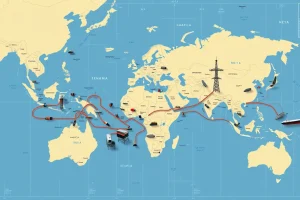
2Africa was announced in May 2020 at 37,000 km and 23 countries; branch additions in August 2021 and the 2Africa Pearls extension in September 2021 expanded it to 45,000 km, 46 landing stations and 33 countries, making it the longest subsea cable, ahead of SMW3 at 39,000 km. The route runs around Africa and links the continent to the Middle East, South Asia and Europe. Its most distinctive mechanical feature is the Red Sea-Mediterranean crossing: two new trans-Egypt terrestrial routes connect the Red Sea to the Mediterranean towards Europe, and a third new marine path links the Ras Ghareb and Suez landing stations in the Red Sea.
Optical layer, SDM1 and landing-station mechanics
At the physical layer, 2Africa uses SDM1 from ASN, incorporating optical switching to enable flexible bandwidth management. The system is designed for up to 180 Tbps on 16 fibre pairs on key segments. Cable burial depth has been increased by 50% compared with older systems, and routing avoids known subsea disturbance. At each landing station, SLTE converts submarine optical signals into terrestrial interfaces; the landing station is therefore the boundary between wet plant and national backhaul. WIOCC, a fibre-pair owner, states that it owns and manages its SLTE, allowing it to light and upgrade capacity as required and offer spectrum from 1 Gbps to 1 Tbps.
Consortium governance and open-access operations
The ownership model is consortium-based and open access. The completion announcement names Bayobab, center3, China Mobile International, Meta, Orange, Vodafone Group, WIOCC and Telecom Egypt. In market terms, this is a mixed group: MTN’s wholesale arm Bayobab and stc’s center3 represent African and Gulf operator interests; Meta represents hyperscale content demand; Orange, Vodafone and Telecom Egypt represent incumbent carrier and landing-hub interests; China Mobile International adds Asian carrier participation; WIOCC adds wholesale open-access capacity. Governance therefore has to reconcile hyperscaler, incumbent, wholesale and state-linked priorities over capacity allocation, landing-station access and upgrade timing.
Operationally, the system is allocated by fibre pair or spectrum rather than as a single homogeneous service. Partners can light capacity in increments, connect at landing stations to national backbones, and route traffic to European content hubs or intra-African points. The open-access design is intended to let multiple operators buy capacity without owning the whole cable, but the practical constraint is terrestrial: a landing station without sufficient backhaul, data-centre interconnection or licensing cannot convert submarine design capacity into usable service.
Key Bottlenecks, Fault Lines & Risks
Financing and cost transparency
The cited project materials do not disclose capital expenditure, financing structure or cost per Tbps. That is a material analytical gap: without capex and take-up data, it is not possible to verify payback assumptions or compare 2Africa’s unit economics with other African subsea systems. The consortium model spreads risk across operators and a hyperscaler, but it also makes capacity allocation and upgrade obligations less transparent than in a single-owner system.
Regulatory and landing-station friction
A 33-country footprint implies multiple landing licences, import permits, spectrum and data-governance regimes, customs clearances and local-ownership rules. Delays at any one landing station can strand capacity on a branch and push traffic onto alternative routes. The open-access model does not remove these national bottlenecks; it redistributes commercial access while leaving regulatory approval with sovereign authorities.
Egypt and Red Sea concentration
The Red Sea-Mediterranean crossing is the system’s most important redundancy feature and its most concentrated risk. Two trans-Egypt terrestrial routes and a third marine path linking Ras Ghareb and Suez improve resilience compared with a single crossing, but they remain within one national jurisdiction and depend on landing-station security, terrestrial wayleaves and customs/regulatory continuity. A disruption in Egypt would affect Europe-Asia-Africa traffic even if the rest of the cable remains intact.
Design capacity versus usable capacity
The 180 Tbps figure applies to 16 fibre pairs on key parts of the system, not uniformly to every branch or landing. Branch capacity, SLTE configuration, backhaul and commercial take-up determine what is usable. The cable also faces standard subsea threats: anchors, fishing gear and deliberate interference. Increased burial depth and route avoidance reduce but do not eliminate those risks. Finally, redundancy is only as good as the terrestrial and data-centre layers behind each landing station.
Regional Economic & Geopolitical Impact
Africa: East-West integration and broadband supply
2Africa interconnects more than 20 African countries and is designed to support 4G, 5G and fixed broadband for hundreds of millions of people and businesses, with the project claiming relevance to over 3 billion people, more than 30% of the world’s population. Its first-order contribution is not simply more international bandwidth; it is the first continuous East-West African subsea route, which creates intra-African path diversity and reduces dependence on routing African traffic through external hubs. The system is also positioned to support healthcare, education and financial-services applications, but those outcomes depend on national backhaul, power and data-centre capacity.
MENA and Egypt: transit hub consolidation
Egypt’s role is reinforced by the trans-Egypt crossings and the Ras Ghareb-Suez marine path. Telecom Egypt’s participation and the presence of center3/stc link the cable to Gulf digital-infrastructure strategies. The economic upside is transit and landing-station revenue, plus improved latency and redundancy for Egyptian operators. The geopolitical downside is chokepoint exposure: Egypt becomes more central to Africa-Europe-Asia connectivity, which raises the cost of any national disruption.
Asia, Europe and the ownership mix
The 2Africa Pearls extension connects the Gulf, Pakistan and India, extending the system’s reach into South Asia. In Europe, the cable delivers direct access into content hubs, which matters for Meta and other capacity buyers. The ownership mix is strategically multi-polar: US hyperscale, African mobile and wholesale, Gulf digital infrastructure, European incumbents and Chinese carrier interests sit in the same consortium. That structure can improve liquidity and route diversity, but it also means capacity allocation and landing access may be shaped by commercial and geopolitical alignments beyond pure bandwidth economics.
For emerging markets, the practical impact is conditional. Where open access, competitive terrestrial backhaul and independent regulation coexist, additional submarine supply can compress wholesale prices and widen ISP and cloud access. Where landing stations remain bottlenecked by licensing or incumbent control, 2Africa adds international capacity without automatically changing domestic market structure.
Primary Sources & Official Citations
- 2Africa Cable - Official FAQ — Primary project disclosure on route, scope and design
- Telecom Egypt - Completion of 2Africa Press Release — Consortium announcement and completion status
- WIOCC - 2Africa — Capacity, fibre-pair ownership and SLTE operating model
FAQ
How much capacity does the 2Africa cable have?
2Africa has a design capacity of up to 180 Tbps on 16 fibre pairs on key parts of the system. Actual lit capacity is lower and depends on SLTE configuration, terrestrial backhaul and commercial activation; it is not uniformly available at every landing station.
Which countries and landing stations does 2Africa connect?
2Africa links 46 cable landing stations in 33 countries across Africa, Asia and Europe. It connects more than 20 African countries and, through the 2Africa Pearls extension, reaches the Gulf, Pakistan and India.
Who owns the 2Africa subsea cable?
2Africa is owned by a consortium that includes Bayobab (MTN), center3 (stc), China Mobile International, Meta, Orange, Vodafone Group, WIOCC and Telecom Egypt. It operates on an open-access model in which partners can own fibre pairs or acquire spectrum.


Leave a Reply