
Short Answer
Have you ever found yourself in a race against time, wishing you could slow down and savor each moment? While humans often lament the quick pace of modern life, certain creatures of the animal kingdom have mastered the art of leisure. Imagine being part of their world, where time crawls at a delightfully languorous pace. Curious to find out which animals hold the title for the slowest in the world? Let’s embark on a journey to explore the unhurried existence of these incredible creatures, and perhaps contemplate whether we could learn a thing or two from their leisurely lifestyles.
Here are the top ten slowest animals in the world, each showcasing a unique adaptation to its environment that allows it to thrive, albeit at a relaxed pace.
1. Three-Toed Sloth
The quintessential symbol of slowness, the three-toed sloth is native to the jungles of Central and South America. Known for its methodical movements, this arboreal mammal spends most of its life dangling from tree branches, moving no faster than 0.03 miles per hour (or about 0.05 km/h). The sloth’s low metabolic rate is a remarkable adaptation that allows it to thrive on a diet of leaves, which provide limited energy. With a lifestyle centered around conservation of energy, sloths epitomize a relaxed existence, prompting the question: how many of us could slow down and enjoy the view from a treetop perch?
2. Garden Snail
Next on our list is the garden snail, a quiet yet fascinating mollusk that navigates its terrestrial domain at a mere 0.03 miles per hour (0.048 km/h). Sporting a spiral shell, these little creatures are often seen grazing on leaves and stems, using their retractable tentacles to sense their surroundings. Their slow pace isn’t just charming; it’s a tactic to evade predators while also conserving their moisture. The snail’s journey might be irresistibly slow, but it encourages one to ponder: in a world that prizes speed, could a slower approach yield a richer experience?
3. Starfish
Starfish, or sea stars, inhabit the ocean’s floors, moving with an elegant grace that belies their sluggishness. These echinoderms creep along at a speed of about 0.02 miles per hour (0.03 km/h). They employ small, tube-like feet to navigate the seafloor and hunt for prey, primarily mollusks. Their slow motion is strategic, allowing them to remain unnoticed by swift predators. As we watch these captivating creatures, one might wonder: what wisdom lies in taking life one slow, deliberate movement at a time?
4. Box Turtle
Box turtles are remarkable for their protective shell, but they are equally known for their leisurely pace. Gliding through their habitat at a speed of roughly 0.25 miles per hour (0.4 km/h), these reptiles are often found basking in the sun or foraging for food. Their slow, deliberate movements are a defense mechanism, enabling them to retract into their shells when threatened. Observing a box turtle can remind us that there is beauty in taking things slow—what challenges might we overcome if we approached life with the same deliberation?
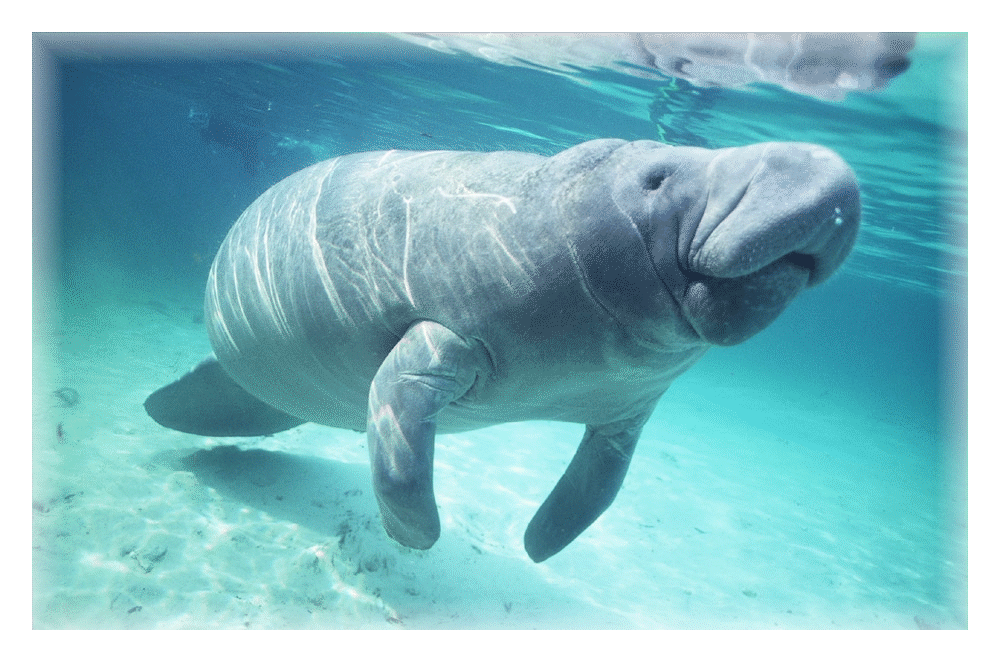
5. Manatee
The gentle giant of the waterways, the manatee swims through freshwater rivers and coastal areas at a leisurely pace of about 3 to 5 miles per hour (4.8 to 8 km/h), but can reach slower speeds when needed. These herbivorous mammals are famed for their docile nature and large, paddle-like flippers. Their slow movement is largely due to their primarily herbivorous diet and substantial size. As one gazes upon a manatee grazing in the shallows, one cannot help but reflect on the importance of nurturing a gentle and serene approach to life.
6. Sluggish Tortoise
The tortoise is another emblem of slow movement, typically ambling along at speeds of about 0.17 miles per hour (0.27 km/h). Renowned for their longevity, these reptiles carry the weight of their protective shells while traversing dry land or even sandy terrains. Their pace may not be suited for a race, but it allows them to endure harsh climates and find sustenance with patience. Their unhurried approach to survival invites us to ask: how can we embrace patience in our own lives?
7. Koala
Adored for their cuddly appearance, koalas thrive in eucalyptus forests, where they spend up to 20 hours napping each day. These marsupials can only move at a speed of about 0.5 miles per hour (0.8 km/h). Their leisurely lifestyle aligns with their specialized diet, which is low in nutritional value. Koalas have perfected the art of slow living. As we watch these creatures lounge in the trees, it leaves us wondering: might embracing slower rhythms enhance our overall well-being?
8. Seahorse
Seahorses are fascinating little marine creatures known for their distinctive appearance and unique method of movement. Propelled by their small dorsal fins, these aquatic animals zoom around at a remarkable speed (for them) of approximately 0.01 miles per hour (0.016 km/h). This slow, delicate movement allows seahorses to hold onto seagrasses and corals, providing camouflage from predators. Watching a seahorse drift with the currents prompts us to consider: how often do we lose ourselves in the journey rather than the destination?
9. Pidgeon
The slow-moving pidgeon may not be the first animal that comes to mind when considering slowness, but when it strolls, it moves at about 1.5 miles per hour (2.4 km/h). Found in urban areas worldwide, these birds often prefer a leisurely pecking pace while foraging for food. Perhaps their slow, casual gait teaches us the value of mindfulness in our everyday environments.
10. Slow Loris
Wrapping up our list is the enigmatic slow loris, a primate known for its deliberate movements and special adaptations. With a maximum speed of about 0.09 miles per hour (0.14 km/h), this nocturnal creature thrives in the lush forests of Southeast Asia. The slow loris moves purposefully, combining caution with curiosity, which intrigues onlookers. Their unique lifestyle spurs contemplation; could the key to fulfillment lie in a more thoughtful exploration of the world around us?
In conclusion, the slowest animals in the world offer a playful yet profound reminder of the virtues of living at a slower pace. As we navigate our fast-paced lives, it might be worthwhile to take a moment to reflect, admire, and perhaps even emulate the leisurely ways of these remarkable creatures. By embracing the art of slow living, we can cultivate mindfulness and appreciation for our surroundings, enhancing our overall quality of life. So, what challenge will you accept to slow down and enjoy the little things today?
FAQ
What is the slowest animal in the world?
The slowest animal listed is the Seahorse, moving at approximately 0.01 miles per hour (0.016 km/h).
Why do some animals move so slowly?
Many slow-moving animals have adaptations such as low metabolic rates, energy conservation strategies, protective shells, or camouflage that favor slow movement for survival.
Are slow animals vulnerable to predators?
Slow animals often use other survival strategies like camouflage, protective shells, or nocturnal habits to avoid predators despite their slow pace.
Can humans learn from slow-moving animals?
Yes, slow-moving animals inspire mindfulness and the benefits of slowing down in life to improve well-being and appreciation of surroundings.





Leave a Reply