
Short Answer
In an era characterized by rapid globalization and economic interdependence, the financial landscape is continuously evolving. Are you curious about which nations stand tall as the beacons of affluence in our interconnected world? Let’s embark on a fascinating journey exploring the top ten richest countries dominating global wealth. Each of these countries boasts not just opulence but also distinct and intricate economic frameworks that invite admiration and study.
1. **Luxembourg**
A minuscule landlocked nation in Western Europe, Luxembourg is often referred to as the wealthiest country per capita. Its robust economy thrives on a combination of finance, technology, and a skilled labor force. Major international banks and financial institutions have their roots here, benefiting from favorable tax conditions and a strategically advantageous location. The dilemma arises: can such a small nation sustain its economic supremacy in the face of global challenges?
2. **Switzerland**
Renowned for its neutrality, picturesque landscapes, and precision engineering, Switzerland has long held a prestigious position in the financial world. The Swiss banking system, characterized by its confidentiality and stability, attracts significant foreign investment. Beyond banking, the nation excels in pharmaceuticals and high-quality manufacturing. But as global financial regulations tighten, will Switzerland continue to maintain its fortress of wealth?
3. **Ireland**
With a vibrant economy driven by technology and pharmaceuticals, Ireland has experienced exponential growth over the last few decades. The country has become a hub for multinational corporations seeking a foothold in the European market, benefiting from a favorable corporate tax regime. However, this reliance poses a challenge: how can Ireland diversify its economic activities to safeguard against external fluctuations?
4. **Norway**
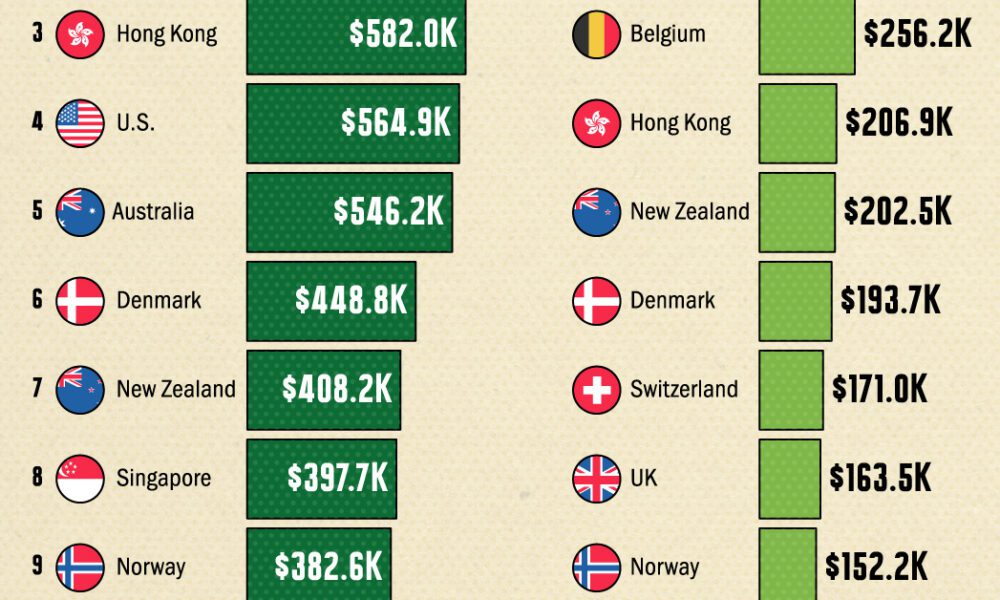
Norway’s abundance of natural resources, particularly oil, positions it among the wealthiest nations. Distinctively, it utilizes its wealth to fund a robust welfare state, aiming for equitable distribution of resources. The paradox lies in its sustainability practices—while oil fuels the economy, how will Norway transition to a greener future without compromising its prosperity?
5. **Qatar**
Another oil-rich sovereign state, Qatar’s wealth is derived from its vast natural gas reserves. The rapid development of infrastructure, alongside ambitious investments in education and healthcare, has elevated the standard of living. Yet, the question hangs: what will happen to Qatar’s economy as global energy consumption shifts toward renewable alternatives?
6. **United States**
As one of the largest economies on the planet, the United States is a melting pot of innovation and entrepreneurship. Technological advances, a diverse consumer base, and a plethora of resources propel wealth generation. However, confronting income inequality and political disparities invites contemplation: will the United States be able to sustain its status amid such challenges?
7. **Singapore**
This city-state exemplifies how strategic positioning and economic policies can create wealth. Its thriving financial sector, combined with logistics and trade, establishes Singapore as a pivotal node in global commerce. Nonetheless, can it maintain its competitive edge amidst rising regional powers like China and India?
8. **Denmark**
A leading nation in environmental and social governance, Denmark excels in fostering sustainable growth. With a high standard of living supported by a strong welfare system, it demonstrates that wealth doesn’t always accumulate in banks—sometimes it enriches the lives of citizens. Still, Denmark faces a critical challenge: how does it innovate further while maintaining its commitment to equality?
9. **Australia**
Rich in natural resources and boasting a stable economy, Australia benefits from its trade relationships with nearby Asian countries. Its fertile land supports a thriving agricultural sector, while mining fuels substantial revenue. Yet, the impending climate crisis pressures Australia to contemplate: how will it adapt its resource-based economy in a warming world?
10. **Sweden**
Famed for its innovative spirit and high quality of life, Sweden leverages a balanced combination of entrepreneurial endeavors and welfare initiatives. Its investment in education and sustainability is noteworthy, but the question looms: can Sweden continue to thrive as a global leader when faced with the complexities of immigration and demographic shifts?
As we reflect on these top ten richest nations, it’s evident that their fortunes are intricately linked to various factors—from resource management and economic policies to global trends and environmental sustainability. Each nation’s unique challenges prompt us to ponder: how will these affluent countries adapt in an ever-changing world? Will their paths lead to new forms of wealth distribution, enhanced social responsibility, or innovative economic models? The conversation surrounding these dynamics is just beginning, and we are all invited to join in.
In conclusion, understanding the richest nations provides a glimpse into the intricacies of global wealth distribution. While they dazzle us with affluence, it’s essential to consider the highlighted challenges that impact their sustainability. As the global economy continues to shift, the question remains: who will champion the future of wealth in our interconnected world? Only time will tell.
FAQ
Which country is the richest by GDP per capita?
Luxembourg is often considered the richest country by GDP per capita due to its strong finance and technology sectors.
What are the common challenges faced by the richest nations?
Challenges include sustainability, adapting to global economic shifts, income inequality, and environmental concerns.
How do natural resources impact the wealth of countries like Norway and Qatar?
Natural resources such as oil and gas provide significant revenue but also pose sustainability and diversification challenges.
Why is Switzerland known for its financial wealth?
Switzerland’s financial wealth stems from its stable banking system, confidentiality policies, and strong manufacturing and pharmaceutical industries.



Leave a Reply