
Short Answer
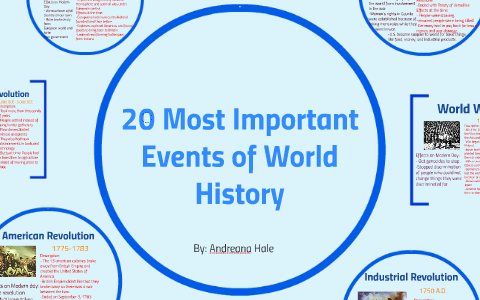
World history is a tapestry woven with the threads of myriad events, each bearing profound implications that shaped societies, ideologies, and the course of humanity itself. Throughout the ages, certain pivotal occurrences have illuminated paths of progress, catalyzed revolutions, ignited conflicts, and inspired reformations. The following is a contemplative enumeration of the top ten most significant events in world history, each promising to shift your perspective and pique your curiosity.
1. The Agricultural Revolution (circa 10,000 BCE)
The dawn of agriculture marked humanity’s transformative transition from nomadic lifestyles to settled existence. By cultivating crops and domesticating animals, early societies established the foundation for civilization. This monumental shift not only engendered food surpluses but also fostered population growth, social stratification, and the genesis of complex societies. The impact was profound: it revolutionized land use, instigated trade routes, and led to innovations such as pottery and weaving.
2. The Rise of Empires: The Roman Empire (27 BCE – 476 CE)
The sprawling expanse of the Roman Empire epitomized the zenith of political and military power in the ancient world. At its peak, it encompassed vast territories across Europe, North Africa, and parts of the Middle East. The introduction of Roman law, governance structures, and architectural marvels not only unified diverse cultures but also laid the groundwork for modern civilization. The legacy of Rome persists, influencing legal systems, languages, engineering, and urban planning to this day.
3. The Spread of Major World Religions: Buddhism and Christianity (circa 500 BCE – 500 CE)
The proliferation of Buddhism and Christianity encapsulated a major ideological shift across continents. As Buddhism spread from India to East and Southeast Asia, it introduced philosophical tenets that emphasized compassion, mindfulness, and the impermanence of life. Simultaneously, Christianity traversed the Mediterranean and beyond, establishing a faith that promoted universal love and salvation. This religious diffusion profoundly shaped cultural identities, artistic expressions, and moral frameworks, resonating through centuries.
4. The Age of Exploration (15th – 17th Centuries)
The Age of Exploration catalyzed an era of unprecedented global interactions. Adventurers like Christopher Columbus and Vasco da Gama traversed uncharted waters, leading to the encounter of the Old and New Worlds. This monumental event birthed a global exchange of goods, ideas, and pathogens, subsequently known as the Columbian Exchange. While it heralded the flourishing of trade networks, it also ushered in devastating consequences for indigenous populations, challenging humanity to grapple with the duality of progress.
5. The American Revolution (1775-1783)
The American Revolution represented a groundbreaking upheaval that reshaped notions of governance, rights, and liberty. Fueled by Enlightenment ideals, American colonists rebelled against British tyranny, culminating in the Declaration of Independence in 1776. This radical assertion of self-determination and personal freedoms had reverberating implications, inspiring worldwide movements toward democracy and social reforms, thereby instilling a sense of possibility that resonated far beyond North America.
6. The Industrial Revolution (late 18th – early 19th Century)
The Industrial Revolution signified a seismic economic and technological transformation, transitioning societies from agrarian economies to industrial powerhouses. Innovations such as the steam engine, mechanized textile production, and advances in metallurgy heralded profound changes in manufacturing and labor. Cities burgeoned with factories, leading to urbanization and altering social structures. This era also incited political philosophies advocating for workers’ rights and set the stage for contemporary economic paradigms.
7. The World Wars (1914-1918; 1939-1945)
The catastrophic toll of the World Wars irrevocably altered global dynamics and geopolitics. World War I resulted in the disintegration of empires, widespread devastation, and the Treaty of Versailles, which sowed the seeds for World War II. The ensuing conflict was marked by unparalleled destruction and the atrocities of the Holocaust. These wars compelled international cooperation and spawned organizations like the United Nations, urging a collective endeavor to prevent future conflicts. Their legacies challenge us to contemplate the horrors of war and the resilience of the human spirit.
8. The Cold War (1947-1991)
The Cold War was an ideological and geopolitical chess match between the United States and the Soviet Union, fostering an environment of espionage, propaganda, and proxy wars. This era was characterized by the stark dichotomy between capitalism and communism, leading to a bipolar world order. The space race, nuclear arms buildup, and the eventual dissolution of the Soviet Union revealed the fragility of global peace and stability. The Cold War’s denouement pivoted the globe into a new paradigm, inviting new alliances and conflicts.
9. The Civil Rights Movement (1950s-1960s)
The American Civil Rights Movement heralded a crucial epoch in the struggle for racial equality and justice. Figures such as Martin Luther King Jr. and Rosa Parks galvanized masses to confront systemic racism and discrimination. The movement’s impact was not confined to the United States; its principles deeply resonated worldwide, inspiring liberation movements and gender equality activism. This era underscored the potency of peaceful protest and civil disobedience, challenging the status quo and inspiring subsequent generations to advocate for justice.
10. The Digital Revolution (late 20th Century – present)
The Digital Revolution has redefined the landscape of communication, commerce, and human interaction. The advent of the internet, personal computing, and mobile technology has transformed societies at an unprecedented pace. Information is now ubiquitous, with knowledge-sharing instantaneously accessible across the globe. This revolution not only reshapes economies and industries but also challenges privacy, security, and the very nature of human connection, urging us to ponder the implications of living in an increasingly digital world.
Each of these events serves as a critical juncture in the complex narrative of humanity. They encourage us to reflect upon our past, recognize the patterns of progression and regression, and confront the ongoing challenges faced as we navigate our present and future. As history unfolds, understanding these pivotal moments allows us not only to appreciate the intricacies of our world but also to embrace the multiplicity of perspectives that shape our collective destiny.
FAQ
What are the top 10 most important events in world history?
They include the Agricultural Revolution, Roman Empire rise, spread of Buddhism and Christianity, Age of Exploration, American Revolution, Industrial Revolution, World Wars, Cold War, Civil Rights Movement, and Digital Revolution.
Why is the Roman Empire considered significant in world history?
Because it unified diverse cultures, influenced legal systems, architecture, language, and governance, leaving a lasting legacy on modern civilization.
How did the Age of Exploration impact global history?
It facilitated global trade, cultural exchange, and colonization, but also caused devastating effects on indigenous populations and global power shifts.
What is the significance of the Civil Rights Movement?
It was a pivotal struggle for racial equality and justice that influenced global human rights and inspired future social reforms.





Leave a Reply