
Short Answer
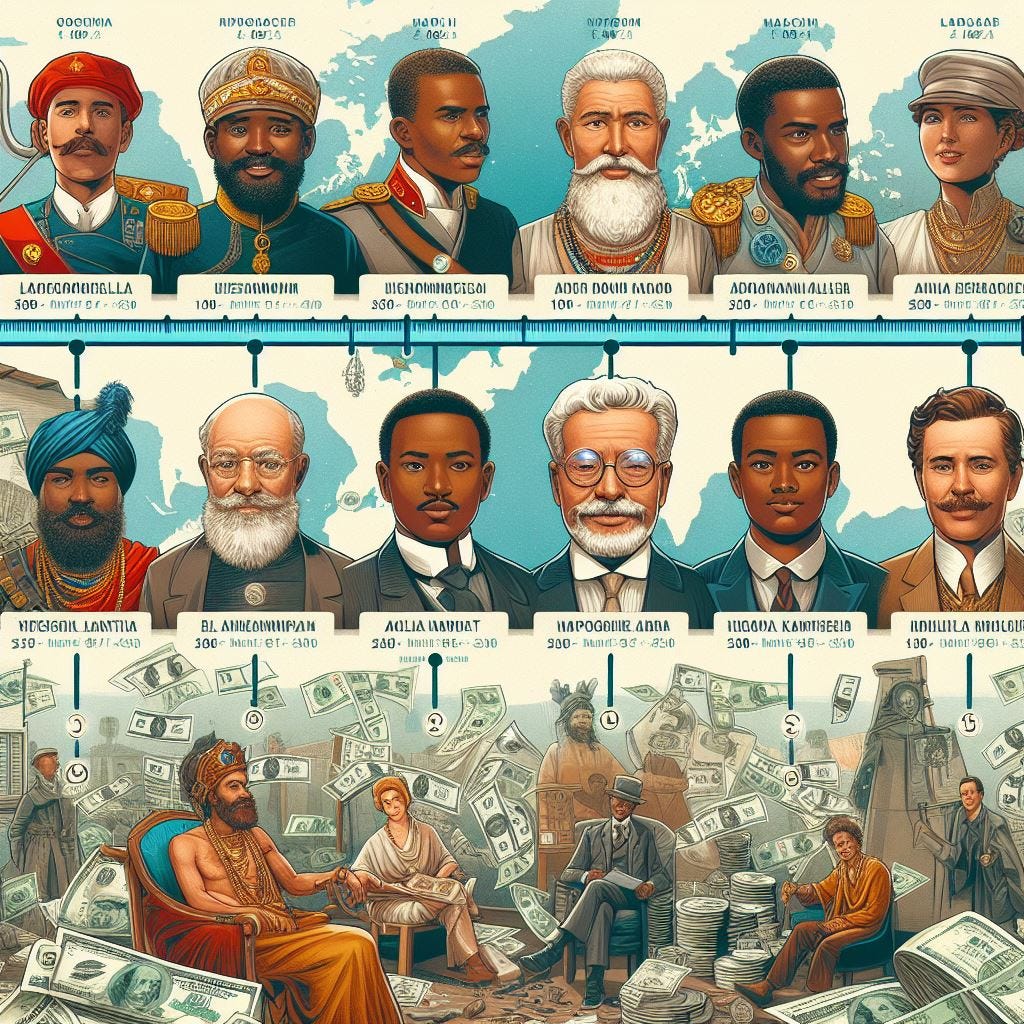
Throughout the annals of human history, wealth has often signified power, influence, and sometimes, sheer audacity. The richest individuals have frequently reshaped the world around them, whether through commerce, industry, or artistry. This exploration delves into the top ten richest people ever in history, examining the insane fortunes they’ve amassed and the empires they’ve cultivated. From ancient times to the modern era, these individuals have etched their names into the pantheon of wealth. Let us embark on this captivating journey through time.
1. Mansa Musa (c. 1280 – c. 1337)
Regarded as the richest person to ever walk the earth, Mansa Musa was the ruler of the Mali Empire in West Africa. His fortune was amassed primarily through the extensive gold mines within his territory, which were among the richest sources of gold in the world at the time. Musa’s wealth was so prodigious that during his pilgrimage to Mecca, he reportedly distributed gold liberally to the poor and even unintentionally destabilized local economies due to the sheer volume circulating through trade routes. His legacy of prosperity remains intertwined with the cultural and architectural advancements in Mali, making him not just an emblem of wealth but also of civilization.
2. John D. Rockefeller (1839 – 1937)
As the founder of the Standard Oil Company, John D. Rockefeller epitomized the American dream and the complexities of capitalism. His net worth, adjusted for inflation, is estimated to have peaked at around $400 billion. Rockefeller’s innovative business practices revolutionized the petroleum industry and positioned him as the first billionaire in the United States. Beyond his business acumen, Rockefeller was known for his philanthropy, establishing foundations that contributed profoundly to medical research and education, forever changing societal landscapes.
3. Andrew Carnegie (1835 – 1919)
Another titan of the industrial era, Andrew Carnegie made his riches primarily in the steel industry, with a fortune that at its zenith surpassed $300 billion in today’s dollars. Carnegie’s story is a quintessential rags-to-riches narrative; born into a poor family in Scotland, he emigrated to America and worked his way up from humble beginnings. Perhaps more notable than his wealth is his commitment to philanthropy, exemplified by his dedication to building libraries across the United States, thus leaving an enduring impact on literacy and education.
4. Augustus Caesar (63 BC – AD 14)
The first Roman Emperor, Augustus Caesar, ruled during a period of unprecedented stability known as the Pax Romana. His wealth came not only from territorial expansion but also from the immense resources of the Roman Empire. Some estimates suggest that his personal fortune, when adjusted for inflation, could be valued at around $4.6 trillion. Moderating wealth and power through political acumen, Augustus transformed Rome into a sprawling empire, setting down policies that would influence governance for centuries.
5. Joseph Stalin (1878 – 1953)
While often regarded for his totalitarian regime, Joseph Stalin was an integral figure in Soviet history with immense control over resources and wealth during his reign. His estimated net worth ranged in the billions, not through personal possession of currency, but through the state’s exertion over vast industries. Stalin’s reign was marked by stark contrasts—totalitarianism coupled with industrialization—which reshaped Russia and left an indelible mark on the global order.
6. Emir of Kuwait (1859 – 1991)
The Emir of Kuwait during the 20th century benefited from the country’s vast oil reserves. With wealth peaking at estimated figures close to $360 billion, his dominion exemplified the relationship between natural resources and affluence. The Emir played a pivotal role in steering Kuwait into the modern world—using oil revenues to develop infrastructure and improve the citizenry’s quality of life, intertwining his family’s legacy with national progress.
7. William the Conqueror (c. 1028 – 1087)
The first Norman King of England, William the Conqueror, significantly altered the trajectory of British history. His rule brought considerable wealth through land acquisition and taxes, with modern scholars estimating his worth at over $200 billion. The Domesday Book, a remarkable survey of his newly obtained kingdom, epitomizes his commitment to administration and wealth management, consolidating power and wealth into a single reign that changed the course of a nation.
8. Jakob Fugger (1459 – 1525)
Often dubbed “Jakob the Rich,” this German banker amassed a fortune from mining and metals, along with his shrewd investments. His wealth, estimated to be around $400 billion in today’s money, was intricately tied to the economic currents of Europe during the Renaissance. Fugger’s influence extended beyond finance; he effectively shaped political destinies, lending to emperors and establishing dynasties through his financial backing.
9. Czar Nicholas II of Russia (1868 – 1918)
The last emperor of Russia, Czar Nicholas II, inherited a staggering fortune bolstered by the vast resources of his empire. His wealth was not merely personal but state-oriented, contributing to an estimated fortune exceeding $300 billion. However, his reign was marred by turmoil, leading to the eventual fall of the Romanov dynasty and a transition into a new political era. His life reflects the precarious balance of power and wealth, and the potential for loss that accompanies such immense fortune.
10. Henry Ford (1863 – 1947)
Founding the Ford Motor Company, Henry Ford fundamentally transformed transportation and manufacturing. His pioneering of the assembly line technique and affordable automobiles revolutionized industries around the globe, making him one of the richest figures of his time, with an estimated fortune exceeding $200 billion. Ford’s innovations not only augmented his wealth but played a crucial role in shaping modern economies and societal norms, making personal transportation accessible to millions.
Understanding the lives and fortunes of these ten extraordinary individuals provides a lens through which to analyze not only wealth but also the transformative impact it has on societies and economies throughout history. Their stories are rich tapestries woven with ambition, innovation, and, often, philanthropy. As we reflect on their legacies, one cannot help but consider the profound responsibilities that come with such immense wealth and influence.
FAQ
Who is considered the richest person in history?
Mansa Musa, the ruler of the Mali Empire, is widely regarded as the richest person ever, with his wealth primarily derived from vast gold resources.
How are historical fortunes estimated in modern terms?
Historical fortunes are often estimated by adjusting for inflation, economic impact, and relative wealth compared to the size of economies during their time.
Did all the richest people contribute to society beyond their wealth?
Many of these individuals, such as Rockefeller and Carnegie, were notable philanthropists who invested in education, medical research, and infrastructure.
Are the wealth estimates of historical figures precise?
No, the wealth estimates are often approximations based on historical records, economic context, and scholarly research.





Leave a Reply