
Short Answer
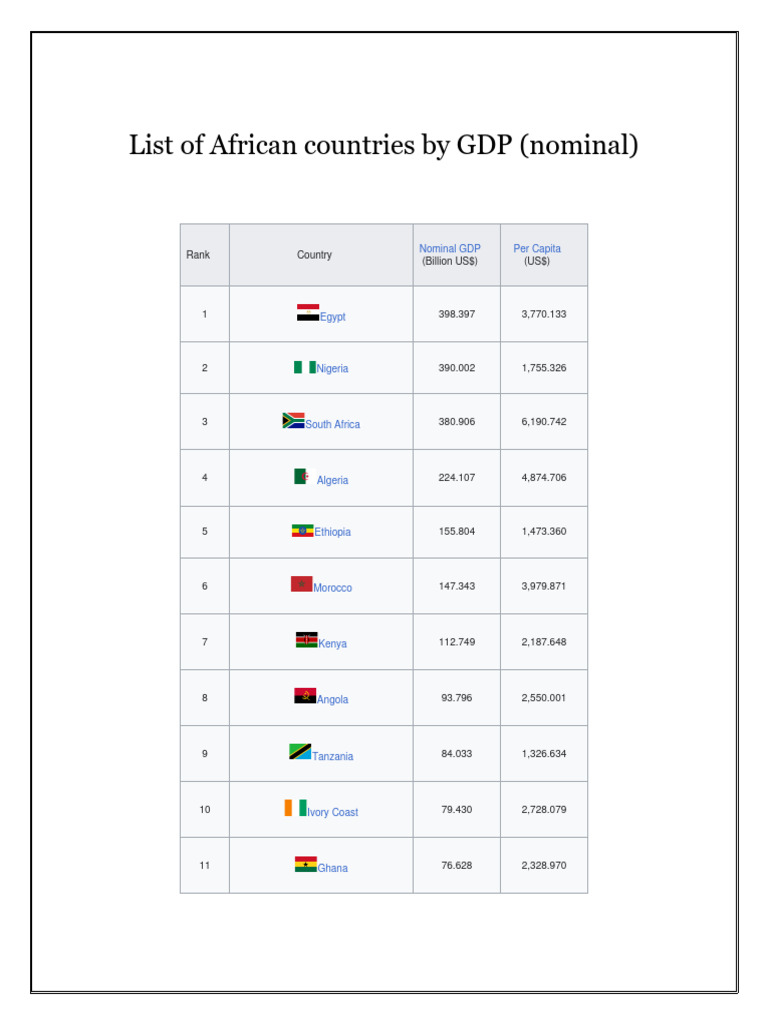
As the 21st century progresses, Africa is increasingly captivating global investors’ attention with its burgeoning economies and vast potential. The continent, rich in resources and cultural diversity, is poised for economic transformation. This guide delves into the top 10 richest African countries by Gross Domestic Product (GDP) in 2026, spotlighting their distinctive economic landscapes and potential for growth. Prepare to embark on an enlightening journey through the vibrant tapestry of Africa’s economic ascendancy.
1. Nigeria
At the forefront of Africa’s economic powerhouses is Nigeria, often referred to as the “Giant of Africa.” With a projected GDP soaring above $500 billion, Nigeria’s economy is underpinned by its vast oil reserves, which account for a substantial portion of its revenue. However, it is not solely reliant on hydrocarbons; agriculture and services are gaining momentum, showcasing the country’s multifaceted economic dynamism. The youth demographic represents a significant advantage, promising innovation and a workforce that could spur further economic growth.
2. South Africa
South Africa, with its GDP anticipated to exceed $400 billion by 2026, continues to be a key economic player on the continent. Rich in minerals and resources, the nation has a well-developed infrastructure, which enhances its industrial sector. The finance and service industries also contribute significantly to its GDP. South Africa’s position as a gateway to Africa opens avenues for trade, creating an environment ripe for investment and fostering regional economic integration.
3. Egypt
Projecting a GDP around $300 billion, Egypt is poised to solidify its position as one of the continent’s wealthiest nations. Its strategic location makes it a vital hub for international trade, particularly through the Suez Canal. Additionally, Egypt’s commitment to attracting foreign investment, coupled with a reform agenda aimed at bolstering economic performance, creates a fertile ground for growth. The tourism sector also plays an integral role, as ancient monuments and landscapes draw millions annually.
4. Ethiopia
In recent years, Ethiopia has emerged as a beacon of rapid economic growth, with a GDP predicted to surpass $250 billion. The government’s focus on industrialization and infrastructure development has been pivotal in elevating the nation’s economic stature. Despite historical challenges, the agricultural sector remains a bedrock of the economy, while urbanization is steering the nation toward a more diversified economic landscape, opening doors to a variety of sectors.
5. Angola
Angola, with a projected GDP of approximately $125 billion, is often seen as a paradox: endowed with substantial natural resources, yet grappling with economic stability. Predominantly an oil-dependent economy, the nation is gradually seeking to diversify its economic base by investing in agriculture and manufacturing. Wealth derived from oil must be judiciously managed to ensure sustainable development and to harness Angola’s full economic potential.
6. Ghana
Ghana, an exemplar of stability and governance in West Africa, anticipates a GDP of around $110 billion by 2026. Its economy has diversified impressively, with cocoa exports, gold mining, and a burgeoning oil industry driving growth. Furthermore, investments in technology and digital services are gaining traction, positioning Ghana as a burgeoning tech hub. This adaptability amidst global economic dynamics makes it a compelling subject of study for investors.
7. Kenya
Often celebrated as East Africa’s economic engine, Kenya is expected to achieve a GDP of $100 billion in 2026. It boasts a robust agricultural sector, along with emerging technology startups fueling innovation. The introduction of mobile money services has revolutionized financial inclusivity, further spurring economic activities. Kenya’s strategic location serves as a gateway for trade with neighboring countries, facilitating its dynamic economic landscape.
8. Tanzania
Tanzania is riding the wave of growing economic momentum, with a projected GDP approaching $90 billion by 2026. The nation’s abundant natural resources, including minerals and agriculture, are complemented by a booming tourism sector, with breathtaking landscapes and cultural richness drawing international visitors. Investment in infrastructure and energy projects aims to elevate Tanzania’s status in the global economy, making it an intriguing prospect for future developments.
9. Côte d’Ivoire
Côte d’Ivoire, witnessing robust economic resilience, is expected to achieve a GDP of around $85 billion. The country is one of the largest cocoa producers globally, and agriculture plays a fundamental role in sustaining its economic robustness. Additionally, strategic investments in infrastructure, manufacturing, and export diversification are shaping a resilient economic tableau that is attracting attention from global investors seeking opportunities in the region.
10. Senegal
Rounding out the list is Senegal, with a projected GDP in the vicinity of $70 billion. The West African nation is leveraging its strategic geographic location to bolster trade and investment. With government initiatives focused on improving infrastructure and fostering innovation, particularly in digital technology and renewable energy sectors, Senegal is positioning itself as a budding economic influencer within the region. Its stable political environment further enhances its attractiveness to foreign investors.
As we gaze into the future, it becomes evident that these ten African nations are not mere statistics; they symbolize the continent’s potential and resilience. Every nation is on a unique trajectory, navigating complexities while striving for sustainable growth. The promise of economic expansion, technological innovation, and resource management offers a paradigm shift in how we perceive Africa. With myriad opportunities unfolding, these countries are undoubtedly ones to watch as they redefine their economic landscapes. The African continent is not just the cradle of civilization; it is also emerging as a dynamic player on the global economic stage, inviting all to witness its transformative journey.
FAQ
What is GDP and why is it important for comparing countries?
Gross Domestic Product (GDP) measures the total value of goods and services produced by a country within a specific time period. It is an important indicator of economic performance and helps compare the economic size and health of different countries.
Which African country has the highest projected GDP in 2026?
Nigeria is projected to have the highest GDP in Africa in 2026, with an estimated GDP exceeding $500 billion.
What are some key sectors driving economic growth in Africa’s richest countries?
Key sectors include oil and gas, agriculture, mining, technology, tourism, finance, and manufacturing, varying by country.
How does economic diversification impact these African countries?
Economic diversification reduces dependence on a single sector, like oil, and promotes sustainable growth by expanding into agriculture, manufacturing, technology, and services.



Leave a Reply