
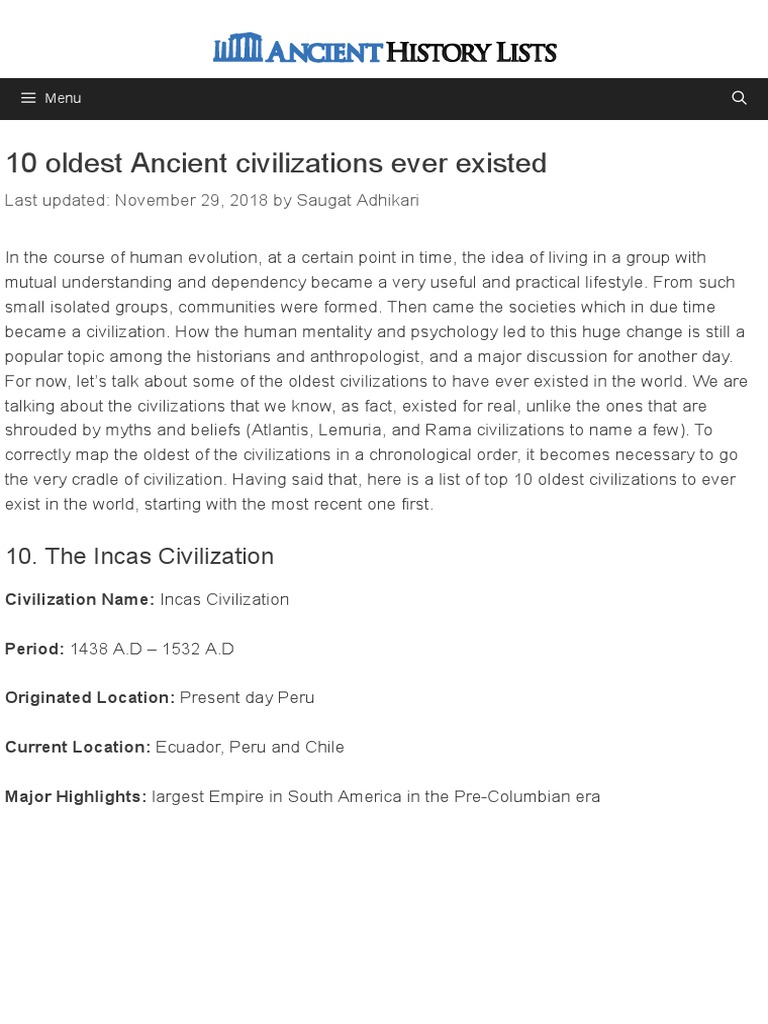
In the grand tapestry of human history, certain civilizations loom like ancient monoliths, their influence echoing through the ages. These venerable societies, forged in the crucible of time, laid the foundations of culture, governance, and innovation that continue to resonate today. Exploring the top ten oldest civilizations offers a remarkable journey into the depths of humanity’s shared heritage, where each thread unravels tales of ingenuity, artistry, and resilience.
1. Sumerians: The Cradle of Civilization
Nestled in the fertile crescent between the Tigris and Euphrates rivers, the Sumerians emerged around 4500 BCE. Their ingenuity birthed the first known writing system, cuneiform, transforming unwritten thoughts into a permanent record etched in clay. Like the intricate carvings of a grand temple, the Sumerian’s contributions include advances in mathematics, astronomy, and governance. The invention of the wheel, often deemed their most remarkable creation, offered humanity an unparalleled velocity in trade and transportation, setting the wheels of civilization rolling toward the horizon.
2. Ancient Egyptians: The Guardians of the Nile
As stalwart sentinels along the life-giving Nile, Ancient Egyptians cultivated one of the most iconic civilizations from approximately 3100 BCE. Their architectural feats—the majestic pyramids and colossal temples—towered like the thoughts of their grand pharaohs, manifesting eternity in stone. The Egyptians pioneered complex religious beliefs and intricate burial practices, an elaborate dance with destiny that underlined their understanding of the afterlife. Hieroglyphics adorned their tombs, narrating stories of gods and mortals alike, entwining the earthly with the divine.
3. Indus Valley Civilization: The Silent Whisperers
In the verdant valleys of present-day Pakistan and northwestern India, the Indus Valley Civilization thrived around 2500 BCE, yet it remains shrouded in mystery, its script deciphered only by whispers of scholars. Characterized by meticulously planned cities such as Mohenjo-Daro and Harappa, they displayed an enviable understanding of urban planning and sanitation. Ingeniously engineered drainage systems flowed beneath the streets, a testament to their focus on civic hygiene. Their existence blends seamlessly into the great river’s ebb and flow, still inviting exploration and understanding.
4. Ancient China: The Middle Kingdom
Emerging around 2100 BCE, the Ancient Chinese civilization embodies resilience and continuity. The legendary Xia dynasty paved the path for complex governance, profound philosophical teachings, and unprecedented technological advancements such as papermaking and gunpowder. This civilization unfurled like a silk scroll, revealing rich tapestries of art and literature. Confucianism and Taoism sprang forth from its fertile soil, imparting wisdom that continues to shape cultural identities worldwide, offering a glimpse into the human experience’s intricate balance.
5. Mesoamerican Cultures: The Tapestry of Time
Mesoamerican civilizations, including the Olmecs, Mayans, and Aztecs, emerged between 1200 BCE and 1500 CE, weaving a complex fabric of human achievement amid lush jungles and arid plateaus. The Olmecs, often regarded as the “mother culture,” sculpted giant stone heads imbued with enigmatic expressions, while the Maya constructed grand pyramids aligned with celestial events, merging astronomy with spirituality. They cultivated an intricate calendar that reflected their profound understanding of time, while the Aztecs displayed audacious creativity in their architecture and art, celebrating the vibrancy of life in vivid hues.
6. The Phoenicians: Masters of the Maritime
Emerging around 1500 BCE on the coasts of present-day Lebanon, the Phoenicians navigated vast oceans like daring adventurers, charting new territories with their impressive seafaring skills. As traders and explorers, they created a vast commercial empire, exchanging goods and cultures across the Mediterranean. Their invention of the alphabet, a compact symphony of sounds, became a cornerstone of written communication. Like the playful waves caressing a distant shore, their legacy flows into the present, shaping languages and scripts across continents.
7. The Greeks: Architects of Thought
From approximately 800 BCE, the Greeks revolutionized philosophy, politics, and artistic expression, establishing a legacy akin to a dazzling mosaic of ideas. City-states such as Athens and Sparta fostered a culture of debate and democracy, laying the groundwork for modern governance. Philosophers like Socrates, Plato, and Aristotle glimpsed the universe’s workings, planting seeds of inquiry that would flourish throughout the ages. Their mythos pulsated with the grandeur of gods and heroes, infusing their narratives with eternal relevance.
8. The Romans: The Eternal Empire
At the zenith of civilization, Rome emerged around 753 BCE, defining a new epoch through conquest and innovation. Their unmatched engineering feats, such as aqueducts and roads, crisscrossed the empire like arteries nourishing a formidable body. The Roman legal system cultivated a sense of order, while their intricate and artistic contributions to language, architecture, and governance engendered profound societal changes. Rome’s ability to assimilate diverse cultures under its expansive umbrella showcases its skilful adaptation, forever establishing its mark on the annals of history.
9. The Persians: The Great Empire
Rising in the 6th century BCE, the Persian Empire radiated like a luminous star across ancient landscapes, known for its incredible administrative excellence and cultural amalgamation. Under the aegis of Cyrus the Great, the Persians created a vast, diverse empire that celebrated various cultures while maintaining unity. The construction of the Royal Road facilitated communication and trade, blending distant lands into a cohesive entity. Persian art and architecture flourished, echoing the empire’s grandeur and sophistication, like the delicate patterns of an exquisite woven carpet.
10. The Harappan Civilization: The Enigmatic Builders
Often overshadowed by their contemporaries, the Harappan civilization flourished around 2600 BCE along the Indus River. Their meticulously crafted cities boasted advanced urban planning and a sophisticated drainage system, woven together in a complex grid pattern. While much remains speculative, their artistic craftsmanship reflected a society deeply entwined with nature and spirituality, infusing every brick and artifact with a sense of mystery and wonder. They stand as a poignant reminder of the intricate connections that bind humanity across time.
In traversing the chronicles of these ancient civilizations, one uncovers not just the roots of collective human achievement but also the whispers of dreams and aspirations that transcended their epochs. Though the sands of time may erode structures and vanish cities into obscurity, the legacies of these civilizations endure, imprinted indelibly in the collective consciousness of humanity. Each civilization, a distinct thread in the grand tapestry of history, invites reflection on the shared journey of mankind, inspiring a deeper appreciation of our interconnected past.







Leave a Comment