
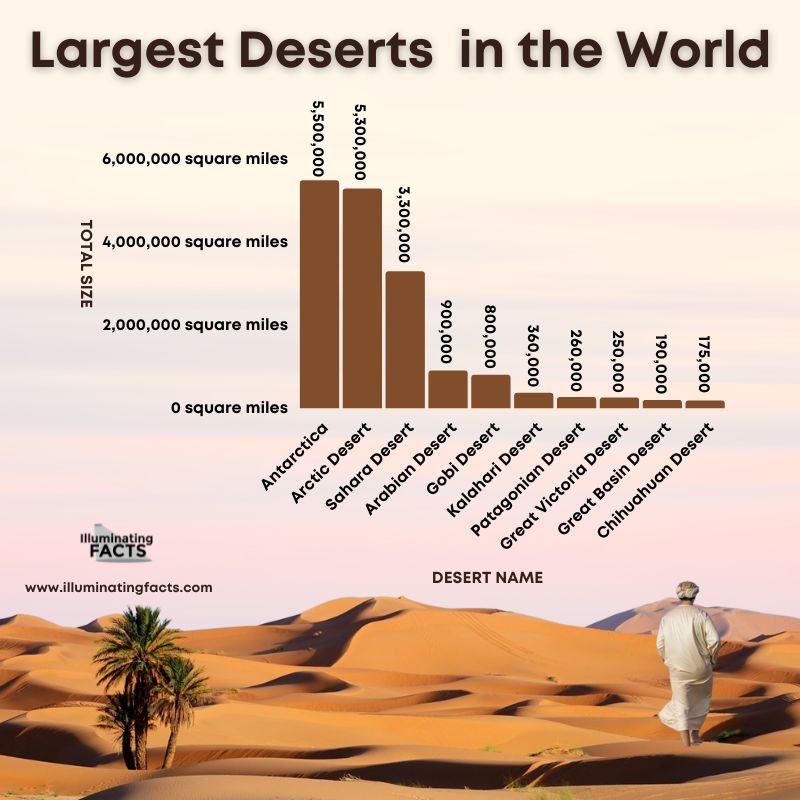
When one thinks of deserts, the imagination often conjures images of vast expanses of sand, scorching heat, and timeless landscapes adorned with resilient flora and fauna. These arid realms represent the earth’s most inhospitable yet stunningly beautiful regions. Exploring the world’s largest deserts unveils not only their size but also the rich tapestry of life and culture that thrives amid their desolation. Below are the top ten largest deserts in the world, each a unique testament to nature’s artistry.
1. Antarctic Desert – 5.5 Million Square Miles
Often perceived as a land of ice, the Antarctic Desert is deceptively beautiful. Think of a frosted paradise—a colossal expanse where the sun rarely kisses the ground, yet life flourishes in its own extraordinary capacity. This vast desert stands as the largest on our planet, swathed in a mantle of perpetual ice, hosting the greatest accumulation of freshwater on Earth. Its spectral beauty conceals an ecosystem rich in resilience, with hardy organisms enduring the harsh conditions to thrive amid the frozen wilderness.
2. Arctic Desert – 5.4 Million Square Miles
Adjacent to its sibling, the Arctic Desert shares the same precept of cold, yet its character is notably distinct. Picture a surreal painting where the shades of blue and white converge, the atmosphere shimmering under the glow of the Northern Lights. The Arctic is not merely a barren landscape; it bursts forth with unique adaptations where polar bears roam and migratory birds flock in search of sustenance. This desert, carved by icebergs and framed by cerulean waters, reminds us that life can flourish in the most unyielding of environments.
3. Sahara Desert – 3.6 Million Square Miles
As the iridescent crown jewel of warm deserts, the Sahara captivates with its golden dunes and undulating landscapes. Here lies the embodiment of heat—where temperatures can soar to 122°F (50°C). This desert sprawls over several countries, enshrining a rich cultural heritage of Tuareg tribes and echoes of ancient civilizations. The Sahara is not just an ocean of sand; it is a vibrant tableau of life, with oases nurturing a myriad of flora and fauna, and an intricate web of trade routes that tell tales of resilience and adaptation.
4. Arabian Desert – 900,000 Square Miles
The Arabian Desert rolls like a vast sea of relentless sand, an expanse steeped in ancient history and vibrant cultures. It’s a landscape that feels both timeless and ephemeral. Shaped by the wind, its dunes are sculpted into whimsical forms that shift and sway. The desert boasts resilience, with savvy flora such as the date palms and fauna like the elusive Arabian Oryx, all adapted to a life of scarcity. The echoes of the past resonate through the desert, with stories of caravans and trade weaving a rich tapestry of human history.
5. Gobi Desert – 500,000 Square Miles
The Gobi Desert, a stark contrast of rocky terrain and rolling sand, tells a story of extremes. Imagine stepping into a tapestry woven with threadbare silks under a grand canopy of stars. This high-altitude desert, flanked by the steppes of Mongolia and the orange-hued sands of inner China, is remarkable for its ability to transform. While it can bear the brunt of scorching days, the nights turn frigid, revealing the duality of nature. It shelters an array of endangered species, including the Bactrian camel, reminders of the connectivity between biodiversity and challenging environments.
6. Kalahari Desert – 360,000 Square Miles
The Kalahari is more than just a desert; it is an undulating sea of life that blooms amid adversity. Picture sun-baked savannahs under a wash of blue skies, punctuated by the resilient acacia trees and lively wildlife. Not strictly a desert by the most stringent definitions, it is often referred to as a “semi-desert” due to its periodic rains. Home to the San people and rich in biodiversity, the Kalahari showcases a harmonious relationship between its inhabitants and the land, where survival becomes an art form.
7. Patagonian Desert – 260,000 Square Miles
Nestled in the southern hemisphere, the Patagonian Desert is defined by its vast steppes and robust landscapes. Picture a wild, untamed expanse that displays an extraordinary palette of colors—with mountains, plateaus, and windswept plains. It stands as the largest desert in Argentina, where the wind howls the tales of ancient civilizations and the land breathes the spirit of the indigenous Mapuche people. Its beauty lies in the stark juxtaposition of land and sky, where the horizon stretches endlessly, inviting contemplation.
8. Great Victoria Desert – 250,000 Square Miles
The Great Victoria Desert is a captivating expanse nestled in Australia, where the red dunes ripple like a sea of clay, and the silence is a gentle lullaby to the ear. It’s a landscape defined by ancient cultures, skilled survival techniques, and a quirky array of wildlife. The desert’s character shifts dramatically with the seasons, showcasing how life can be both delicate and resilient. This great expanse is not merely a barren space; rather, it embodies the spirit of the Australian outback, pulsating with life stories etched into its sand.
9. Syahara Desert – 200,000 Square Miles
The Syahara Desert, a relatively lesser-known expanse, invites adventurers to a world of stark beauty and silence. It flourishes beneath the warm sun, where the terrain consists of sandy floors, rocky outcrops, and a sparse scatter of vegetation. As one traverses its expanse, they unearth secrets of ancient rocks and whispering winds, providing a canvas for human exploration. This enigmatic desert offers insights into geological formations and uniquely adapted wildlife, making it a haven for the intrepid traveler.
10. Chihuahuan Desert – 140,000 Square Miles
Lastly, the Chihuahuan Desert stretches across the United States and Mexico, awash with vibrant life against a backdrop of stark, rugged beauty. With unique ecosystems, it houses a variety of cacti and an assortment of diverse wildlife. The desert echoes with the calls of coyotes and the rustle of lizards basking under a searing sun. It’s a living gallery that showcases the adaptability of life amid dry terrain, revealing how beauty often thrives in the least expected places.
These ten deserts, each a world unto itself, beckon to explorers and dreamers alike. They embody not only the physical extremes of our planet but also the intricate interplays of life, culture, and history that unfold within their vast expanses. In the study of these arid wastelands, one finds more than desolation; one discovers resilience, beauty, and the profound connectivity of existence, reminding us that even in life’s harshest landscapes, vibrancy abounds.







Leave a Comment