
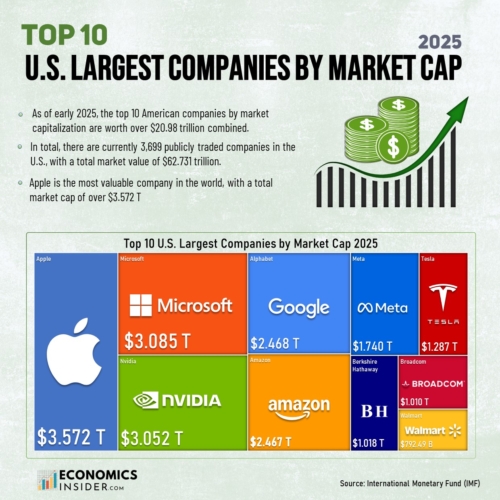
Have you ever pondered what makes certain companies truly titans in the marketplace? The world of corporate giants is both fascinating and complex. Market capitalization, often abbreviated as market cap, serves as a vital metric indicating a company’s value in the eyes of investors. As we traverse the landscape of the United States’ financial prowess, let’s explore the top ten companies that dominate this realm by market cap, shall we? Buckle up, because while this journey may highlight some household names, it also unveils the competitive nature of modern capitalism.
1. **Apple Inc.**
Pioneering the tech revolution, Apple stands tall as a behemoth in the market cap hierarchy. Renowned for its innovative products like the iPhone, iPad, and Mac, the company has cultivated a devoted user base. With its continuous foray into services—such as Apple Music and Apple TV+—the brand has diversified its revenue streams, promising sustained growth. The robust ecosystem it has created poses a question: can the competition catch up to its juggernaut status?
2. **Microsoft Corporation**
Once solely recognized for its software supremacy, Microsoft has adeptly adapted to the evolving technological landscape. The incorporation of cloud computing through Azure has propelled it into the stratosphere of market capitalization. Microsoft’s ability to harmonize productivity with innovative solutions offers a formidable challenge to other tech entities. Who can rival its sheer dominance in enterprise solutions?
3. **Alphabet Inc.**
Home to search engine giants Google and various other subsidiaries, Alphabet’s diverse portfolio reaches far beyond advertising. Its pursuits in artificial intelligence, autonomous vehicles, and cloud services illustrate a commitment to the future. With each venture, Alphabet not only solidifies its market presence but tantalizes investors with the prospect of untapped territories. Will rivals manage to disrupt its various dominions?
4. **Amazon.com Inc.**
A titan in e-commerce and cloud computing, Amazon’s market cap is a testament to its relentless expansion strategy. With an unwavering focus on customer satisfaction and rapid delivery options, it has transformed shopping habits across the globe. Furthermore, its foray into original content production and smart home technology makes one wonder: is Amazon’s growth even close to its zenith, or have we merely glimpsed the surface of its potential?
5. **Berkshire Hathaway Inc.**
Led by the astute Warren Buffett, Berkshire Hathaway represents a conglomerate whose market cap reflects diverse investments ranging from insurance to railroads. The company’s philosophy prioritizes intrinsic value and long-term gains rather than short-term fluctuations. When the world of fleeting trends beckons, can this stalwart of steadfast investment continue to thrive?
6. **Tesla Inc.**
Revolutionary in the automotive industry, Tesla’s market cap is fueled by its vision of sustainable energy and electric vehicles. Breaking barriers through cutting-edge technology, it has captured consumer interest and investor enthusiasm alike. However, as traditional manufacturers ramp up their electric offerings, Tesla faces an impending test: can it maintain its innovative edge and production cadence amidst burgeoning competition?
7. **Meta Platforms, Inc.**
Formerly known as Facebook, Meta has transcended its beginnings, now positioning itself as a leader in social media and virtual reality. As the digital landscape continues to evolve, its ambitious shift towards the metaverse indicates a strategic pivot that could redefine online interaction. Yet, with increasing scrutiny and competition, how will Meta navigate the potential labyrinth of regulations and public opinion?
8. **NVIDIA Corporation**
In the realm of semiconductors and graphics processing units (GPUs), NVIDIA has gained prominence as a vanguard of technological advancement. Its pivotal role in artificial intelligence and machine learning has been instrumental in creating innovative solutions across various industries. Given the expansive applications of its technology, one must ponder: can NVIDIA sustain its rapid growth, or will new contenders in the semiconductor space pose formidable challenges?
9. **Visa Inc.**
As a leader in the financial services sector, Visa’s market cap reflects its integral role in facilitating global commerce through electronic payments. With the ongoing shift toward a cashless society, its innovative solutions in digital payment technologies suggest a bright future. However, as fintech companies emerge, can Visa hold its ground in an increasingly competitive landscape?
10. **Procter & Gamble Co.**
As a stalwart in the consumer goods industry, Procter & Gamble has deftly navigated market fluctuations to maintain a significant market cap. Well-known brands like Tide, Gillette, and Pampers underline its strong consumer affinity. Nevertheless, with shifting consumer preferences leaning towards sustainability, how adept is Procter & Gamble in adapting to the modern eco-conscious shopper?
In conclusion, the landscape of the companies with the highest market capitalization in the United States reveals a rich tapestry of innovation, competition, and strategy. Each entity has its unique strengths and challenges, yet they all play a pivotal role in molding the economic landscape. As the dynamics of the economy evolve, these companies face ever-increasing competition and challenges that will determine their future trajectories. So, which company do you think will lead the charge in the coming years? That’s a question worth pondering, as the only constant in the world of business is change.







Leave a Comment