
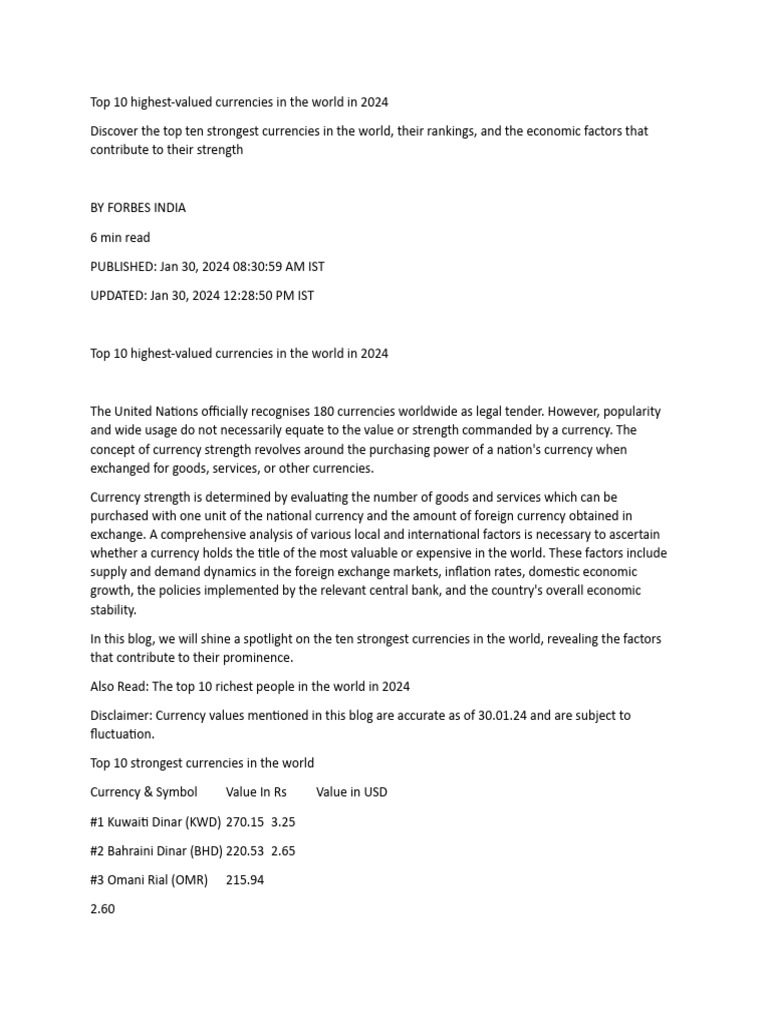
Short Answer
The world of currency often mirrors the intricate dynamics of global economies, demonstrating not only the strength of nations but also their economic philosophies. At the heart of this financial ebb and flow lies the concept of currency strength, defined primarily by its exchange rate against the United States dollar (USD), amongst other currencies. This exploration dives into the top ten strongest currencies around the globe, examining the factors contributing to their robust standing and the underlying narratives that render them fascinating in the ever-evolving economic landscape.
1. Kuwaiti Dinar (KWD)
The Kuwaiti Dinar emerges as the reigning champion in the realm of currency strength. Its value rests significantly on the country’s oil reserves, which are among the largest in the world. The Kuwaiti government’s prudent management of oil revenues and a sound fiscal policy has fortuitously fortified the Dinar against fluctuations common to other currencies. The allure of the KWD is not merely numerical but entwined with Kuwait’s efforts to stabilize its economic environment, making it a currency of intrigue and respect.
2. Bahraini Dinar (BHD)
Following closely is the Bahraini Dinar, a reflection of Bahrain’s well-diversified economy. The BHD is tethered to a robust financial sector alongside significant oil production, which underpins its strength. Factors such as Bahrain’s strategic location in the Gulf and its status as a financial hub perpetuate its economic significance. The Dinar’s resilience invites admiration, showcasing how a smaller nation can wield immense economic power through strategic planning.
3. Omani Rial (OMR)
The Omani Rial is another heavyweight in global currencies, characterized by its strong valuation against the USD. A mix of natural resource wealth, specifically oil, and a prudent approach to public expenditure fuels its strength. The OMR’s allure extends beyond its exchange rate; it epitomizes Oman’s strategic investments in infrastructure and economic diversification, making it a profound case study in modern economic resilience.
4. Jordanian Dinar (JOD)
China’s meteoric rise has impacted many global economies, but the Jordanian Dinar manages to maintain a solid footing amidst regional challenges. Its strength is bolstered by policies that have fostered relative stability and control over inflation. The fixed exchange rate regime enhances confidence amongst investors and citizens alike, transforming the JOD into a symbol of economic stability in a sometimes unpredictable region.
5. British Pound Sterling (GBP)
The British Pound Sterling, one of the oldest currencies still in use, commands respect worldwide. Amidst the intricacies of Brexit and a transitioning economy, the GBP remains a powerhouse largely due to the UK’s financial sector’s prominence and the historical appeal of British commerce. The GBP offers a fascinating lens into how historical legacy intertwines with contemporary economic realities.
6. Euro (EUR)
As the common currency for European Union member states, the Euro provides a fascinating insight into collective economic strength. Its value fluctuates based on the collective prosperity of its 19 member countries. The Eurozone benefits from a significant trade bloc, which adds to the Euro’s stability. This currency embodies the complexities and cooperation of nations striving for economic unity amidst diversity.
7. Swiss Franc (CHF)
Occupying a unique position, the Swiss Franc is synonymous with stability, often viewed as a safe haven during tumultuous economic times. The currency’s strength is underpinned by Switzerland’s robust banking sector, strong fiscal policies, and an impeccable credit rating. The CHF’s reliability fosters an intriguing fascination among global investors seeking refuge from uncertainty, showcasing the psychological dimensions of currency valuation.
8. Canadian Dollar (CAD)
The Canadian Dollar stands out as a pillar of strength, largely due to Canada’s abundant natural resources and a well-regulated banking system. The CAD is frequently influenced by commodity prices, making its strength a barometer for global economic trends. Its appeal transcends traditional parameters of strength, reflecting a nation’s commitment to sustainable growth and market responsiveness.
9. US Dollar (USD)
Often referred to as the world’s primary reserve currency, the US Dollar holds a pivotal role in international trade and finance, allowing it to maintain a unique strength. Though it may not lead in value against some currencies, its ubiquity and acceptance define its superiority. This widespread dependence speaks to deeper ties and complexities of global financial interconnections that intrigue economists and analysts alike.
10. Singapore Dollar (SGD)
Rounding out this list is the Singapore Dollar, which encapsulates the transformative story of Singapore as a global financial hub. A thriving economy driven by high-tech industries and financial services, the SGD signifies not only economic prowess but also the success of strategic governance and investment in education and innovation. Singapore’s resilience provides an aspirational model for emerging economies.
In conclusion, the strongest currencies in the world present an intricate tapestry woven from historical legacies, resource wealth, entrepreneurial vigor, and strategic governance. Their strengths are not just numerical; they represent the stories of nations that persistently navigate complexities to achieve economic robustness. Understanding these currencies offers an enlightening perspective on the global economy, shedding light on the interplay of power dynamics, cultural narratives, and the multifaceted nature of wealth. As we observe these financial titans, we are reminded that behind every currency lies a story of resilience, ambition, and an ever-changing world order.
FAQ
What determines the strength of a currency?
The strength of a currency is primarily determined by its exchange rate against other currencies, economic stability, fiscal policies, natural resources, inflation control, and investor confidence.
Why is the Kuwaiti Dinar considered the strongest currency?
The Kuwaiti Dinar is considered the strongest currency due to Kuwait's large oil reserves, prudent management of oil revenues, and sound fiscal policies that stabilize its economic environment.
How does the US Dollar maintain its global strength despite not being the highest valued currency?
The US Dollar maintains global strength due to its role as the world’s primary reserve currency, widespread acceptance in international trade, and deep financial markets.
What makes the Swiss Franc a safe haven currency?
The Swiss Franc is viewed as a safe haven because of Switzerland’s robust banking sector, strong fiscal policies, and impeccable credit rating, which attract investors during economic uncertainty.



Leave a Reply