
Short Answer
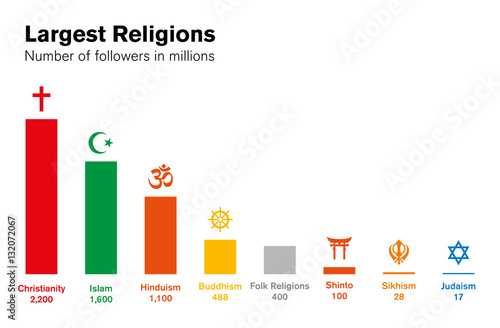
In a world awash with diverse belief systems, have you ever pondered which religions hold sway over the hearts and minds of the majority? As you embark on this inquisitive journey, you may find it challenging to comprehend not just the numbers, but also the rich tapestry of traditions, rituals, and philosophies that these faiths embrace. Herein lies a classification of the top ten religions, ranked by the estimated number of followers globally.
1. Christianity
With approximately 2.4 billion adherents, Christianity stands at the zenith of global religions. This monotheistic faith is anchored in the teachings of Jesus Christ, whose message of love, forgiveness, and redemption resonates with multitudes. Christianity is a tapestry woven from various denominations, including Catholicism, Protestantism, and Eastern Orthodoxy, each contributing unique interpretations of sacred texts and rituals. The global reach of Christianity spans continents, underlining its adaptability and enduring relevance.
2. Islam
Islam claims around 1.9 billion followers and is centered on the teachings of the Prophet Muhammad, conveyed through the Quran. This Abrahamic faith emphasizes submission to the will of Allah and encompasses five pillars that serve as a spiritual foundation: the declaration of faith (Shahada), prayer (Salah), almsgiving (Zakat), fasting during Ramadan (Sawm), and pilgrimage to Mecca (Hajj). The rich history of Islam includes diverse sects such as Sunni and Shia, each offering distinct perspectives while sharing core beliefs.
3. Secular/Atheist/Agnostic Nonreligious
Approximately 1.2 billion individuals identify as secular, atheist, or agnostic, challenging traditional notions of religion. This category showcases a growing community that prioritizes scientific reasoning and empirical evidence over faith-based beliefs. However, within this group, myriad philosophical stances coexist. Some adhere to humanistic principles, while others may find solace in existential explorations of life’s meaning without invoking the divine.
4. Hinduism
With about 1.2 billion adherents, Hinduism is often regarded as one of the oldest religions, characterized by its polytheistic beliefs and rich philosophical underpinnings. Unlike many faiths, Hinduism lacks a singular foundational text; instead, it is a confluence of various scriptures, including the Vedas, Upanishads, and epics like the Mahabharata and Ramayana. The religion encompasses a multitude of deities, rituals, and customs, fostering an intricate spiritual landscape that celebrates both individuality and community.
5. Buddhism
Originating in the 5th century BCE, Buddhism has around 520 million adherents who follow the teachings of Siddhartha Gautama, known as the Buddha. Central to this philosophy are the Four Noble Truths and the Eightfold Path, which guide practitioners toward enlightenment and the cessation of suffering (Nirvana). Buddhism, with its emphasis on mindfulness, compassion, and ethical living, has evolved into various branches, including Theravada and Mahayana, each offering distinct interpretations and practices.
6. Chinese Traditional Religion
Encompassing various folk beliefs, ancestor worship, and philosophies such as Confucianism and Taoism, Chinese Traditional Religion boasts approximately 394 million followers. This eclectic spiritual framework celebrates harmony with nature and reverence for the wisdom of ancestors. Festivals, rituals, and practices often reflect the cyclical nature of life and emphasize collective well-being, making it a deeply communal experience.
7. Sikhism
With a robust following of around 30 million, Sikhism emerged in the 15th century in the Punjab region of India. Founded by Guru Nanak, the faith emphasizes living a truthful life, sharing with others, and meditative worship of one God. The Guru Granth Sahib, the spiritual scripture of Sikhism, serves as the eternal Guru, guiding followers in their spiritual journey. The vibrant community ethos of Sikhism is exemplified by the practice of Langar, where all, regardless of background, share a meal.
8. Judaism
The Jewish faith, with roughly 14.8 million adherents, is one of the oldest monotheistic religions, founded over 3,500 years ago. Centered on the covenant between God and the people of Israel, Judaism encompasses a rich mosaic of traditions, laws, and cultural practices. The Hebrew Bible (Tanakh) is the foundation of Jewish faith, with the Talmud offering interpretations and discussions that have shaped Jewish thought over millennia. Festivals such as Passover and Yom Kippur reflect profound historical and theological significance.
9. Bahá’í Faith
With about 7 million followers, the Bahá’í Faith emerged in the 19th century, promoting the oneness of humanity and the unity of all religions. Founded by Bahá’u’lláh, this faith emphasizes global harmony and peace, advocating for racial and gender equality. Its teachings encourage spiritual and moral development, focusing on the importance of service to others as a method of realizing one’s purpose.
10. Jainism
Jainism, with approximately 4.5 million adherents, is an ancient Indian religion that espouses non-violence (ahimsa) as its core principle. Founded by Mahavira in the 6th century BCE, Jainism teaches the path to spiritual purity and enlightenment through unwavering commitment to truth, non-possessiveness, and compassion toward all living beings. The Jain community is known for its exquisite rituals, festivals, and a dedication to ecological consciousness.
As we traverse this expansive spectrum of beliefs, it becomes increasingly clear that the world’s religions are not mere numbers; they embody the hopes, dreams, and values of billions. Each faith offers a unique lens through which adherents interpret existence and navigate life’s complexities. So, which of these spiritual paths resonate most profoundly with you? Exploring these faiths may present an enriching challenge, opening windows to understanding not just their doctrines but the universal human experience that binds us all.
FAQ
What are the top 3 religions in the world by number of followers?
The top three religions by number of followers are Christianity (2.4 billion), Islam (1.9 billion), and Secular/Atheist/Agnostic Nonreligious (1.2 billion).
Which religion has the oldest origins among the top 10?
Hinduism is considered one of the oldest religions among the top 10, with ancient scriptures like the Vedas dating back thousands of years.
What are the main pillars of Islam?
The five pillars of Islam are the declaration of faith (Shahada), prayer (Salah), almsgiving (Zakat), fasting during Ramadan (Sawm), and pilgrimage to Mecca (Hajj).
How many followers does Buddhism have worldwide?
Buddhism has approximately 520 million followers globally.
What is the core principle of Jainism?
The core principle of Jainism is non-violence (ahimsa), emphasizing truth, non-possessiveness, and compassion toward all living beings.






Leave a Reply