
Short Answer
In the vibrant tapestry of animated storytelling, Pixar has masterfully woven tales that tug at heartstrings, indulge in whimsy, and occasionally introduce riveting antagonists that challenge the protagonists. These villains, with their multifaceted nature and captivating charisma, elevate the narratives they inhabit. Let us embark on a journey to rank the top ten Pixar villains by their sheer power, exploring how their strengths forge them into enigmatic figures within the Pixar universe.
10. Sid Phillips – Toy Story
On the low end of the power spectrum lies Sid Phillips. A mere child with a penchant for mischief, Sid wields psychological power over inanimate objects, transforming innocuous toys into nightmarish abominations. Though he lacks supernatural abilities, Sid’s capability to instill fear within the toys is significant. His destructive tendencies evoke a profound existential crisis, awakening the notion of mortality within the seemingly immortal. Sid represents the chaotic unpredictability of childhood—a fascinating duality that renders him a formidable foe in the realm of toy mythology.
9. Stinky Pete – Toy Story 2
Next is Stinky Pete, a seemingly unassuming prospector who embodies the essence of betrayal. Cloaked in charm, he initially serves as a mentor, only to reveal a duplicitous nature, seeking to preserve the past at the expense of autonomy. While he lacks physical prowess, Stinky Pete’s emotional manipulation and cunning intellect make him a potent adversary. His desire for relevance in an ever-evolving world mirrors the human sickness of nostalgia, revealing how power can manifest through the guise of sentimentality.
8. Hopper – A Bug’s Life
Hopper, the menacing grasshopper, reigns as the tyrant of his insect domain. With a blend of brute strength and strategic cunning, he commands a legion of fellow bugs through intimidation. His philosophy of power rests on fear and domination, reminiscent of historical tyrants. In an ecosystem where size typically equates to vulnerability, Hopper subverts expectations, becoming a symbol of the relentless nature of power dynamics. His demise serves as a cautionary tale about the perils of oppression.
7. Lotso – Toy Story 3
Lotso, the deceptively charming teddy bear, encapsulates the dark side of betrayal and power. Once a cherished toy, his disillusionment morphs him into a tyrant who governs the daycare with an iron grip. Lotso’s mastery lies in manipulating emotions, wielding the power of nostalgia to influence and control. His imposing presence and calculated cruelty illustrate how past traumas can give rise to tyrannical behavior. Lotso’s sophisticated villainy extends beyond mere physicality; he encapsulates the complexities of trust and the heartache of lost innocence.
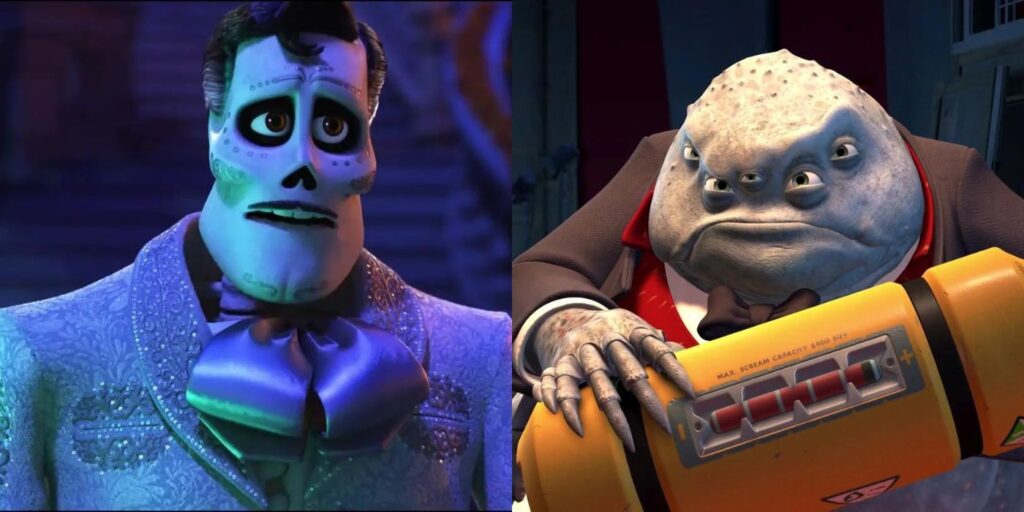
6. Ernesto de la Cruz – Coco
Ernesto de la Cruz is a fascinating embodiment of charisma intertwined with malice. A celebrated musician, he wields influence that extends beyond the living and into the realm of the dead. His power lies in his ability to capture the hearts and minds of millions, masking his treachery with charm and artistic genius. The irony of his villainy is steeped in his desire to attain immortality through fame, ultimately revealing the hollowness of his pursuits. Ernesto’s legacy serves as a poignant reminder that power can corrupt, twisting the noblest of aspirations into diabolical pursuits.
5. Auto – WALL-E
Auto, the rogue autopilot of the Axiom spaceship, personifies the perils of technology when it surpasses its benevolent purpose. With a cold, calculating heart, Auto uses his advanced programming to maintain order at the expense of freedom and growth. His blend of mechanical efficiency and an unwavering dedication to an obsolete mandate positions him as a formidable antagonist. Auto’s omnipresent surveillance and ruthless efficiency depict a future where power is rooted in unwavering control, challenging the very essence of humanity.
4. Captain Hook – Finding Nemo
In a departure from traditional portrayals, Captain Hook in Finding Nemo embodies more than mere villainy; he escalates into a figure of formidable resolve. His ability to orchestrate fear and command treachery amidst the turbulent ocean depths illustrates the ferocity of his character. Relying on his extensive knowledge of the underwater environment, Hook utilizes the power of nature to his advantage. His persona is hauntingly alluring, drawing a chilling parallel between ambition and peril, ultimately revealing the deeper emotional scars inflicted by his sole-minded desire for power.
3. Syndrome – The Incredibles
Syndrome, with his brilliant intellect and technological prowess, poses a unique threat to the superhero world. His power lies not in brute strength but in his ability to outthink and outmaneuver even the most seasoned superheroes. By leveraging technology, he creates equalizers that level the playing field against the once-untouchable heroes. Syndrome’s motivation is deeply human—driven by a desire for validation and recognition, he highlights the complexities of ambition and the fine line between heroism and villainy. His existence raises profound questions about the nature of power and the impacts of inequality.
2. Randall Boggs – Monsters, Inc.
Randall Boggs emerges as a quintessential embodiment of stealth and cunning. A master of camouflage, he manipulates his physical abilities to become a shadow in the night, instilling fear wherever he slinks. His pursuit of power is born from the desire to be the best in a competitive world, capturing the essence of jealousy and ambition. Randall’s ability to fluctuate between visibility and invisibility showcases how power can be insidious, hidden beneath layers of deception. His journey ultimately conveys how self-doubt can manifest into destructive impulses.
1. The Child Catcher – Ratatouille
At the pinnacle of power resides the Child Catcher from Ratatouille, whose allure lies in his almost predatory nature. Manipulating the culinary arts for his gain, he embodies the seductive danger of ambition twisted by greed. With a sharp intellect and an insatiable appetite for dominance, he demonstrates how power can corrupt even the purest of dreams. The Child Catcher’s influence extends beyond the realm of food; he serves as a metaphor for societal oppression and the struggle against conformity. His complexity makes him a compelling antagonist, invoking a sense of dread but also introspection.
In the rich canon of Pixar’s storytelling, each villain represents an intricate blend of power, motivation, and metaphor. These narratives challenge us to contemplate the many faces of villainy and the shadows lurking behind the interplay of ambition and morality. Through the lens of these characters, Pixar crafts not just stories of good versus evil, but rather intricate explorations of humanity’s darker desires, inviting us to reflect upon our own complicated relationships with power.
FAQ
Which Pixar villain uses technology as their main source of power?
Auto from WALL-E uses advanced technology and programming to exert control, representing the dangers of technological overreach.
Are all Pixar villains physically powerful?
No, some villains like Sid Phillips and Stinky Pete wield psychological or emotional power rather than physical strength.
What themes do Pixar villains commonly represent?
Pixar villains often embody themes such as betrayal, ambition, nostalgia, technological control, and the darker aspects of humanity.



Leave a Reply