
Short Answer
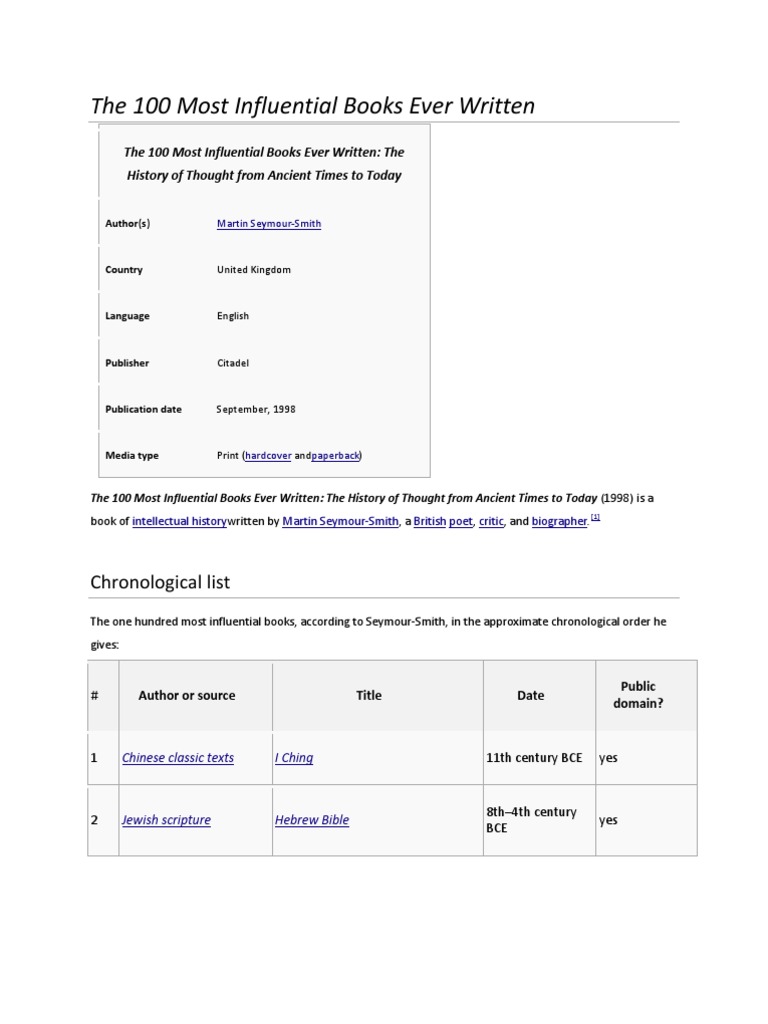
Books possess an uncanny ability to transcend time and culture, offering profound insights into the human condition. Whether they provoke thought, inspire revolutions, or illuminate the darkness of ignorance, the most influential books serve as harbingers of change and catalysts for dialogue. They capture the zeitgeist of their era while often providing timeless wisdom that resonates across generations. This compilation of the top ten most influential books ever written delves into their historical significance, thematic profundity, and enduring relevance, thereby illuminating the deeper reasons for our fascination with them.
1. The Bible
No exploration of influential literature can commence without acknowledging the reverberations of the Bible. This sacred text, revered in Christianity, Judaism, and Islam, comprises myriad genres, including poetry, history, and law. Its narratives encompass themes of morality, faith, and the human struggle, making it a cornerstone for countless cultural and ethical frameworks. The Bible has not only shaped religious thought but also sparked sociopolitical movements, influencing art, literature, and even the formation of legal systems across civilizations.
2. The Quran
As the holy book of Islam, the Quran commands profound respect and reverence among its followers. Its lyrical eloquence and intricate narrative structures encapsulate the doctrine of one of the world’s largest religions. Beyond its religious significance, the Quran has inspired philosophical discussions about existence, morality, and governance, serving as a source of guidance for millions. Its role in shaping identity, culture, and social justice issues depicts the intricate interplay between literature, spirituality, and society.
3. “1984” by George Orwell
George Orwell’s dystopian saga “1984” has become a landmark of social criticism and political discourse. Within its pages, Orwell explores themes of totalitarianism, surveillance, and the manipulation of truth. The term “Orwellian” has entered the lexicon, representing the era’s chilling fear of oppressive regimes. The novel’s prescience and relevance in today’s world of digital surveillance and information wars reveal our ceaseless battle against authoritarianism and the disintegration of civil liberties, captivating readers with its inexorable warnings.
4. “The Communist Manifesto” by Karl Marx and Friedrich Engels
With its iconic call to arms for the proletariat, “The Communist Manifesto” has influenced a plethora of political movements and ideologies around the globe. Its incisive critique of capitalism and class struggle provided a foundation for revolutionary thought. The manifesto’s enduring legacy lies in its capacity to frame discussions about economic disparity, social justice, and human rights. The fervent advocacy for a classless society resonates today, as it prompts dialogues about the implications of rampant capitalism in modern society.
5. “To Kill a Mockingbird” by Harper Lee
Harper Lee’s poignant exploration of racism and empathy in “To Kill a Mockingbird” offers a timeless reflection on human integrity and moral fortitude. Set in the racially charged American South, the novel portrays the innocence of childhood against the backdrop of societal prejudice, inspiring generations to confront their biases. Its exploration of compassion and justice invites readers to reconsider the complexities of human behavior, urging a call to action for social change and understanding.
6. “Pride and Prejudice” by Jane Austen
Jane Austen’s “Pride and Prejudice” remains a quintessential examination of social class, gender expectations, and romantic sensibilities. The novel’s sharp wit and perceptive observations offer a microcosmic view of early 19th-century British society. Through the dynamics of Elizabeth Bennet and Mr. Darcy, Austen encourages readers to question societal norms and underscores the value of personal virtue over wealth and status. Its enduring popularity lies in its exploration of love and marriage, as well as its commentary on societal constructs.
7. “The Great Gatsby” by F. Scott Fitzgerald
F. Scott Fitzgerald’s “The Great Gatsby” stands as a poignant critique of the American Dream during the Jazz Age. Through the tragic narrative of Jay Gatsby, Fitzgerald elucidates the disillusionment that accompanies wealth and the ephemeral nature of success. The novel captures the essence of a civilization caught between the veneer of opulence and the stark realities of moral decay. Its exploration of ambition, identity, and societal illusion continues to resonate with readers confronting similar themes in contemporary culture.
8. “The Diary of a Young Girl” by Anne Frank
The haunting reflections of Anne Frank during her time in hiding encapsulate the horrors of the Holocaust and the indomitable spirit of youth. This intimate narrative serves as both a historical document and a universal testament to resilience amid adversity. Anne’s eloquence, humor, and insight provide a deeply personal lens into the atrocities of war, invoking empathy and a powerful reflection on humanity’s capacity for both cruelty and compassion. Her diary endures as a clarion call for tolerance and understanding.
9. “One Hundred Years of Solitude” by Gabriel García Márquez
Gabriel García Márquez’s “One Hundred Years of Solitude” epitomizes the magic realism movement and highlights the cyclical nature of history. Through the Buendía family saga, Márquez delves into themes of solitude, myth, and the intersection of personal and political histories. The rich tapestry of narrative offers insights into Latin American culture while resonating with universal themes of love, loss, and the inexorable passage of time. Its literary innovation and depth captivate readers, inviting reflection on the complexity of human experience.
10. “Sapiens: A Brief History of Humankind” by Yuval Noah Harari
In “Sapiens,” Yuval Noah Harari embarks on a sweeping exploration of human history, from the Stone Age to the present. By weaving anthropology, history, and economics, Harari challenges readers to reconsider the narratives that shape our understanding of civilization. His thought-provoking inquiries into the evolution of societies, technology, and consciousness compel us to reflect on our collective future. Harari’s insights into the human condition stir curiosity about what it means to be human, fostering an enduring fascination with our species’ journey.
In conclusion, the remarkable journey through these top ten influential books uncovers the intricacies of the human spirit and the myriad narratives that shape our understanding of the world. Each book, with its unique voice and purpose, contributes to the dialogue of civilization, illuminating the trials and tribulations we face. Their enduring legacy beckons future generations to engage with their themes, fostering a profound empathy and an unwavering quest for knowledge. The magic of literature lies in its power to provoke thought, inspire change, and connect us across time and space, making these texts perennially relevant and essential in our shared human narrative.




Leave a Reply