
Short Answer
The world is a stage where nature has sculpted colossal performers, grandiose in size and ancient in wisdom. The largest trees on the planet stand as silent witnesses to the passage of time, embodying not only the grandeur of their height and girth but also the intricate stories woven into their very fibers. Each tree, with its immense trunk and sprawling canopy, resembles a monument carved by nature herself, inviting awe and prompting us to reflect on the majesty of life. Here, we delve into the top ten largest trees in the world, each a living testament to resilience and longevity.
1. Hyperion: The Titan of the Redwood Forest
Nestled in the remote reaches of California’s coastal redwood (Sequoia sempervirens) habitat, Hyperion towers at a staggering height of 379.7 feet (115.7 meters). Discovered in 2006, this eminent tree has quickly become a paragon among its peers. Its vertical reach is akin to a celestial spire, piercing the heavens and draping itself in a mantle of verdant foliage. The ambiance surrounding Hyperion is almost ethereal; those fortunate enough to stand in its shadow can feel the very pulse of the Earth.
2. Dawn Redwood: A Relic of Time
Metasequoia glyptostroboides, or the dawn redwood, might appear like a prehistoric creature, frozen in time. These trees can reach remarkable heights of about 200 feet (61 meters) and are often found in the valleys of China. Their conical crowns and feathery, needle-like leaves evoke imagery of ancient forests from the Mesozoic era. Stately and graceful, the dawn redwood has forged a resilient comeback, symbolizing hope and continuity as it flourishes where once it faced extinction.
3. Sequioa National Park Giant: General Sherman
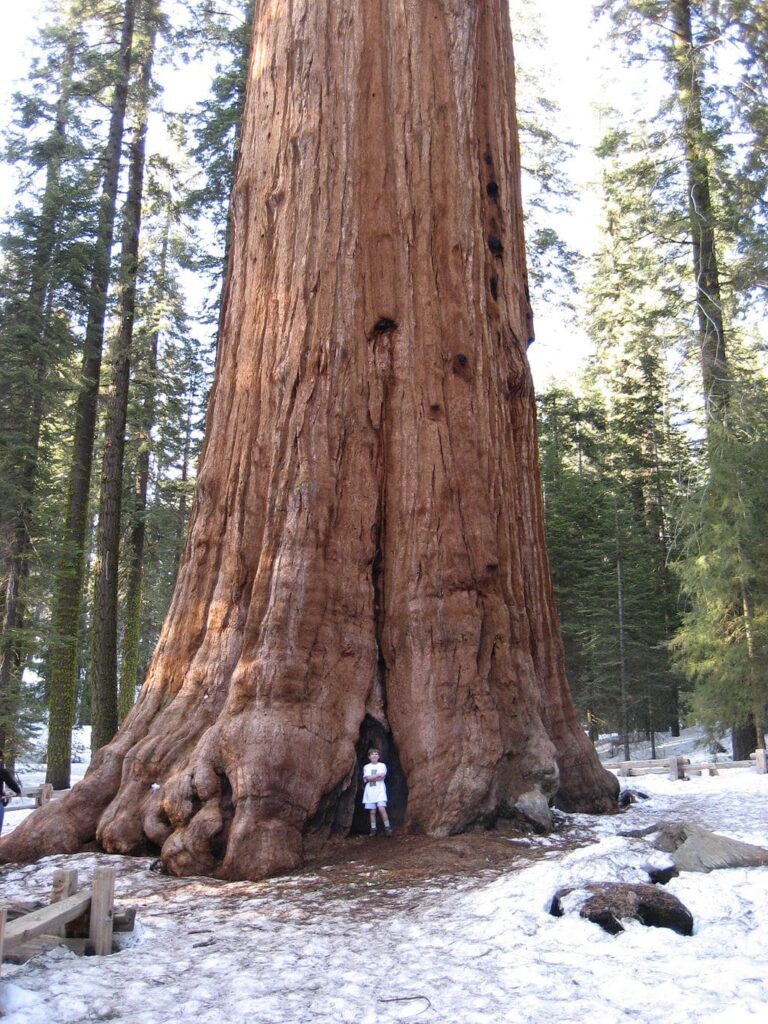
General Sherman, a giant sequoia (Sequoiadendron giganteum), is the largest tree on Earth by volume, measuring 275 feet (83.8 meters) tall. The trunk of this magnificent being, with a diameter of more than 36 feet (11 meters), is a staggering testament to its longevity—over 2,200 years old! This arboreal titan evokes a sense of stoicism; its massive, rust-colored bark, thick and rugged like the armor of a soldier, tells stories of endurance against fire and the elements.
4. The Sarv-e Abarqu: Persia’s Ancient Giant
Emerging from the timeless landscapes of Iran, the Sarv-e Abarqu (Cypress of Abarqu) boasts a history stretching back over 4,000 years, making it a living artifact in the annals of nature. Towering at about 75 feet (23 meters) high, this tree represents the blend of antiquity and vitality. Its twisting branches reach out like aged hands, inviting a sentimentality that transcends cultures and eras. As a symbol of resilience in arid climates, this cypress stands in dignified solitude amidst the harshness of its surroundings.
5. Alerce: Timber’s Guardian
In the temperate forests of Chile, the Fitzroya cupressoides, commonly known as the alerce, can reach heights of up to 202 feet (61.5 meters). Standing as a guardian of Chile’s landscapes, this tree has remained largely untouched due to its slow growth and impressive resistance to decay. The alerce’s bark, thick and fibrous, serves as nature’s own armor, encapsulating centuries of growth rings—each one a story, each one a distinct chapter in its long lifespan.
6. The Old Tjikko: Nature’s Longevous Wonder
A marvel among trees, Old Tjikko is a clonal Norway spruce (Picea abies) located in Sweden, estimated to be around 9,560 years old. This extraordinary organism presents an intricate tapestry of interconnected root systems, whereby the tree regenerates itself anew with genetically identical stems. Standing only 16.8 feet (5.1 meters) tall, Old Tjikko proves that grandeur lies not in stature but in the depth of legacy—a reminder that life endures clandestinely beneath the surface.
7. The Senator: A Towering Southern Live Oak
Once an emblem of majesty, the Senator, an iconic Southern live oak (Quercus virginiana), reached a height of 68 feet (20.7 meters) before its untimely demise in 2012. Aged at over 3,500 years, this tree stood as a regal sentinel, its gnarled branches draping like the arms of a wise elder inviting passersby into its embrace. The Senator reminds us of the passage of time and the ephemeral nature of existence.
8. The Chestnut Tree of One Hundred Horses: A Multi-Trunked Marvel
This ancient chestnut tree (Castanea sativa), located on the slopes of Mount Etna in Sicily, is considered to be over 2,000 years old. Its trunk has grown so colossal that it boasts multiple openings, giving the appearance of a small grove in and of itself. Legend tells of a hundred knights sheltering beneath its branches; indeed, this tree is a reminder of the stories that intertwine with our natural surroundings, each ring holding whispers of history past.
9. Jomon Sugi: A Mystical Treasure of Yakushima
Deep within the cedar forests of Yakushima, Japan, lies Jomon Sugi, a cryptomeria tree (Cryptomeria japonica) believed to be between 2,170 and 7,200 years old. Towering at approximately 108 feet (33 meters), the gnarled and twisted trunk of Jomon Sugi stands as a resilient pillar of nature’s endurance. Mysterious and majestic, this tree is often shrouded in mist, evoking an ethereal quality that captivates the imagination.
10. Pando: The Trembling Giant
Pando, a sprawling clonal colony of quaking aspen (Populus tremuloides) in Utah, presents a unique interpretation of size. Covering over 106 acres and weighing an estimated 6,000 tons, its interconnected root system defines the very notion of a single organism. Each tree, while appearing distinct, is essentially a part of the same entity—more than an arboreal wonder, it symbolizes interconnectedness and harmony within nature’s realm.
In summary, the largest trees in the world are not merely colossal organisms; they are themes in the grand opera of life, embodying the essence of endurance, strength, and continuity. They connect us to our past and remind us of the natural world’s wonders, urging us to respect and cherish these magnificent giants. Each tree stands tall, a beacon of history and a celebration of life, inviting us to look upward and dream beyond the clouds.
FAQ
What defines the largest tree in the world?
Largest trees can be measured by height, volume, age, or clonal colony size, with different trees holding records in these categories.
Why are some trees considered clonal colonies?
Clonal colonies consist of genetically identical trees connected by a shared root system, such as Pando, which functions as a single organism.





Leave a Reply