
Short Answer
Our planet’s oceans, shrouded in mystery and teeming with life, hold some of the largest and most enigmatic creatures ever to swim in Earth’s waters. As we dive deeper into the azure depths, we are met with astonishing giants whose existence challenges our understanding of biology, evolution, and the very nature of life itself. Enveloping these sea creatures are tales of wonder, awe, and in some cases, trepidation. Join us as we embark on an exploration of the top ten largest sea creatures ever discovered.
1. Blue Whale (Balaenoptera musculus)
The blue whale reigns supreme as the largest animal ever known to exist on Earth. These marine mammals can reach lengths of over 100 feet (30 meters) and can weigh as much as 200 tons or more. Their immense size is complemented by their grace; blue whales glide through the water with a gentle elegance, primarily feeding on krill. Despite their gargantuan dimensions, these creatures communicate through low-frequency vocalizations that can be heard across vast distances.
2. Fin Whale (Balaenoptera physalus)
The fin whale, the second-largest animal on the planet, captures the imagination with its streamlined shape and remarkable speed. Reaching lengths of up to 88 feet (27 meters), fin whales can reach speeds up to 30 miles per hour (48 km/h), making them the fastest of the large whale species. With a distinct dorsal fin rising high above the waterline, these elegant giants often travel in small pods, showcasing their social nature.
3. Sperm Whale (Physeter macrocephalus)
Boasting the largest brain of any creature—an area of fascination for scientists—the sperm whale can reach lengths of 67 feet (20 meters) and weigh up to 56 tons. Known for their deep-diving capabilities, these whales can plunge over 10,000 feet (3,000 meters) in pursuit of squid and other prey. Their iconic block-shaped head houses a unique spermaceti organ, believed to aid in buoyancy and echolocation.
4. Whale Shark (Rhincodon typus)
The gentle giant of the coral reefs, the whale shark, can grow up to 60 feet (18 meters) in length. As the largest fish in the ocean, these filter feeders are a sight to behold. Swallowing vast quantities of plankton while swimming with incredible grace, whale sharks often gather in substantial numbers at locations rich in food, captivating divers and snorkelers with their serene demeanor.
5. Colossal Squid (Mesonychoteuthis dixonii)
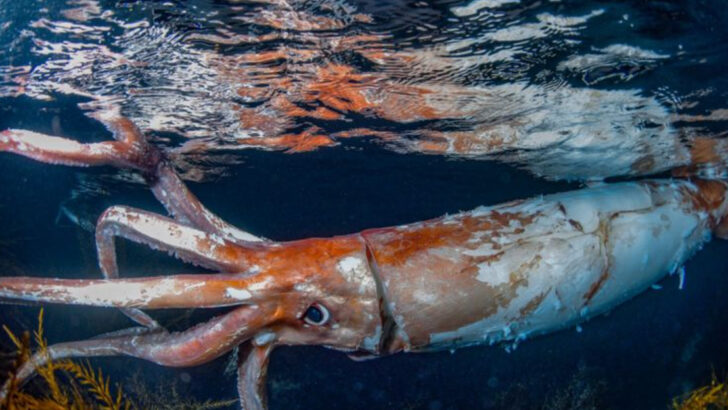
Deep in the frigid waters of the Antarctic lies the colossal squid, a creature that remains steeped in mystery. With estimates suggesting a length of up to 45 feet (14 meters) and a weight of almost 1,000 pounds (450 kg), this tentacled titan possesses the largest eyes in the animal kingdom, which can grow to the size of a soccer ball. Equipped with beak-like jaws and hooks on its tentacles, it has adapted to become a formidable predator of the deep.
6. Giant Squid (Architeuthis dux)
The enigmatic giant squid, another denizen of the deep, can reach lengths of 43 feet (13 meters), with eyes equally prominent as its colossal cousin. For centuries, this creature has inspired legends of sea monsters and mythical beings. With its long, muscular body and a set of eight arms, the giant squid remains elusive. Though they are rarely seen by humans, their presence in various ecosystems is well established.
7. Oarfish (Regalecus glesne)
Often referred to as the “royal fish,” the oarfish boasts a sinuous body that can grow over 36 feet (11 meters) in length. Its shimmering silver scales glint in the ocean’s sunlight, creating an ethereal appearance. Though docile and rarely seen, oarfish are sometimes spotted near the surface, sparking tales of sea serpents throughout history. Their unique morphology allows them to navigate the depths effortlessly, feeding on small fish and plankton.
8. Bowhead Whale (Balaena mysticetus)
The bowhead whale embodies resilience and endurance, with a lifespan potentially exceeding 200 years. These Arctic inhabitants can grow up to 66 feet (20 meters) and are known for their impressive bow-shaped skulls, which they use to break through thick ice. Their baleen plates allow for efficient feeding on zooplankton, and they are critical indicators of environmental health in their frigid habitats.
9. Humpback Whale (Megaptera novaeangliae)
The humpback whale, reaching lengths of 52 feet (16 meters), is renowned for its acrobatic behaviors and haunting songs. These whales, which traverse oceans every year on their migratory journeys, can be recognized by their distinct pectoral fins and knobby heads. Remarkably social, humpbacks often breach and slap the water, creating spectacular displays that leave onlookers in awe. Their complex songs, often lasting up to 20 minutes, are believed to play a role in mating rituals.
10. Jellyfish (Rhizostoma pulmo)
While not a traditional contender for the title of “largest sea creature,” the lion’s mane jellyfish can reach a bell diameter of 8 feet (2.4 meters). With tentacles extending as long as 120 feet (36 meters), the jellyfish exemplifies marvels of simplicity and adaptability. These gelatinous beings drift gracefully through the ocean, providing both beauty and ecological significance as they serve as a crucial part of marine food webs.
As we conclude this underwater odyssey, it becomes evident that the vastness of the ocean conceals extraordinary wonders beyond our wildest imaginations. These magnificent creatures not only redefine the limits of size but also compel us to reflect on the intricate tapestries of life thriving in the deep. Each encounter with these giants beckons curiosity, urging us to delve into the mysteries of the ocean and explore the realm beneath the waves. Understanding them is not merely a scientific pursuit; it is a profound and humbling journey into the heart of our planet’s most unexplored frontier.
FAQ
What is the largest sea creature ever discovered?
The blue whale is the largest sea creature ever discovered, measuring over 100 feet in length and weighing as much as 200 tons.
Which sea creature has the largest brain?
The sperm whale has the largest brain of any creature, which is of great interest to scientists.
How deep can sperm whales dive?
Sperm whales can dive to depths of over 10,000 feet in search of prey such as squid.
What is unique about the colossal squid's eyes?
The colossal squid has the largest eyes in the animal kingdom, reaching the size of a soccer ball.
Why are oarfish often associated with sea serpent legends?
Oarfish have extremely long, sinuous bodies and are rarely seen, leading to myths and sightings being mistaken for sea serpents.





Leave a Reply