
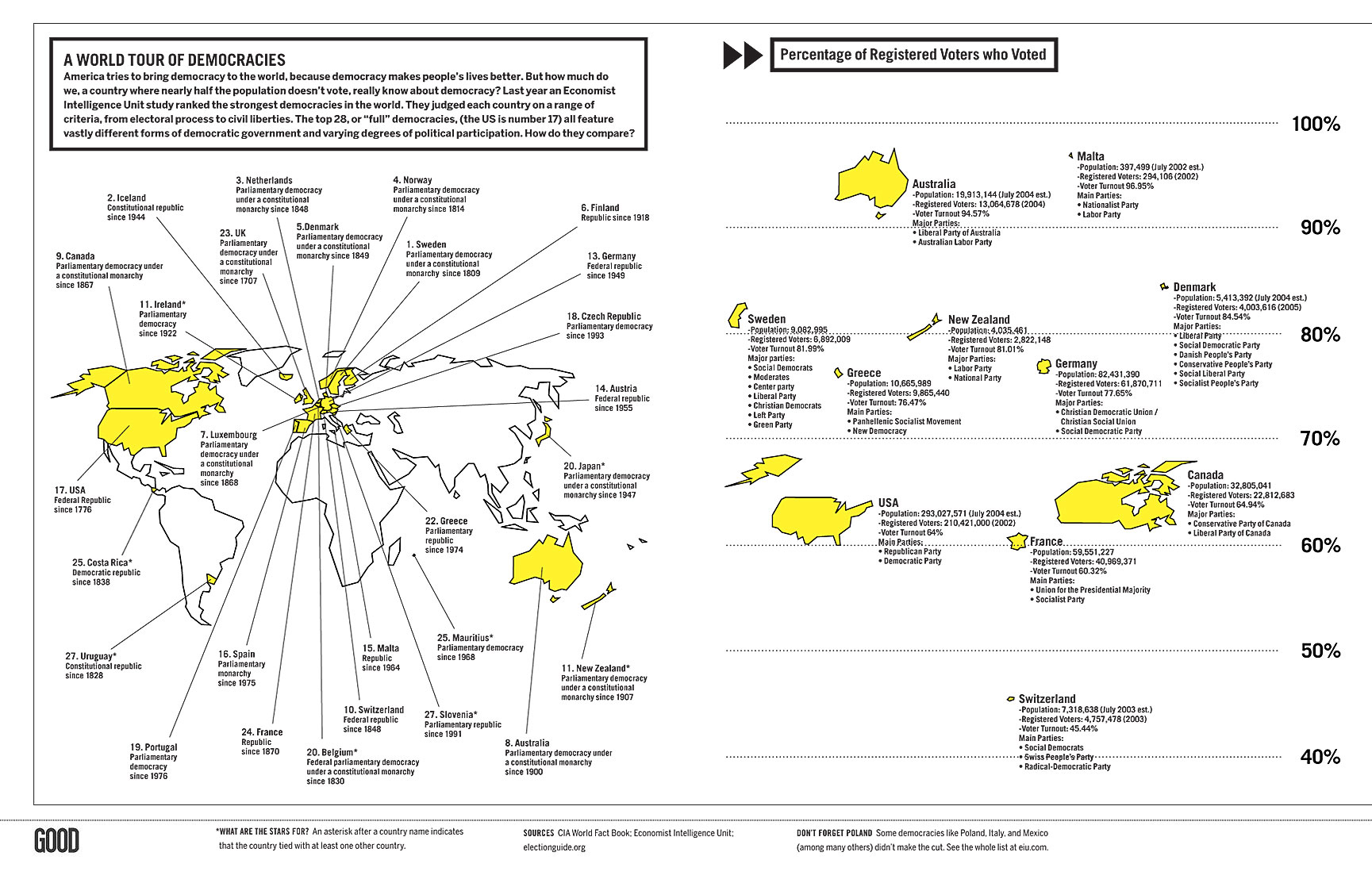
Democracy, often heralded as the fulcrum upon which societal progress pivots, embodies the principles of freedom, representation, and equality. As we traverse through the contemporary landscape of governance, it becomes salient to observe the gargantuan democracies that command attention not just for their size, but for their unique systems of governance and cultural nuances. Herein lies a riveting exploration into the top ten largest democracies in the world, each emblematic of distinct narratives, socio-political complexities, and the ever-evolving dance of power.
1. India
India, the veritable titan of democracy, boasts a staggering populace exceeding 1.4 billion souls. Its democratic foundation is enshrined in a constitution that not only guarantees fundamental rights but also engenders a multitude of regional identities. The parliamentary system, accentuated by a vibrant multiparty landscape, breathes life into the ethos of Indian democracy. Elections are not merely procedural; they are a spectacular festivity, drawing unfathomable participation and showcasing the kaleidoscope of the nation’s diversity.
2. United States
The United States stands as the eldest constitutional democracy, where the principles of liberty and justice have been codified since the late 18th century. With a populace of over 331 million, the U.S. exhibits a federal structure that balances powers between the national and state governments. The electoral system, while shrouded in complexities such as the Electoral College, is characterized by spirited debates, advocacy, and civic engagement that pervades its fabric, reflecting a dynamic approach to representative governance.
3. Indonesia
Indonesia, the world’s largest archipelagic democracy, harbors an astounding population of approximately 270 million individuals. Its transition to democracy post-1998, following years of authoritarian rule, is a testament to the resilience of its populace. The nation’s commitment to pluralism is expressed through its motto, “Unity in Diversity,” which resonates across its myriad islands, cultures, and religions. The Indonesian democratic process, rich in local elections and decentralization, supports vibrant grassroots movements alongside presidential governance.
4. Brazil
As the largest country in South America, Brazil exemplifies the vibrancy of democracy amidst a diverse cultural tapestry. Home to around 213 million people, Brazil’s democratic journey has been tumultuous, marked by military rule and an invigorating return to civilian governance. The Brazilian electoral system champions direct democracy through initiatives and referendums, while also fostering political engagement through Carnival-like exuberance at election time, where every vote counts in shaping the nation’s trajectory.
5. Pakistan
Pakistan, with its population nearing 240 million, reflects the complexities of a democracy grappling with its identity amidst a diverse array of ethnicities, languages, and religious beliefs. Since its inception in 1947, the spirit of democratic governance has been both challenged and rejuvenated through various military and civilian regimes. The parliamentary system underscores a unique interplay between federal and provincial governments, allowing for regional representation that resonates with its disparate populace while advocating for political stability.
6. Nigeria
Nigeria, Africa’s most populous nation, with over 211 million inhabitants, is a vibrant mosaic of cultures, languages, and traditions. The nation’s democratic evolution, post-military rule, is a beacon of hope amidst volatility. Nigeria’s federal structure emphasizes regional governance, crucial for accommodating its ethnic plurality. The electoral landscape, rife with both fervor and discord, showcases the passionate engagement of its populace, yearning for reform and stability in the face of enduring challenges.
7. Bangladesh
With a burgeoning population of approximately 170 million, Bangladesh’s democracy is a compelling narrative of resilience. Emerging from a turbulent history of war and political strife, it has adopted a parliamentary system that underscores representative governance. The vibrant civil society and relentless activism have become crucial components of its democratic fabric, advocating for the rights of the marginalized and fostering a spirit of inclusivity amidst ongoing socio-economic challenges.
8. Russia
Despite being characterized by an autocratic tilt in recent years, Russia, housing around 144 million residents, reportedly embodies the complexities of a democracy in transition. Its semi-presidential system has seen fluctuating degrees of political pluralism and civic participation, presenting an intriguing tableau for political analysts. As a nation rich in resources and cultural heritage, Russia’s democratic development remains a topic of fervent debate, particularly regarding freedoms, civil society, and governance.
9. Mexico
Mexico stands as a vibrant example of a transitional democracy, boasting a population of nearly 126 million. Following a historical struggle against authoritarian rule, Mexico’s democratic evolution has been characterized by significant reforms aimed at enhancing electoral integrity and political participation. The country’s party system encourages lively debates and critiques, juxtaposed against challenges from narcotraficante influences that periodically threaten the democratic framework, presenting a complex interplay of governance.
10. Japan
Rounding out the list, Japan, with over 126 million residents, exemplifies a stable, albeit atypical, democratic process characterized by its unique mix of traditional influences and modern governance structures. The parliamentary system harmonizes diverse political parties and ideologies, often leading to a cooperative approach in policy-making. Japan’s democratic ethos is underscored by an active citizenry that partakes in elections with dedication, fostering a sense of national identity and civic responsibility.
As we delve into these ten largest democracies, we are reminded that the essence of democracy transcends mere numbers. Each nation’s story is a rich tapestry woven through history, culture, and the undying pursuit of representation. The contours of democracy may vary, yet the underlying aspirations for freedom, equality, and justice persist. In examining these diverse paradigms, one inevitably cultivates a greater appreciation for the complexities and triumphs inherent in the democratic journey, igniting a curiosity to explore and understand the myriad ways in which societies govern themselves.







Leave a Comment