
Short Answer
Sir Isaac Newton, a luminary of the Scientific Revolution, profoundly altered the course of science with his groundbreaking discoveries and inventions. His inquisitive nature sought to unravel the mysteries of the natural world, leading to the formulation of principles that still govern modern physics and mathematics. Inevitably, his intellectual odyssey bequeathed us innovations that continue to resonate through the annals of time. Here are the top 10 inventions and contributions attributed to Isaac Newton that irrevocably transformed the scientific landscape.
1. Calculus
Although the debate regarding its independent development rages on, Newton’s formulation of calculus stands as a monumental achievement. This mathematical framework enables the analysis of rates of change and the summation of infinitely small quantities. Through calculus, Newton laid the foundation for mathematical physics, empowering future scientists to model complex phenomena and innovate in various disciplines ranging from engineering to economics.
2. The Reflecting Telescope
Newton’s celestial aspirations culminated in the invention of the reflecting telescope in 1668. Foreseeing the limitations of refracting telescopes—primarily the issue of chromatic aberration—he ingeniously utilized a curved mirror to gather and focus light. This design not only enhanced clarity and brightness but also diminished distortions, revolutionizing the observations of heavenly bodies. Today, many modern telescopes owe their design to Newton’s pioneering work.
3. Laws of Motion
Encompassing three axioms, Newton’s Laws of Motion delineate the relationship between the forces acting upon objects and the resulting motion. This triad of principles—specifically the idea that an object in motion remains in motion unless acted upon by an external force—serves as a cornerstone of classical mechanics. Newton’s laws provided a systematic framework, facilitating quantitative analysis and predictions of motion that endure in applications ranging from everyday life to astrophysics.
4. Universal Gravitation
Embedded within his seminal work, “Philosophiæ Naturalis Principia Mathematica,” Newton posited the law of universal gravitation, elucidating the attractive force between masses. This revolutionary concept not only elucidated terrestrial phenomena, such as the falling of an apple, but also comprehensively explained the motion of celestial bodies. Consequently, it laid the groundwork for orbital mechanics, enabling explorers to chart the cosmos with newfound precision.
5. Newton’s Rings
In the realm of optics, Newton’s Rings epitomize his curiosity and ingenuity regarding light refraction. By examining the interference patterns generated by light passing through layers of air between two surfaces, he unveiled a plethora of insights about the nature of light. This phenomenon not only attests to his artistry in empirical experimentation but also paved the way for the development of more advanced optical devices, thereby influencing fields such as microscopy and photography.
6. The Color Spectrum
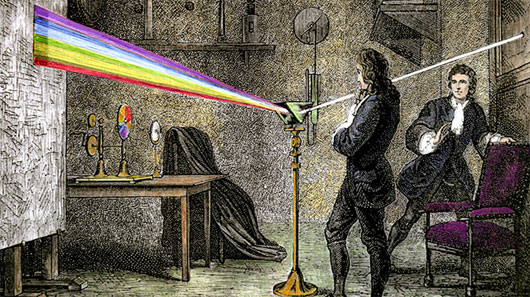
Newton’s fascination with light led to one of his most captivating experiments: the dispersion of light through a prism. He discovered that white light is composed of various colors—red, orange, yellow, green, blue, indigo, and violet—forming a spectrum. This revelation triggered an epoch in the study of optics, initiating inquiries into the nature of color and light that resonate within the disciplines of physics, art, and even psychology to this day.
7. The Law of Cooling
Newton’s examination of the rate at which objects lose heat culminated in the formulation of the Law of Cooling. His principle asserts that the rate of temperature decrease of an object is proportional to the difference in temperature between the object and its environment. This notion has garnered significance across various scientific disciplines, impacting thermodynamics and forensic science where understanding heat transfer plays a critical role.
8. Binomial Theorem
Newton’s brilliance is further illuminated through his generalized formulation of the Binomial Theorem, allowing for the expansion of expressions of the form (a + b)ⁿ. This algebraic breakthrough has proven indispensable in combinatorics and calculus, facilitating the evaluation of complex mathematical expressions and the understanding of polynomial functions. The theorem’s applicability extends beyond mathematics into fields such as statistics and computer science.
9. Newton’s Cradle
Visualizing Newton’s laws takes a tangible form in the delightful contraption known as Newton’s Cradle. This elegant device consists of a series of suspended spheres that demonstrate the principles of momentum and energy conservation through a chain reaction of collisions. Not only does it serve as a captivating desk ornament, but it also embodies the fundamental principles of mechanics, sparking curiosity and learning.
10. Calculating the Value of Gravity
By meticulously analyzing the motion of celestial bodies and earthly objects, Newton ingeniously calculated the numerical value of gravitational acceleration (approximately 9.81 m/s²). This calculation provided a pragmatic basis for understanding the forces dictating movement on Earth, contributing extensively to gravimetric studies and enhancing our comprehension of dynamics in physics.
In conclusion, the myriad inventions and discoveries of Isaac Newton illuminate why he remains a monumental figure in the history of science. His relentless pursuit of knowledge and understanding not only changed our grasp of natural phenomena but also ignited a fervor for scientific inquiry among successive generations. Through calculus, his laws of motion, and the reflection of light, Newton’s legacy continues to educate, inspire, and shape scientific thought, rendering him an indelible icon in the vast tapestry of human advancement.
FAQ
What are some of Isaac Newton's most important inventions?
Some of Isaac Newton’s key inventions include calculus, the reflecting telescope, the laws of motion, universal gravitation, and Newton’s rings.
How did Newton's laws of motion impact science?
Newton’s laws of motion provided the foundation for classical mechanics, enabling precise predictions of object movement and influencing fields from engineering to astrophysics.
What is the significance of Newton's reflecting telescope?
Newton’s reflecting telescope improved image clarity by using a curved mirror, reducing chromatic aberration and influencing modern telescope designs.
Did Isaac Newton invent calculus?
Newton independently formulated calculus, a mathematical framework essential for analyzing change and motion, although its independent development by Leibniz sparked historical debate.
What is Newton's Law of Cooling?
Newton’s Law of Cooling states that the rate of temperature decrease of an object is proportional to the difference between the object’s temperature and its environment.






Leave a Reply